Ciftci Rukiye, Kurtoğlu Ahmet
Department of Anatomy, Faculty of Medicine, Gaziantep Islami Bilim ve Teknoloji University, Gaziantep, TUR.
Department of Coaching, Faculty of Sports Sciences, Bandırma Onyedi Eylül University, Balıkesir, TKM.
Cureus. 2023 Aug 17;15(8):e43615. doi: 10.7759/cureus.43615. eCollection 2023 Aug.
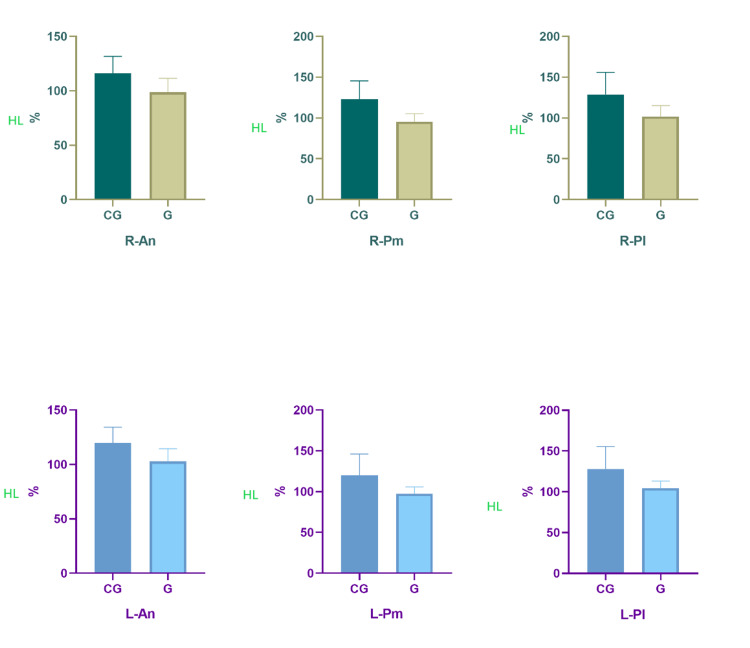
Introduction Gonarthrosis (G) is a progressive disease that affects the knee joint and causes pain and limitation of movement in the knee. The determination of the morphometric status of G patients has been a subject of interest recently. The purpose of this study is to determine how hamstring length (HL) and patellofemoral angle (Q angle [QA]) affect the ability of individuals with G to maintain balance. Methods A total of 80 (40 G patients and 40 in the control group [CG]) participants aged 40-65 were included in the study. A goniometer was used to measure the participants' QA. The mean age of the participants was 50.18±7.16 in the G group and 51.40±6.64 in CG. HL was measured using the sit-and-reach test. Participants' dynamic balance state was evaluated using the Y balance test by stepping in the following directions: right-anterior (R-An), right-posteromedial (R-Pm), right-posterolateral (R-Pl), left-anterior (L-An), left-posteromedial (L-Pm), and left-posterolateral (L-Pl). Results According to the results of this research, the balance performance of G patients was significantly lower in all directions (R-An, R-Pm, R-Pl, L-An, L-Pm, L-Pl) compared to the CG. In both groups, R-QA, L-QA, and HL did not change. However, linear regression analysis indicated that in G patients, R-QA, L-QA, and HL affected balance performance. No significant interaction was found between these parameters and balance performance in the CG. Conclusion HL and QA have a significant role in determining body balance. In our study, we found that QA decreased in G patients, leading to genu varum in these individuals. The hamstring muscle shortening observed in G patients significantly negatively affected balance, especially in the R-An, R-Pm, L-An, L-Pm, and L-Pl directions. For healthcare professionals preparing treatment protocols for G patients, we recommend providing exercises to improve balance, especially in these directions.
引言
膝骨关节炎(G)是一种渐进性疾病,会影响膝关节并导致膝关节疼痛和活动受限。确定G患者的形态测量状态最近一直是人们感兴趣的课题。本研究的目的是确定腘绳肌长度(HL)和髌股角(Q角[QA])如何影响G患者维持平衡的能力。
方法
本研究共纳入80名年龄在40 - 65岁的参与者(40名G患者和40名对照组[CG])。使用角度计测量参与者的QA。G组参与者的平均年龄为50.18±7.16岁,CG组为51.40±6.64岁。使用坐立前屈测试测量HL。通过向以下方向迈步,使用Y平衡测试评估参与者的动态平衡状态:右前(R - An)、右后内侧(R - Pm)、右后外侧(R - Pl)、左前(L - An)、左后内侧(L - Pm)和左后外侧(L - Pl)。
结果
根据本研究结果,与CG组相比,G患者在所有方向(R - An、R - Pm、R - Pl、L - An、L - Pm、L - Pl)的平衡表现均显著较低。在两组中,右QA、左QA和HL均未改变。然而,线性回归分析表明,在G患者中,右QA、左QA和HL影响平衡表现。在CG组中,这些参数与平衡表现之间未发现显著相互作用。
结论
HL和QA在确定身体平衡方面具有重要作用。在我们的研究中,我们发现G患者的QA降低,导致这些个体出现膝内翻。在G患者中观察到的腘绳肌缩短对平衡有显著负面影响,尤其是在R - An、R - Pm、L - An、L - Pm和L - Pl方向。对于为G患者制定治疗方案的医疗保健专业人员,我们建议提供改善平衡的运动,尤其是在这些方向。