Li Meng, Habes Mohamad, Grabe Hans, Kang Yan, Qi Shouliang, Detre John A
College of Medicine and Biological Information Engineering, Northeastern University, Shenyang, China.
Department of Neurology, University of Pennsylvania, Philadelphia, PA, United States.
Front Aging Neurosci. 2023 Aug 31;15:1237198. doi: 10.3389/fnagi.2023.1237198. eCollection 2023.
White matter hyperintensities (WMH) are commonly seen on T2-weighted magnetic resonance imaging (MRI) in older adults and are associated with an increased risk of cognitive decline and dementia. This study aims to estimate changes in the structural connectome due to age-related WMH by using a virtual lesion approach.
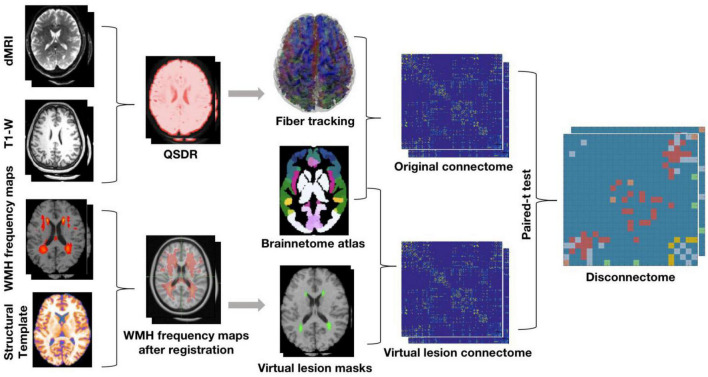
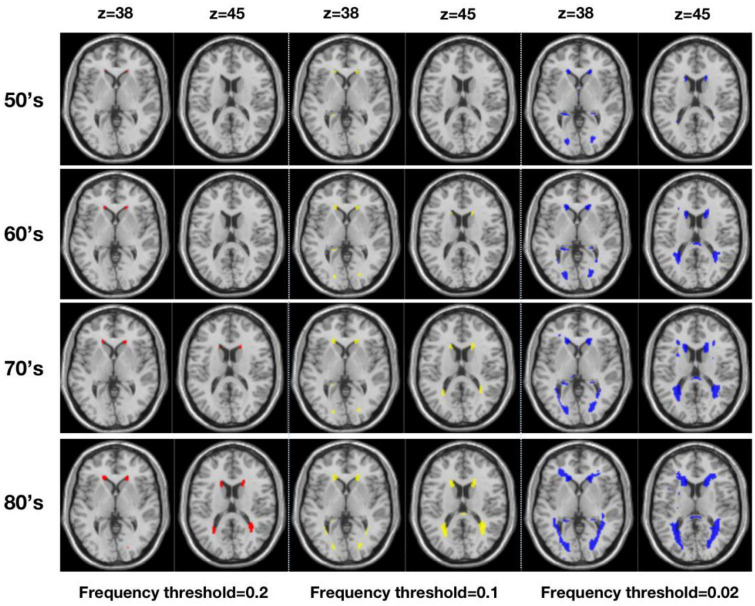
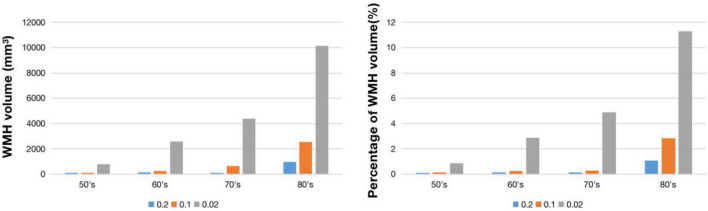
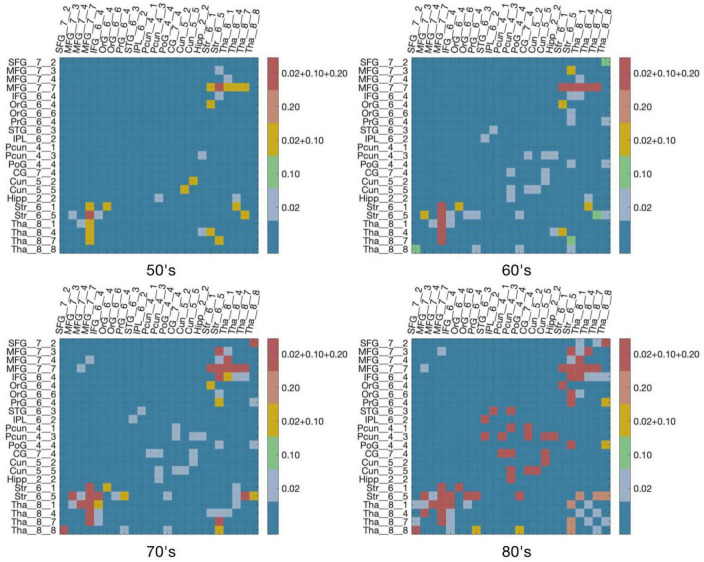
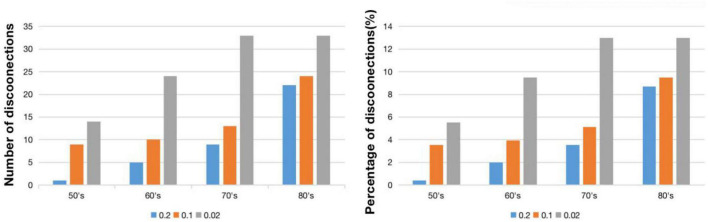
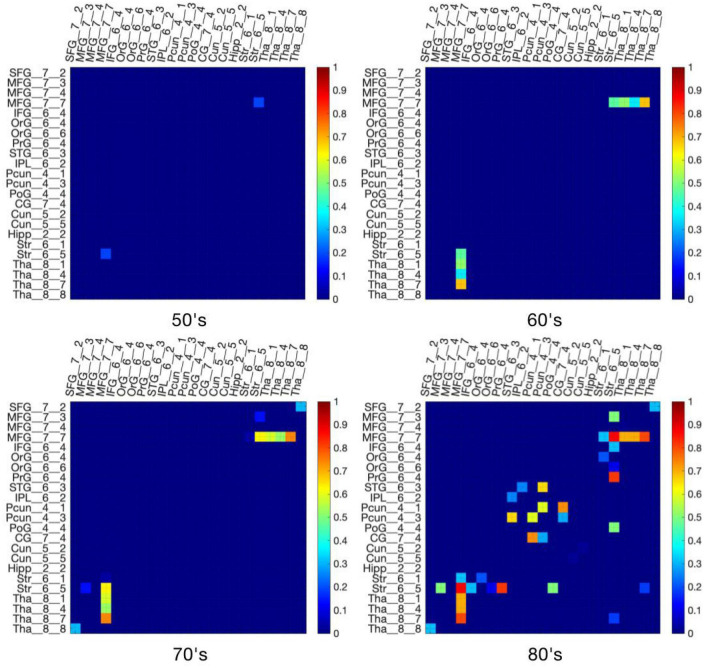
High-quality diffusion-weighted imaging data of 30 healthy subjects were obtained from the Human Connectome Project (HCP) database. Diffusion tractography using q-space diffeomorphic reconstruction (QSDR) and whole brain fiber tracking with 10 seed points was conducted using diffusion spectrum imaging studio and the brainnetome atlas was used to parcellate a total of 246 cortical and subcortical nodes. Previously published WMH frequency maps across age ranges (50's, 60's, 70's, and 80's) were used to generate virtual lesion masks for each decade at three lesion frequency thresholds, and these virtual lesion masks were applied as regions of avoidance (ROA) in fiber tracking to estimate connectivity changes. Connections showing significant differences in fiber density with and without ROA were identified using paired tests with False Discovery Rate (FDR) correction.
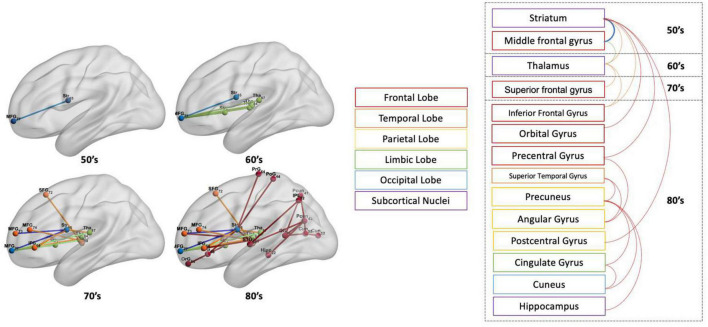
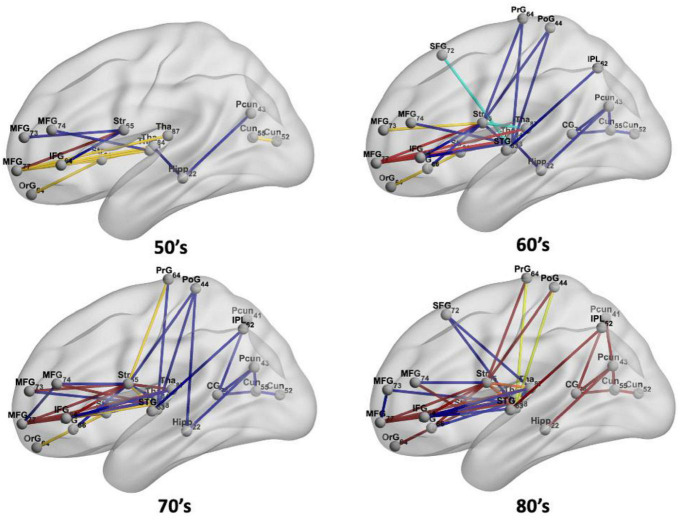
Disconnections appeared first from the striatum to middle frontal gyrus (MFG) in the 50's, then from the thalamus to MFG in the 60's and extending to the superior frontal gyrus in the 70's, and ultimately including much more widespread cortical and hippocampal nodes in the 80's.
Changes in the structural disconnectome due to age-related WMH can be estimated using the virtual lesion approach. The observed disconnections may contribute to the cognitive and sensorimotor deficits seen in aging.
白质高信号(WMH)在老年人的T2加权磁共振成像(MRI)中很常见,并且与认知能力下降和痴呆风险增加有关。本研究旨在通过使用虚拟病变方法来估计与年龄相关的WMH导致的结构连接组的变化。
从人类连接组计划(HCP)数据库中获取30名健康受试者的高质量扩散加权成像数据。使用扩散频谱成像工作室进行基于q空间微分同胚重建(QSDR)的扩散束描记术和具有10个种子点的全脑纤维追踪,并使用脑网络图谱将总共246个皮质和皮质下节点进行分割。先前发表的各年龄范围(50岁、60岁、70岁和80岁)的WMH频率图用于在三个病变频率阈值下为每个十年生成虚拟病变掩码,并且这些虚拟病变掩码在纤维追踪中用作避开区域(ROA)以估计连接性变化。使用具有错误发现率(FDR)校正的配对检验来识别在有和没有ROA的情况下纤维密度存在显著差异的连接。
在50岁时,首先出现从纹状体到额中回(MFG)的断开连接,然后在60岁时从丘脑到MFG,在70岁时延伸到额上回,最终在80岁时包括更广泛的皮质和海马节点。
可以使用虚拟病变方法估计与年龄相关的WMH导致的结构断开连接组的变化。观察到的断开连接可能导致衰老过程中出现的认知和感觉运动缺陷。