Fredericks-Younger Janine, Feldman Cecile, Allareddy Veerasathpurush, Funkhouser Ellen, McBurnie MaryAnn, Meyerowitz Cyril, Ragusa Pat, Chapman-Greene Julie, Coker Modupe, Fine Daniel H, Gennaro Maria Laura, Subramanian Gayathri
Rutgers School of Dental Medicine.
University of Illinois Chicago College of Dentistry.
Res Sq. 2023 Sep 7:rs.3.rs-3011647. doi: 10.21203/rs.3.rs-3011647/v1.
The COVID-19 pandemic highlights the need for practitioners to enhance workflows to increase safety and mitigate risk. As dental practice creates a highly aerosolized environment, pre-visit testing for SARS-CoV-2 has the potential to be an effective mitigation strategy to minimize disease transmission in dental offices. The Pragmatic Return to Effective Dental Infection Control through Testing (PREDICT) Feasibility Study examined the potential, logistics, and impact related to laboratory-based PCR viral testing and point-of-care (POC) antigen testing.
Dental healthcare workers (DHCWs) and patients in four dental offices within the National Dental Practice-based Research Network participated in this prospective study. In addition to electronic surveys, participants in two offices completed POC testing, while participants in two offices used lab based PCR methods to detect SARS-CoV-2 infection. For this feasibility study, analysis was limited to descriptive measures. Median and interquartile ranges were reported for Likert scale responses and mean and standard deviation for continuous variables.
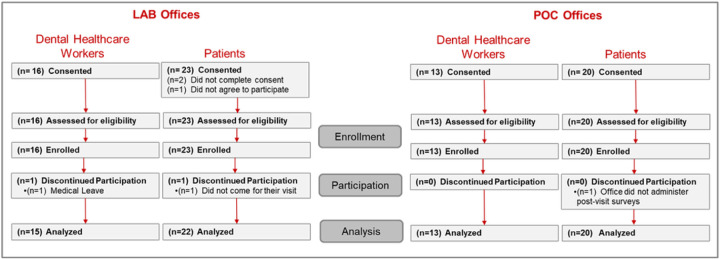
Forty-one of forty-three consented patients and twenty-eight of twenty-nine DHCWs completed the protocol. Descriptive statistics calculations including median and interquartile ranges revealed (1) saliva, tongue epithelial cells and nasal swabs were the most desirable specimens for testing for groups (2) both LAB and POC protocols took similar amounts of total time to complete the full testing protocol and (3) DHCWs and patients reported feeling more comfortable when both groups were tested.
This feasibility study suggests that pre-visit SARS-CoV-2 testing can be effectively implemented into dental practice workflows and positively impact perception of safety for DHCWs and patients, though a larger scale, network study is necessary for generalizability of results. As new virulent infectious diseases continue to emerge, preparing dental personnel to employ an entire toolbox of risk mitigation strategies, including testing, may have the potential to decrease dental practice closure time, maintaining continuity of dental care services for patients.
This trial was registered on ClinicalTrials.gov: NCT05123742.
2019年冠状病毒病(COVID-19)大流行凸显了从业者改进工作流程以提高安全性和降低风险的必要性。由于牙科诊疗会产生高度雾化的环境,就诊前进行严重急性呼吸综合征冠状病毒2(SARS-CoV-2)检测有可能成为一种有效的缓解策略,以尽量减少牙科诊所内的疾病传播。通过检测实现务实的有效牙科感染控制(PREDICT)可行性研究考察了基于实验室的聚合酶链反应(PCR)病毒检测和即时检验(POC)抗原检测的潜力、后勤保障及影响。
国家基于牙科实践的研究网络中四个牙科诊所的牙科医护人员(DHCW)和患者参与了这项前瞻性研究。除电子调查外,两个诊所的参与者完成了即时检验,而另外两个诊所的参与者使用基于实验室的PCR方法检测SARS-CoV-2感染。对于这项可行性研究,分析仅限于描述性指标。报告了李克特量表反应的中位数和四分位间距以及连续变量的均值和标准差。
43名同意参与的患者中有41名、29名牙科医护人员中有28名完成了方案。包括中位数和四分位间距在内的描述性统计计算结果显示:(1)唾液、舌上皮细胞和鼻拭子是各群体检测最理想的样本;(2)实验室检测和即时检验方案完成整个检测方案所需的总时间相似;(3)牙科医护人员和患者报告称,两组都接受检测时他们感觉更安心。
这项可行性研究表明,就诊前SARS-CoV-2检测可有效纳入牙科诊疗工作流程,并对牙科医护人员和患者的安全认知产生积极影响,不过要使结果具有普遍性,还需要进行更大规模的网络研究。随着新的烈性传染病不断出现,让牙科人员准备好采用包括检测在内的一整套风险缓解策略,可能有潜力缩短牙科诊所关闭时间,维持为患者提供的牙科护理服务的连续性。
本试验已在ClinicalTrials.gov注册:NCT05123742。