Dwivedi Laxmi Kant, Puri Parul, Pant Anjali, Chauhan Alka, Scott Samuel, Singh Shrikant, Pedgaonker Sarang, Nguyen Phuong H
International Institute of Population Sciences, Mumbai, India.
International Food Policy Research Institute, South Asia Office, New Delhi, India.
Curr Dev Nutr. 2023 Aug 19;7(9):101987. doi: 10.1016/j.cdnut.2023.101987. eCollection 2023 Sep.
The double burden of malnutrition (DBM), characterized by concurrent undernutrition and overnutrition, is a growing global concern. Families share resources and eating behaviors and programs often target households, yet evidence of the DBM at the family level is scarce.
This study examined trends and inequality in the intrahousehold DBM in India between 2006 and 2021.
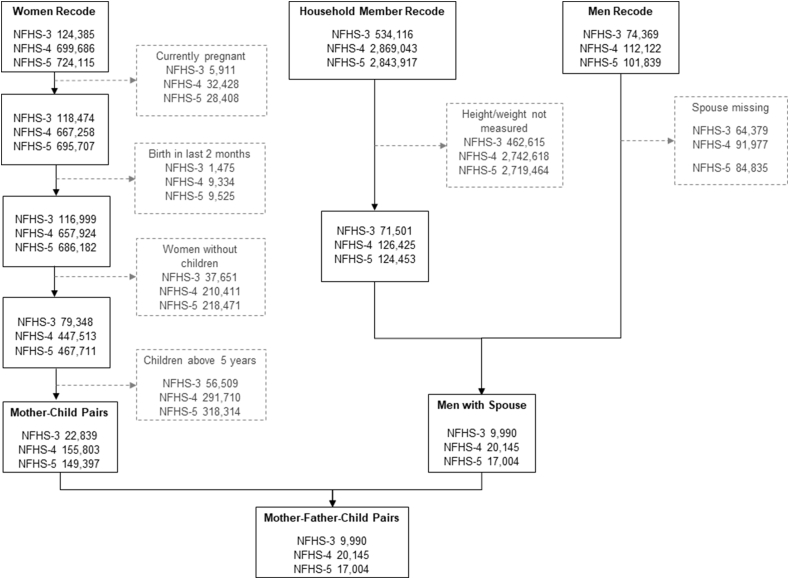
Data were from 3 waves of India's National Family Health Survey (NFHS 2006, 2016, and 2021). We examined 3 types of household member (with children aged <5 y) combinations: mother-child ( = 328,039 across 3 waves), father-child, and parent (mother and father)-child ( = 47,139 for each pair). The DBM was defined as one or more individuals with undernutrition (either wasting or stunting in children or underweight in adults) and one or more overweight individuals within the same household. DBM was examined over time, at national and subnational levels, and by residence and wealth.
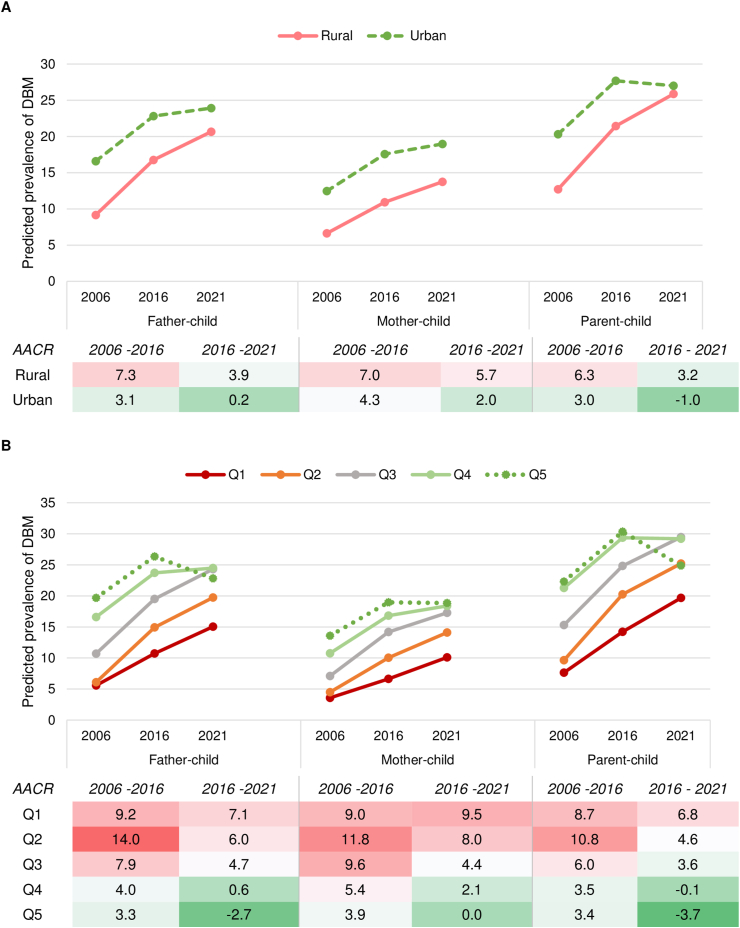
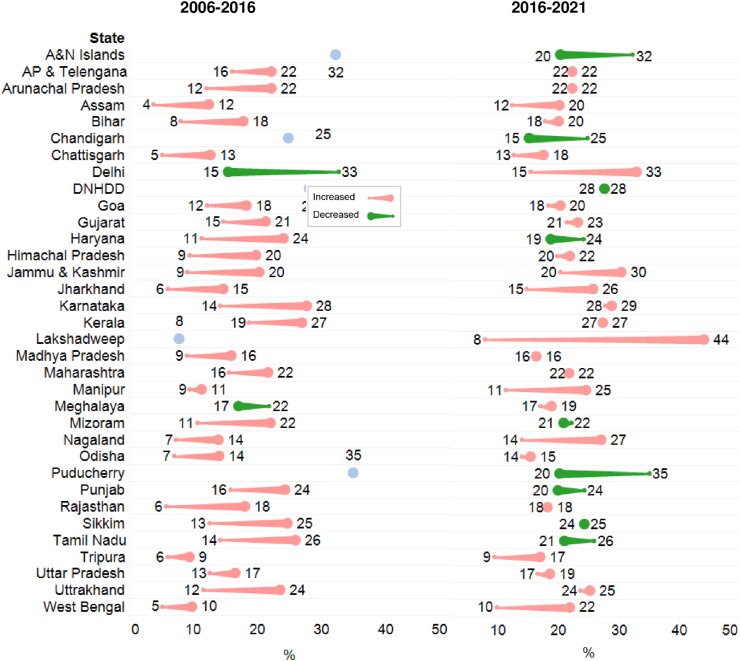
Nearly all DBM was in the form of an overweight parent and an undernourished weight or stunted child. The prevalence of parent-child DBM increased from 15% in 2006 to 26% in 2021. Father-child pairs experienced the most rapid DBM increase, from 12% in 2006 to 22% in 2021, an 83% increase, driven by increasing overweight among men. In 2021, the DBM was highest in North-Eastern and Southern states, and among relatively rich households from urban areas. The increase in the DBM was faster in rural areas and among poor households compared with that in urban areas and rich households. Urban-rural and rich-poor inequalities in the DBM have decreased over time.
The intrahousehold DBM has increased over time, affecting 1 in 4 households in India in 2021. Family-based interventions that can simultaneously address child underweight and parent overweight are required to address India's increasing intrahousehold DBM.
营养不良双重负担(DBM),其特征为同时存在营养不足和营养过剩,是一个日益受到全球关注的问题。家庭共享资源和饮食行为,且项目通常以家庭为目标,但家庭层面的DBM证据却很稀少。
本研究调查了2006年至2021年期间印度家庭内部DBM的趋势和不平等情况。
数据来自印度全国家庭健康调查的3轮调查(2006年、2016年和2021年)。我们研究了3种类型的家庭成员(有5岁以下儿童)组合:母子(3轮调查共有328,039对)、父子以及父母(母亲和父亲)与子女(每对有47,139对)。DBM被定义为同一家庭中有一个或多个营养不足的个体(儿童消瘦或发育迟缓,或成人体重过轻)以及一个或多个超重个体。我们在国家和次国家层面,按时间、居住地区和财富状况对DBM进行了研究。
几乎所有的DBM表现为超重的父母和营养不足或发育迟缓的儿童。亲子DBM的患病率从2006年的15%上升至2021年的26%。父子组合的DBM增长最为迅速,从2006年的12%增至2021年的22%,增长了83%,这是由男性超重情况增加所致。2021年,东北部和南部各邦以及城市地区相对富裕的家庭中DBM最高。与城市地区和富裕家庭相比,农村地区和贫困家庭的DBM增长更快。随着时间的推移,DBM在城乡和贫富之间的不平等现象有所减少。
家庭内部的DBM随时间有所增加,2021年影响了印度四分之一的家庭。需要采取能够同时解决儿童体重过轻和父母超重问题的家庭干预措施,以应对印度家庭内部日益增加的DBM。