Poverty, Health and Nutrition Division, International Food Policy Research Institute, Washington, DC, United States of America.
FHI360, Hanoi, Vietnam.
PLoS One. 2021 Feb 25;16(2):e0247856. doi: 10.1371/journal.pone.0247856. eCollection 2021.
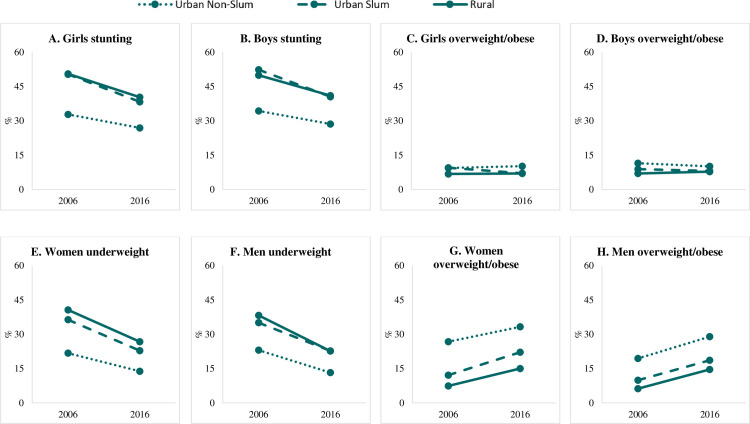
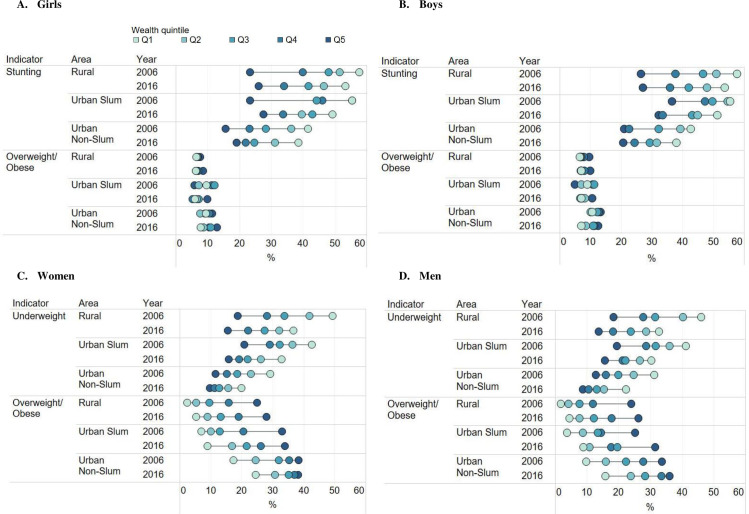
Rapid urban expansion has important health implications. This study examines trends and inequalities in undernutrition and overnutrition by gender, residence (rural, urban slum, urban non-slum), and wealth among children and adults in India. We used National Family Health Survey data from 2006 and 2016 (n = 311,182 children 0-5y and 972,192 adults 15-54y in total). We calculated differences, slope index of inequality (SII) and concentration index to examine changes over time and inequalities in outcomes by gender, residence, and wealth quintile. Between 2006 and 2016, child stunting prevalence dropped from 48% to 38%, with no gender differences in trends, whereas child overweight/obesity remained at ~7-8%. In both years, stunting prevalence was higher in rural and urban slum households compared to urban non-slum households. Within-residence, wealth inequalities were large for stunting (SII: -33 to -19 percentage points, pp) and declined over time only in urban non-slum households. Among adults, underweight prevalence decreased by ~13 pp but overweight/obesity doubled (10% to 21%) between 2006 and 2016. Rises in overweight/obesity among women were greater in rural and urban slum than urban non-slum households. Within-residence, wealth inequalities were large for both underweight (SII -35 to -12pp) and overweight/obesity (+16 to +29pp) for adults, with the former being more concentrated among poorer households and the latter among wealthier households. In conclusion, India experienced a rapid decline in child and adult undernutrition between 2006 and 2016 across genders and areas of residence. Of great concern, however, is the doubling of adult overweight/obesity in all areas during this period and the rise in wealth inequalities in both rural and urban slum households. With the second largest urban population globally, India needs to aggressively tackle the multiple burdens of malnutrition, especially among rural and urban slum households and develop actions to maintain trends in undernutrition reduction without exacerbating the rapidly rising problems of overweight/obesity.
快速的城市扩张对健康有重要影响。本研究通过性别、居住地点(农村、城市贫民窟、城市非贫民窟)和财富,考察了印度儿童和成年人的营养不良和营养过剩的趋势和不平等。我们使用了 2006 年和 2016 年的全国家庭健康调查数据(总共有 311182 名 0-5 岁儿童和 972192 名 15-54 岁的成年人)。我们计算了差异、不平等斜率指数(SII)和集中指数,以检查随着时间的推移和按性别、居住地点和财富五分位数划分的结果不平等。2006 年至 2016 年间,儿童发育迟缓的患病率从 48%下降到 38%,趋势上没有性别差异,而儿童超重/肥胖率仍保持在 7-8%左右。在这两年中,农村和城市贫民窟家庭的儿童发育迟缓患病率都高于城市非贫民窟家庭。在同一居住地点内,发育迟缓的财富不平等程度很大(SII:-33 至-19 个百分点,pp),且仅在城市非贫民窟家庭中随时间减少。在成年人中,体重不足的患病率下降了约 13 个百分点,但超重/肥胖症在 2006 年至 2016 年间翻了一番(从 10%增加到 21%)。农村和城市贫民窟家庭中女性超重/肥胖症的上升幅度大于城市非贫民窟家庭。在同一居住地点内,成年人的体重不足(SII-35 至-12pp)和超重/肥胖症(+16 至+29pp)的财富不平等程度都很大,前者在较贫困家庭中更为集中,后者在较富裕家庭中更为集中。总之,印度在 2006 年至 2016 年间,在性别和居住地点方面经历了儿童和成年人营养不良的快速下降。然而,令人担忧的是,在此期间,所有地区的成年人超重/肥胖症增加了一倍,农村和城市贫民窟家庭的财富不平等程度也在上升。印度拥有全球第二大的城市人口,需要积极应对营养不良的多种负担,特别是在农村和城市贫民窟家庭,并制定行动,以保持减少营养不良的趋势,而不会加剧超重/肥胖症的迅速上升问题。