Matthews Tomas E, Stupacher Jan, Vuust Peter
Center for Music in the Brain, Department of Clinical Medicine, Aarhus University Hospital, Nørrebrogade 44, Building 1A, 8000 Aarhus C, Denmark.
Royal Academy of Music, Skovgaardsgade 2C, DK-8000 Aarhus C, Denmark.
J Cogn. 2023 Sep 13;6(1):55. doi: 10.5334/joc.320. eCollection 2023.
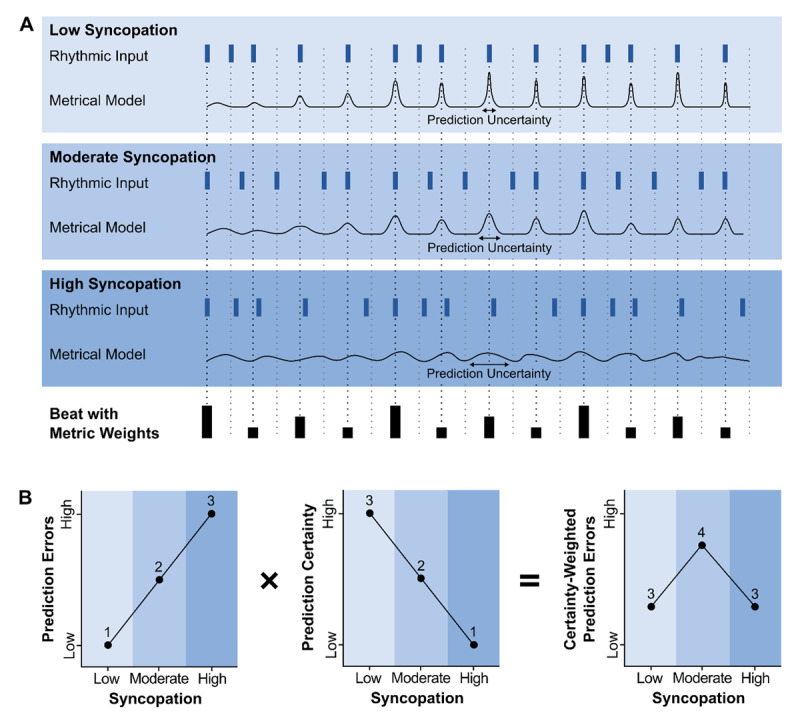
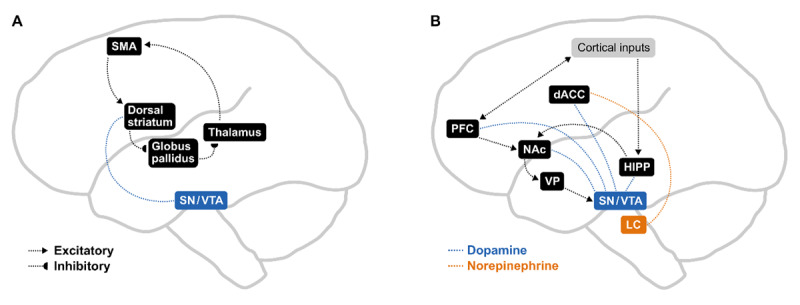
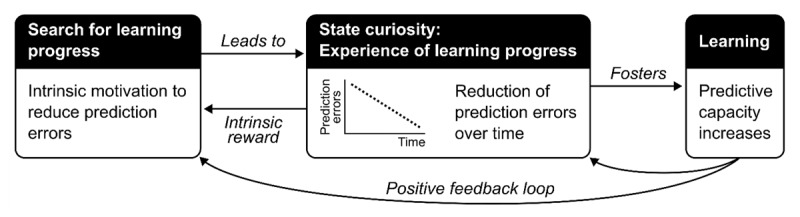
Interacting with music is a uniquely pleasurable activity that is ubiquitous across human cultures. Current theories suggest that a prominent driver of musical pleasure responses is the violation and confirmation of temporal predictions. For example, the pleasurable urge to move to music (PLUMM), which is associated with the broader concept of groove, is higher for moderately complex rhythms compared to simple and complex rhythms. This inverted U-shaped relation between PLUMM and rhythmic complexity is thought to result from a balance between predictability and uncertainty. That is, moderately complex rhythms lead to strongly weighted prediction errors which elicit an urge to move to reinforce the predictive model (i.e., the meter). However, the details of these processes and how they bring about positive affective responses are currently underspecified. We propose that the intrinsic motivation for learning progress drives PLUMM and informs the music humans choose to listen to, dance to, and create. Here, learning progress reflects the rate of prediction error minimization over time. Accordingly, reducible prediction errors signal the potential for learning progress, producing a pleasurable, curious state characterized by the mobilization of attentional and memory resources. We discuss this hypothesis in the context of current psychological and neuroscientific research on musical pleasure and PLUMM. We propose a theoretical neuroscientific model focusing on the roles of dopamine and norepinephrine within a feedback loop linking prediction-based learning, curiosity, and memory. This perspective provides testable predictions that will motivate future research to further illuminate the fundamental relation between predictions, movement, and reward.
与音乐互动是一种独特的愉悦活动,在人类文化中普遍存在。当前理论表明,音乐愉悦反应的一个主要驱动因素是时间预测的违背与确认。例如,与更广泛的律动概念相关的随着音乐起舞的愉悦冲动(PLUMM),对于中等复杂节奏而言比简单节奏和复杂节奏更高。PLUMM与节奏复杂性之间的这种倒U形关系被认为是可预测性与不确定性之间平衡的结果。也就是说,中等复杂的节奏会导致权重较大的预测误差,从而引发一种随着音乐起舞以强化预测模型(即节拍)的冲动。然而,这些过程的细节以及它们如何引发积极情感反应目前尚不清楚。我们提出,学习进步的内在动机驱动着PLUMM,并影响人类选择聆听、随之起舞和创作的音乐。在这里,学习进步反映了随着时间推移预测误差最小化的速率。相应地,可减少的预测误差表明存在学习进步的潜力,产生一种以注意力和记忆资源调动为特征的愉悦、好奇状态。我们在当前关于音乐愉悦和PLUMM的心理学及神经科学研究背景下讨论这一假设。我们提出一个理论神经科学模型,重点关注多巴胺和去甲肾上腺素在一个将基于预测的学习、好奇心和记忆联系起来的反馈回路中的作用。这一观点提供了可检验的预测,将推动未来研究进一步阐明预测、动作和奖励之间的基本关系。