• 文献检索
  • 文档翻译
  • 深度研究
  • 学术资讯
  • Suppr Zotero 插件Zotero 插件
  • 邀请有礼
  • 套餐&价格
  • 历史记录
应用&插件
Suppr Zotero 插件Zotero 插件浏览器插件Mac 客户端Windows 客户端微信小程序
定价
高级版会员购买积分包购买API积分包
服务
文献检索文档翻译深度研究API 文档MCP 服务
关于我们
关于 Suppr公司介绍联系我们用户协议隐私条款
关注我们

Suppr 超能文献

核心技术专利:CN118964589B侵权必究
粤ICP备2023148730 号-1Suppr @ 2026

文献检索

告别复杂PubMed语法,用中文像聊天一样搜索,搜遍4000万医学文献。AI智能推荐,让科研检索更轻松。

立即免费搜索

文件翻译

保留排版,准确专业,支持PDF/Word/PPT等文件格式,支持 12+语言互译。

免费翻译文档

深度研究

AI帮你快速写综述,25分钟生成高质量综述,智能提取关键信息,辅助科研写作。

立即免费体验

通过对 15 个国家的节奏先验进行跨文化比较,揭示了音乐心理表征的共性和差异。

Commonality and variation in mental representations of music revealed by a cross-cultural comparison of rhythm priors in 15 countries.

机构信息

Computational Auditory Perception Group, Max Planck Institute for Empirical Aesthetics, Frankfurt am Main, Germany.

Presidential Scholars in Society and Neuroscience, Columbia University, New York, NY, USA.

出版信息

Nat Hum Behav. 2024 May;8(5):846-877. doi: 10.1038/s41562-023-01800-9. Epub 2024 Mar 4.

DOI:10.1038/s41562-023-01800-9
PMID:38438653
原文链接:https://pmc.ncbi.nlm.nih.gov/articles/PMC11132990/
Abstract

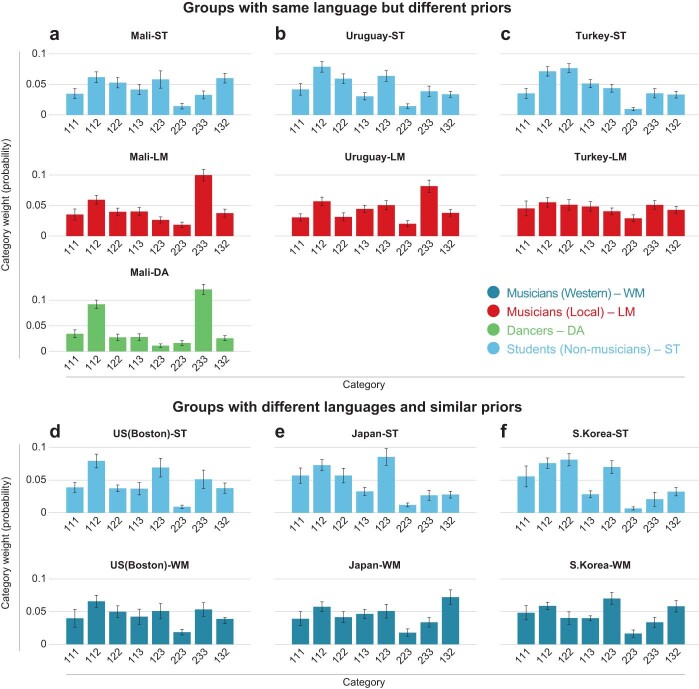
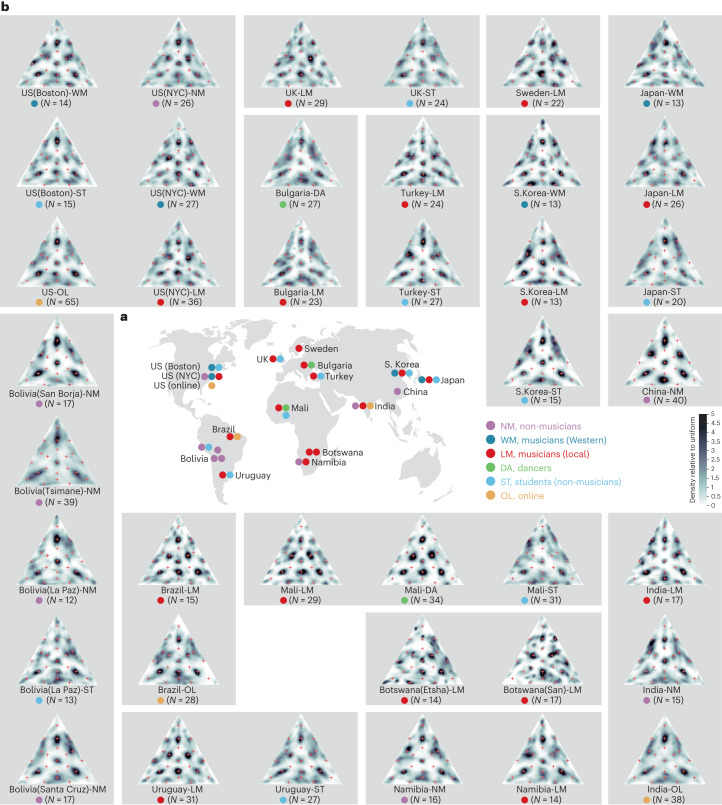
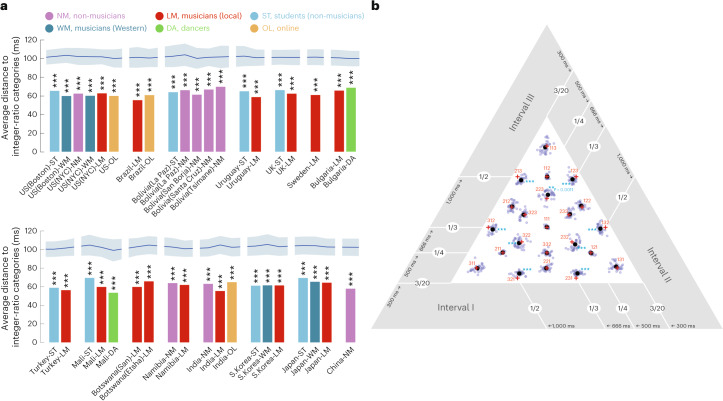
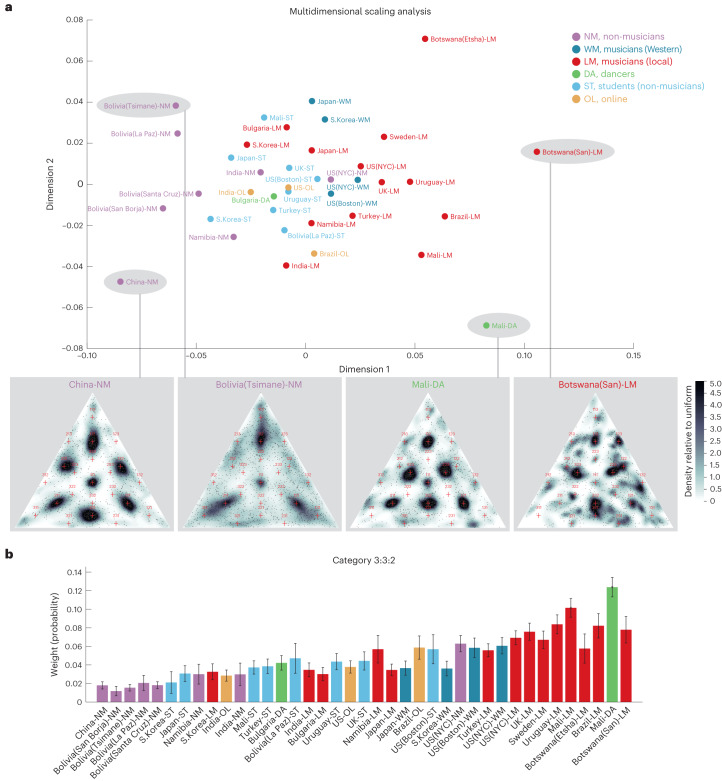
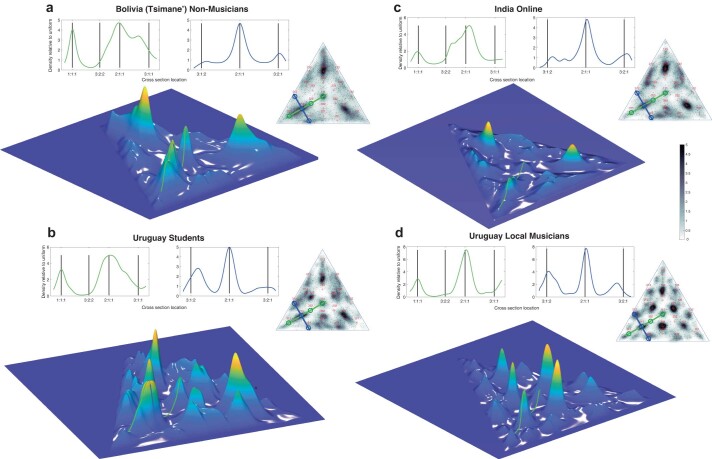
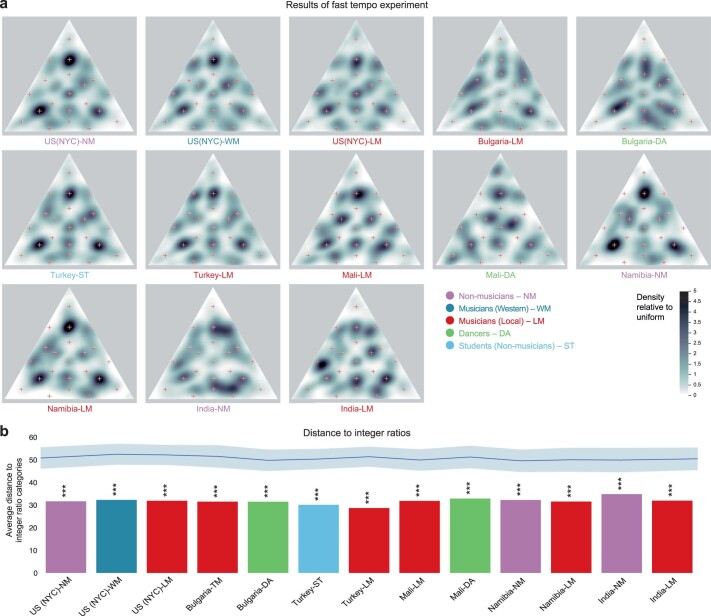
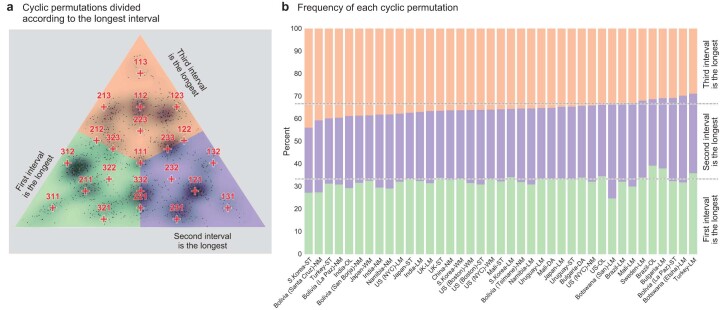
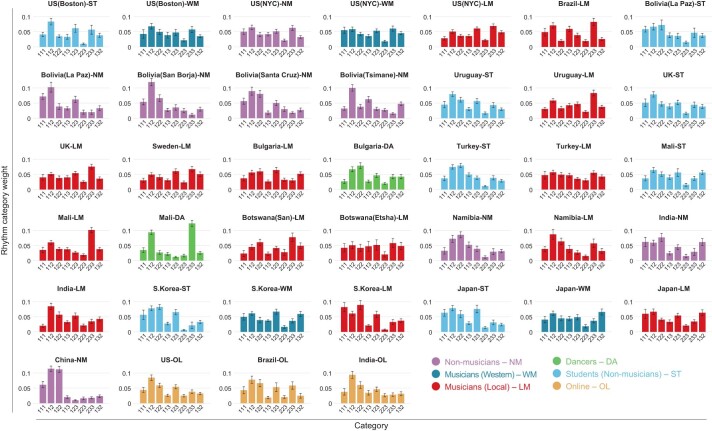
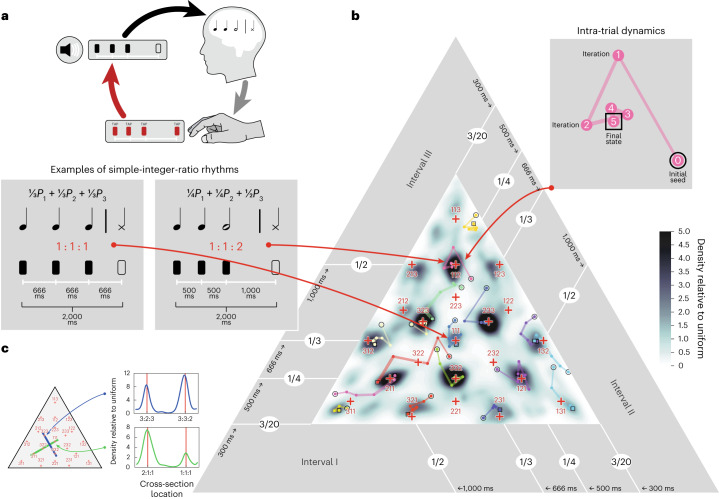
Music is present in every known society but varies from place to place. What, if anything, is universal to music cognition? We measured a signature of mental representations of rhythm in 39 participant groups in 15 countries, spanning urban societies and Indigenous populations. Listeners reproduced random 'seed' rhythms; their reproductions were fed back as the stimulus (as in the game of 'telephone'), such that their biases (the prior) could be estimated from the distribution of reproductions. Every tested group showed a sparse prior with peaks at integer-ratio rhythms. However, the importance of different integer ratios varied across groups, often reflecting local musical practices. Our results suggest a common feature of music cognition: discrete rhythm 'categories' at small-integer ratios. These discrete representations plausibly stabilize musical systems in the face of cultural transmission but interact with culture-specific traditions to yield the diversity that is evident when mental representations are probed across many cultures.

摘要

音乐存在于每一个已知的社会中,但在不同的地方有所不同。如果有任何东西是音乐认知普遍存在的,那会是什么呢?我们在 15 个国家的 39 个参与者群体中测量了节奏的心理表现的特征,这些群体涵盖了城市社会和原住民群体。听众复制随机的“种子”节奏;他们的复制作为刺激反馈(就像在“电话”游戏中一样),这样他们的偏差(先验)可以从复制的分布中估计出来。每个测试组都显示出稀疏的先验,峰值出现在整数比的节奏上。然而,不同整数比的重要性在不同的群体中有所不同,这通常反映了当地的音乐实践。我们的结果表明音乐认知存在一个共同的特征:小整数比的离散节奏“类别”。这些离散的表示形式在面对文化传播时可能会稳定音乐系统,但会与特定于文化的传统相互作用,从而产生在跨许多文化进行心理表现探测时明显的多样性。
https://cdn.ncbi.nlm.nih.gov/pmc/blobs/6926/11132990/a6b725852028/41562_2023_1800_Fig17_ESM.jpg
https://cdn.ncbi.nlm.nih.gov/pmc/blobs/6926/11132990/14aedcac2c23/41562_2023_1800_Fig1_HTML.jpg
https://cdn.ncbi.nlm.nih.gov/pmc/blobs/6926/11132990/266fec58a96f/41562_2023_1800_Fig2_HTML.jpg
https://cdn.ncbi.nlm.nih.gov/pmc/blobs/6926/11132990/7c9c4788e948/41562_2023_1800_Fig3_HTML.jpg
https://cdn.ncbi.nlm.nih.gov/pmc/blobs/6926/11132990/c0b079b938ea/41562_2023_1800_Fig4_HTML.jpg
https://cdn.ncbi.nlm.nih.gov/pmc/blobs/6926/11132990/238b67cfdab5/41562_2023_1800_Fig5_HTML.jpg
https://cdn.ncbi.nlm.nih.gov/pmc/blobs/6926/11132990/2577170edf0b/41562_2023_1800_Fig6_HTML.jpg
https://cdn.ncbi.nlm.nih.gov/pmc/blobs/6926/11132990/09a0c774b564/41562_2023_1800_Fig7_HTML.jpg
https://cdn.ncbi.nlm.nih.gov/pmc/blobs/6926/11132990/111c842e12bf/41562_2023_1800_Fig8_HTML.jpg
https://cdn.ncbi.nlm.nih.gov/pmc/blobs/6926/11132990/b81c138bbd8f/41562_2023_1800_Fig9_ESM.jpg
https://cdn.ncbi.nlm.nih.gov/pmc/blobs/6926/11132990/d9dd0c7d1726/41562_2023_1800_Fig10_ESM.jpg
https://cdn.ncbi.nlm.nih.gov/pmc/blobs/6926/11132990/bfc5775dbfbd/41562_2023_1800_Fig11_ESM.jpg
https://cdn.ncbi.nlm.nih.gov/pmc/blobs/6926/11132990/d0352f0387ff/41562_2023_1800_Fig12_ESM.jpg
https://cdn.ncbi.nlm.nih.gov/pmc/blobs/6926/11132990/e61d9d1cf8f6/41562_2023_1800_Fig13_ESM.jpg
https://cdn.ncbi.nlm.nih.gov/pmc/blobs/6926/11132990/a2b3ea90b766/41562_2023_1800_Fig14_ESM.jpg
https://cdn.ncbi.nlm.nih.gov/pmc/blobs/6926/11132990/7b685807e58b/41562_2023_1800_Fig15_ESM.jpg
https://cdn.ncbi.nlm.nih.gov/pmc/blobs/6926/11132990/65243a8009f1/41562_2023_1800_Fig16_ESM.jpg
https://cdn.ncbi.nlm.nih.gov/pmc/blobs/6926/11132990/a6b725852028/41562_2023_1800_Fig17_ESM.jpg
https://cdn.ncbi.nlm.nih.gov/pmc/blobs/6926/11132990/14aedcac2c23/41562_2023_1800_Fig1_HTML.jpg
https://cdn.ncbi.nlm.nih.gov/pmc/blobs/6926/11132990/266fec58a96f/41562_2023_1800_Fig2_HTML.jpg
https://cdn.ncbi.nlm.nih.gov/pmc/blobs/6926/11132990/7c9c4788e948/41562_2023_1800_Fig3_HTML.jpg
https://cdn.ncbi.nlm.nih.gov/pmc/blobs/6926/11132990/c0b079b938ea/41562_2023_1800_Fig4_HTML.jpg
https://cdn.ncbi.nlm.nih.gov/pmc/blobs/6926/11132990/238b67cfdab5/41562_2023_1800_Fig5_HTML.jpg
https://cdn.ncbi.nlm.nih.gov/pmc/blobs/6926/11132990/2577170edf0b/41562_2023_1800_Fig6_HTML.jpg
https://cdn.ncbi.nlm.nih.gov/pmc/blobs/6926/11132990/09a0c774b564/41562_2023_1800_Fig7_HTML.jpg
https://cdn.ncbi.nlm.nih.gov/pmc/blobs/6926/11132990/111c842e12bf/41562_2023_1800_Fig8_HTML.jpg
https://cdn.ncbi.nlm.nih.gov/pmc/blobs/6926/11132990/b81c138bbd8f/41562_2023_1800_Fig9_ESM.jpg
https://cdn.ncbi.nlm.nih.gov/pmc/blobs/6926/11132990/d9dd0c7d1726/41562_2023_1800_Fig10_ESM.jpg
https://cdn.ncbi.nlm.nih.gov/pmc/blobs/6926/11132990/bfc5775dbfbd/41562_2023_1800_Fig11_ESM.jpg
https://cdn.ncbi.nlm.nih.gov/pmc/blobs/6926/11132990/d0352f0387ff/41562_2023_1800_Fig12_ESM.jpg
https://cdn.ncbi.nlm.nih.gov/pmc/blobs/6926/11132990/e61d9d1cf8f6/41562_2023_1800_Fig13_ESM.jpg
https://cdn.ncbi.nlm.nih.gov/pmc/blobs/6926/11132990/a2b3ea90b766/41562_2023_1800_Fig14_ESM.jpg
https://cdn.ncbi.nlm.nih.gov/pmc/blobs/6926/11132990/7b685807e58b/41562_2023_1800_Fig15_ESM.jpg
https://cdn.ncbi.nlm.nih.gov/pmc/blobs/6926/11132990/65243a8009f1/41562_2023_1800_Fig16_ESM.jpg
https://cdn.ncbi.nlm.nih.gov/pmc/blobs/6926/11132990/a6b725852028/41562_2023_1800_Fig17_ESM.jpg

相似文献

1
Commonality and variation in mental representations of music revealed by a cross-cultural comparison of rhythm priors in 15 countries.通过对 15 个国家的节奏先验进行跨文化比较,揭示了音乐心理表征的共性和差异。
Nat Hum Behav. 2024 May;8(5):846-877. doi: 10.1038/s41562-023-01800-9. Epub 2024 Mar 4.
2
Integer Ratio Priors on Musical Rhythm Revealed Cross-culturally by Iterated Reproduction.跨文化迭代再现揭示的音乐节奏整数比先验。
Curr Biol. 2017 Feb 6;27(3):359-370. doi: 10.1016/j.cub.2016.12.031. Epub 2017 Jan 5.
3
The development of rhythmic categories as revealed through an iterative production task.通过迭代生成任务揭示的节奏范畴的发展。
Cognition. 2024 Jan;242:105634. doi: 10.1016/j.cognition.2023.105634. Epub 2023 Oct 10.
4
What rhythm production can tell us about culture.节奏制作能告诉我们关于文化的什么。
Trends Cogn Sci. 2024 Jun;28(6):487-488. doi: 10.1016/j.tics.2024.04.004. Epub 2024 Apr 24.
5
Cultural constraints on music perception and cognition.音乐感知和认知的文化制约因素。
Prog Brain Res. 2009;178:67-77. doi: 10.1016/S0079-6123(09)17805-6.
6
Universal and culture-specific factors in the recognition and performance of musical affect expressions.音乐情感表达的识别和表现中的普遍因素和文化特定因素。
Emotion. 2013 Jun;13(3):434-449. doi: 10.1037/a0031388. Epub 2013 Feb 11.
7
Familiarity overrides complexity in rhythm perception: a cross-cultural comparison of American and Turkish listeners.熟悉度胜过节奏感知的复杂性:美国和土耳其听众的跨文化比较。
J Exp Psychol Hum Percept Perform. 2012 Jun;38(3):543-8. doi: 10.1037/a0027225. Epub 2012 Feb 20.
8
Categorical Rhythms Are Shared between Songbirds and Humans.鸣禽和人类共享类别节律。
Curr Biol. 2020 Sep 21;30(18):3544-3555.e6. doi: 10.1016/j.cub.2020.06.072. Epub 2020 Jul 23.
9
Music perception and cognition: a review of recent cross-cultural research.音乐感知与认知:跨文化研究述评。
Top Cogn Sci. 2012 Oct;4(4):653-67. doi: 10.1111/j.1756-8765.2012.01215.x. Epub 2012 Jul 18.
10
Musical expertise facilitates statistical learning of rhythm and the perceptive uncertainty: A cross-cultural study.音乐专业知识促进节奏的统计学习和感知不确定性:一项跨文化研究。
Neuropsychologia. 2020 Sep;146:107553. doi: 10.1016/j.neuropsychologia.2020.107553. Epub 2020 Jul 8.

引用本文的文献

1
Revealing rhythm categorization in human brain activity.揭示人类大脑活动中的节律分类
Sci Adv. 2025 Aug;11(31):eadu9838. doi: 10.1126/sciadv.adu9838. Epub 2025 Jul 30.
2
The Expanded Natural History of Song Discography, A Global Corpus of Vocal Music.《歌曲唱片的扩展自然史:全球声乐音乐语料库》
Open Mind (Camb). 2025 Jul 7;9:844-863. doi: 10.1162/opmi.a.4. eCollection 2025.
3
Core systems of music perception.音乐感知的核心系统。

本文引用的文献

1
Globally, songs and instrumental melodies are slower and higher and use more stable pitches than speech: A Registered Report.从全球范围来看,歌曲和器乐曲的速度比言语更慢、音高更高,且使用更稳定的音高:注册报告。
Sci Adv. 2024 May 17;10(20):eadm9797. doi: 10.1126/sciadv.adm9797. Epub 2024 May 15.
2
Language experience predicts music processing in a half-million speakers of fifty-four languages.语言经验预测了 54 种语言的 50 万名使用者的音乐处理能力。
Curr Biol. 2023 May 22;33(10):1916-1925.e4. doi: 10.1016/j.cub.2023.03.067. Epub 2023 Apr 26.
3
Large-scale iterated singing experiments reveal oral transmission mechanisms underlying music evolution.
Trends Cogn Sci. 2025 Aug;29(8):763-777. doi: 10.1016/j.tics.2025.05.013. Epub 2025 Jun 13.
4
Mechanisms of cultural diversity in urban populations.城市人口中文化多样性的机制。
Nat Commun. 2025 Jun 4;16(1):5192. doi: 10.1038/s41467-025-60538-2.
5
Pitch biases sensorimotor synchronization to auditory rhythms.音高会使感觉运动同步偏向听觉节奏。
Sci Rep. 2025 May 16;15(1):17012. doi: 10.1038/s41598-025-00827-4.
6
Sensorimotor synchronization to rhythm in an experienced sea lion rivals that of humans.经验丰富的海狮对节奏的感觉运动同步能力可与人类相媲美。
Sci Rep. 2025 May 1;15(1):12125. doi: 10.1038/s41598-025-95279-1.
7
The influence of vocal expertise on the perception of microrhythm in song and speech.声乐专业知识对歌曲和言语中微节奏感知的影响。
Atten Percept Psychophys. 2025 Apr 25. doi: 10.3758/s13414-025-03057-y.
8
Measuring self-similarity in empirical signals to understand musical beat perception.测量经验信号中的自相似性以理解音乐节拍感知。
Eur J Neurosci. 2025 Jan;61(2):e16637. doi: 10.1111/ejn.16637.
9
The rhythm of horse gaits.马的步态节奏。
Ann N Y Acad Sci. 2025 Jan;1543(1):86-93. doi: 10.1111/nyas.15271. Epub 2024 Dec 28.
10
White matter structural bases for phase accuracy during tapping synchronization.敲击同步相位准确性的白质结构基础。
Elife. 2024 Sep 4;13:e83838. doi: 10.7554/eLife.83838.
大规模迭代歌唱实验揭示了音乐进化的口头传播机制。
Curr Biol. 2023 Apr 24;33(8):1472-1486.e12. doi: 10.1016/j.cub.2023.02.070. Epub 2023 Mar 22.
4
Cross-Cultural Work in Music Cognition: Challenges, Insights, and Recommendations.音乐认知中的跨文化研究:挑战、见解与建议。
Music Percept. 2020 Feb;37(3):185-195. doi: 10.1525/mp.2020.37.3.185. Epub 2020 Feb 1.
5
Modeling enculturated bias in entrainment to rhythmic patterns.建模文化偏见对节奏模式的顺应。
PLoS Comput Biol. 2022 Sep 29;18(9):e1010579. doi: 10.1371/journal.pcbi.1010579. eCollection 2022 Sep.
6
Acoustic regularities in infant-directed speech and song across cultures.跨文化的婴儿指向言语和歌曲中的声学规律。
Nat Hum Behav. 2022 Nov;6(11):1545-1556. doi: 10.1038/s41562-022-01410-x. Epub 2022 Jul 18.
7
Aesthetics of musical timing: Culture and expertise affect preferences for isochrony but not synchrony.音乐时间美学:文化和专业知识影响等时性偏好,但不影响同步性偏好。
Cognition. 2022 Oct;227:105205. doi: 10.1016/j.cognition.2022.105205. Epub 2022 Jun 17.
8
REPP: A robust cross-platform solution for online sensorimotor synchronization experiments.REPP:一个用于在线感觉运动同步实验的强大跨平台解决方案。
Behav Res Methods. 2022 Oct;54(5):2271-2285. doi: 10.3758/s13428-021-01722-2. Epub 2022 Feb 11.
9
Music-selective neural populations arise without musical training.音乐选择神经群体在没有音乐训练的情况下出现。
J Neurophysiol. 2021 Jun 1;125(6):2237-2263. doi: 10.1152/jn.00588.2020. Epub 2021 Feb 17.
10
Harmonic organisation conveys both universal and culture-specific cues for emotional expression in music.和声组织传达了音乐中情感表达的普遍和文化特定的线索。
PLoS One. 2021 Jan 13;16(1):e0244964. doi: 10.1371/journal.pone.0244964. eCollection 2021.