Sabatino Raffaella, Sbaffi Tomasa, Sivalingam Periyasamy, Corno Gianluca, Fontaneto Diego, Di Cesare Andrea
Molecular Ecology Group (MEG), National Research Council of Italy - Water Research Institute (CNR-IRSA) , Verbania, Italy.
Microbiol Spectr. 2023 Sep 19;11(5):e0110123. doi: 10.1128/spectrum.01101-23.
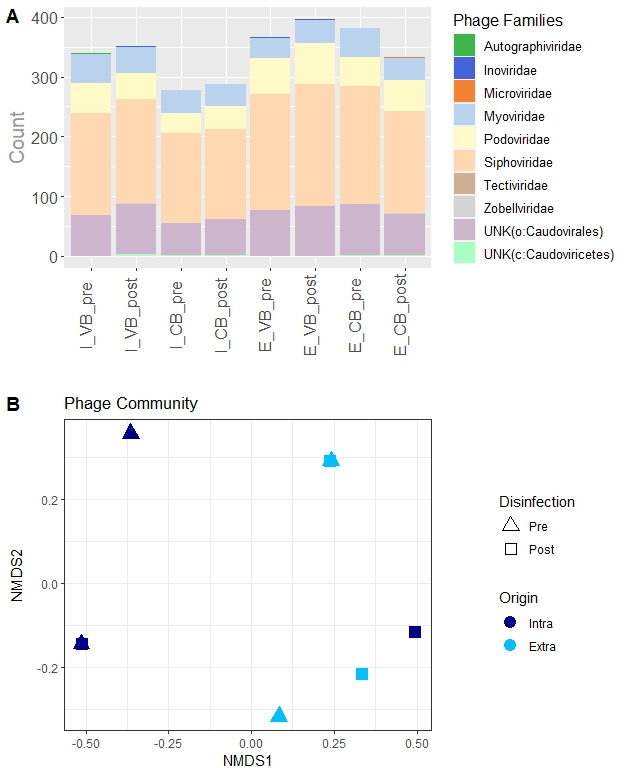
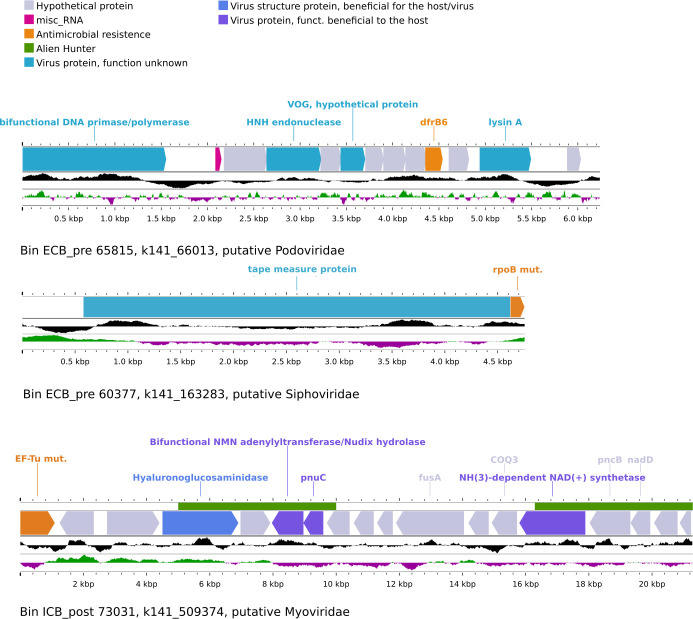
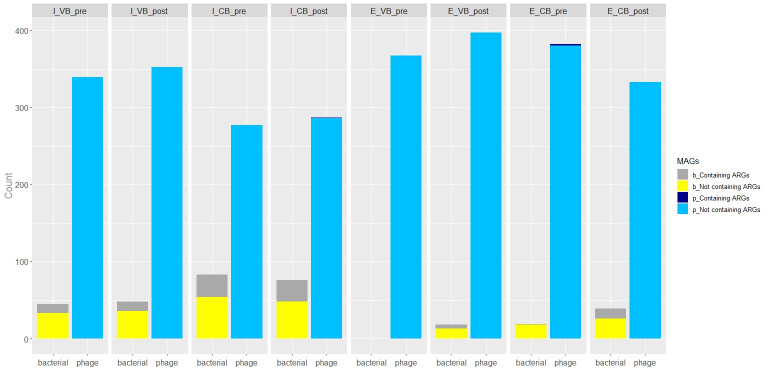
Bacteriophages are known as players in the transmission of antimicrobial resistance genes (ARGs) by horizontal gene transfer. In this study, we characterized the bacteriophage community and the associated ARGs to estimate the potential for phages to spread ARGs in aquatic ecosystems analyzing the intra- and extracellular DNA isolated from two wastewater treatment plants (WWTPs) by shotgun metagenomics. We compared the phage antimicrobial resistome with the bacterial resistome and investigated the effect of the final disinfection treatment on the phage community and its resistome. Phage community was mainly composed by and other members of the order . The final disinfection only marginally affected the composition of the phage community, and it was not possible to measure its effect on the antimicrobial resistome. Indeed, only three phage metagenome-assembled genomes (pMAGs) annotated as , , and were positive for putative ARGs. Among the detected ARGs, i.e., B6, B mutants, and EF-Tu mutants, the first one was not annotated in the bacterial MAGs. Overall, these results demonstrate that bacteriophages limitedly contribute to the whole antimicrobial resistome. However, in order to obtain a comprehensive understanding of the antimicrobial resistome within a microbial community, the role of bacteriophages needs to be investigated. IMPORTANCE WWTPs are considered hotspots for the spread of ARGs by horizontal gene transfer. In this study, we evaluated the phage composition and the associated antimicrobial resistome by shotgun metagenomics of samples collected before and after the final disinfection treatment. Only a few bacteriophages carried ARGs. However, since one of the detected genes was not found in the bacterial metagenome-assembled genomes, it is necessary to investigate the phage community in order to gain a comprehensive overview of the antimicrobial resistome. This investigation could help assess the potential threats to human health.
噬菌体被认为是通过水平基因转移传播抗微生物耐药基因(ARGs)的参与者。在本研究中,我们对噬菌体群落和相关的ARGs进行了表征,通过鸟枪法宏基因组学分析从两个污水处理厂(WWTPs)分离的细胞内和细胞外DNA,以评估噬菌体在水生生态系统中传播ARGs的潜力。我们将噬菌体抗微生物耐药组与细菌耐药组进行了比较,并研究了最终消毒处理对噬菌体群落及其耐药组的影响。噬菌体群落主要由 和该目其他成员组成。最终消毒仅对噬菌体群落的组成产生了轻微影响,且无法测量其对抗微生物耐药组的影响。实际上,只有三个注释为 、 和 的噬菌体宏基因组组装基因组(pMAGs)对推定的ARGs呈阳性。在检测到的ARGs中,即B6、B突变体和EF-Tu突变体,第一个在细菌MAGs中未被注释。总体而言,这些结果表明噬菌体对整个抗微生物耐药组的贡献有限。然而,为了全面了解微生物群落中的抗微生物耐药组,需要研究噬菌体的作用。重要性污水处理厂被认为是通过水平基因转移传播ARGs的热点。在本研究中,我们通过对最终消毒处理前后采集的样本进行鸟枪法宏基因组学评估了噬菌体组成和相关的抗微生物耐药组。只有少数噬菌体携带ARGs。然而,由于检测到的一个基因在细菌宏基因组组装基因组中未被发现,因此有必要研究噬菌体群落,以便全面了解抗微生物耐药组。这项研究有助于评估对人类健康的潜在威胁。