CAS Key Laboratory of Separation Science for Analytical Chemistry, Dalian Institute of Chemical Physics, Chinese Academy of Sciences, Dalian, 116023, People's Republic of China.
University of Chinese Academy of Sciences, Beijing, 100049, People's Republic of China.
BMC Bioinformatics. 2023 Sep 19;24(1):348. doi: 10.1186/s12859-023-05485-9.
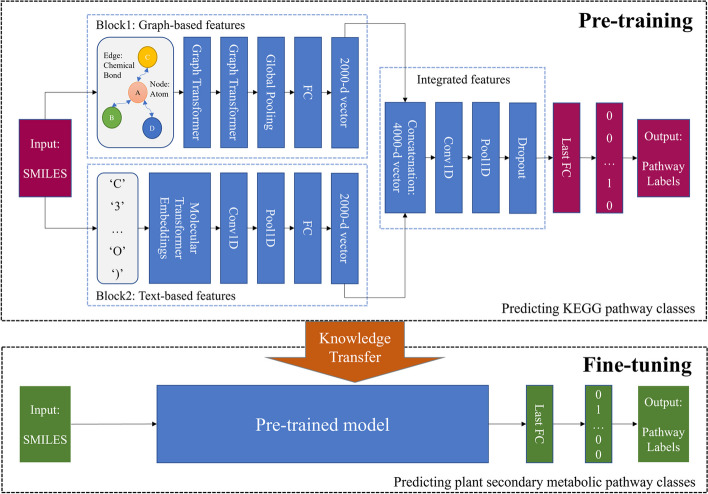
Plant secondary metabolites are highly valued for their applications in pharmaceuticals, nutrition, flavors, and aesthetics. It is of great importance to elucidate plant secondary metabolic pathways due to their crucial roles in biological processes during plant growth and development. However, understanding plant biosynthesis and degradation pathways remains a challenge due to the lack of sufficient information in current databases. To address this issue, we proposed a transfer learning approach using a pre-trained hybrid deep learning architecture that combines Graph Transformer and convolutional neural network (GTC) to predict plant metabolic pathways.
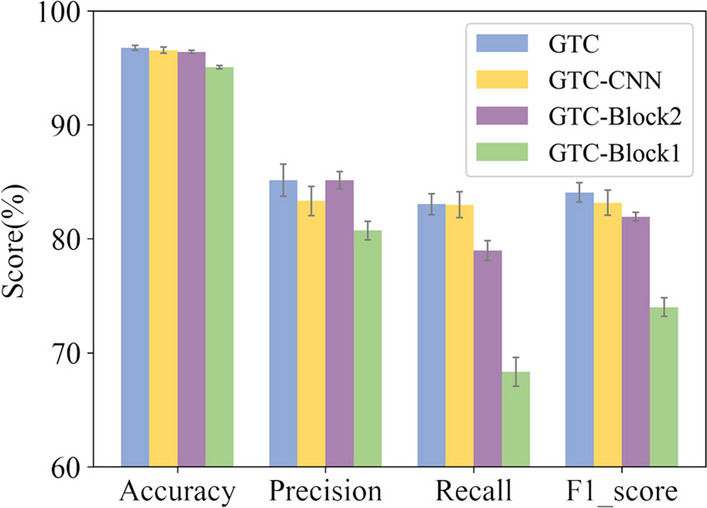
GTC provides comprehensive molecular representation by extracting both structural features from the molecular graph and textual information from the SMILES string. GTC is pre-trained on the KEGG datasets to acquire general features, followed by fine-tuning on plant-derived datasets. Four metrics were chosen for model performance evaluation. The results show that GTC outperforms six other models, including three previously reported machine learning models, on the KEGG dataset. GTC yields an accuracy of 96.75%, precision of 85.14%, recall of 83.03%, and F1_score of 84.06%. Furthermore, an ablation study confirms the indispensability of all the components of the hybrid GTC model. Transfer learning is then employed to leverage the shared knowledge acquired from the KEGG metabolic pathways. As a result, the transferred GTC exhibits outstanding accuracy in predicting plant secondary metabolic pathways with an average accuracy of 98.30% in fivefold cross-validation and 97.82% on the final test. In addition, GTC is employed to classify natural products. It achieves a perfect accuracy score of 100.00% for alkaloids, while the lowest accuracy score of 98.42% for shikimates and phenylpropanoids.
The proposed GTC effectively captures molecular features, and achieves high performance in classifying KEGG metabolic pathways and predicting plant secondary metabolic pathways via transfer learning. Furthermore, GTC demonstrates its generalization ability by accurately classifying natural products. A user-friendly executable program has been developed, which only requires the input of the SMILES string of the query compound in a graphical interface.
植物次生代谢产物因其在医药、营养、风味和美学方面的应用而备受重视。阐明植物次生代谢途径非常重要,因为它们在植物生长和发育过程中的生物过程中起着至关重要的作用。然而,由于当前数据库中信息不足,理解植物生物合成和降解途径仍然是一个挑战。为了解决这个问题,我们提出了一种使用预先训练的混合深度学习架构的迁移学习方法,该架构结合了图转换器和卷积神经网络(GTC)来预测植物代谢途径。
GTC 通过从分子图中提取结构特征和从 SMILES 字符串中提取文本信息,提供全面的分子表示。GTC 在 KEGG 数据集上进行预训练以获取一般特征,然后在植物衍生数据集上进行微调。选择了四个指标来评估模型性能。结果表明,GTC 在 KEGG 数据集上的表现优于其他六个模型,包括三个之前报告的机器学习模型。GTC 的准确率为 96.75%,精度为 85.14%,召回率为 83.03%,F1 得分为 84.06%。此外,消融研究证实了混合 GTC 模型所有组成部分的不可或缺性。然后,采用迁移学习来利用从 KEGG 代谢途径中获得的共享知识。结果,转移后的 GTC 在预测植物次生代谢途径方面表现出色,在五重交叉验证中的平均准确率为 98.30%,最终测试中的准确率为 97.82%。此外,GTC 用于分类天然产物。它对生物碱的准确率达到了 100.00%,而对 shikimates 和苯基丙氨酸的准确率最低,为 98.42%。
所提出的 GTC 有效地捕获分子特征,并通过迁移学习在分类 KEGG 代谢途径和预测植物次生代谢途径方面取得了很高的性能。此外,GTC 通过准确地对天然产物进行分类,展示了其泛化能力。已经开发了一个用户友好的可执行程序,该程序只需在图形界面中输入查询化合物的 SMILES 字符串即可。