School of Social and Political Science, University of Edinburgh, Edinburgh, EH8 9LD, UK.
School of Geography, Politics and Sociology, Newcastle University, Newcastle upon Tyne, NE1 7RU, UK.
Int J Health Geogr. 2023 Sep 20;22(1):23. doi: 10.1186/s12942-023-00341-8.
Precise geographical targeting is well recognised as an indispensable intervention strategy for achieving many Sustainable Development Goals (SDGs). This is more cogent for health-related goals such as the reduction of the HIV/AIDS pandemic, which exhibits substantial spatial heterogeneity at various spatial scales (including at microscale levels). Despite the dire data limitations in Low and Middle Income Countries (LMICs), it is essential to produce fine-scale estimates of health-related indicators such as HIV/AIDS. Existing small-area estimates (SAEs) incorporate limited synthesis of the spatial and socio-behavioural aspects of the HIV/AIDS pandemic and/or are not adequately grounded in international indicator frameworks for sustainable development initiatives. They are, therefore, of limited policy-relevance, not least because of their inability to provide necessary fine-scale socio-spatial disaggregation of relevant indicators.
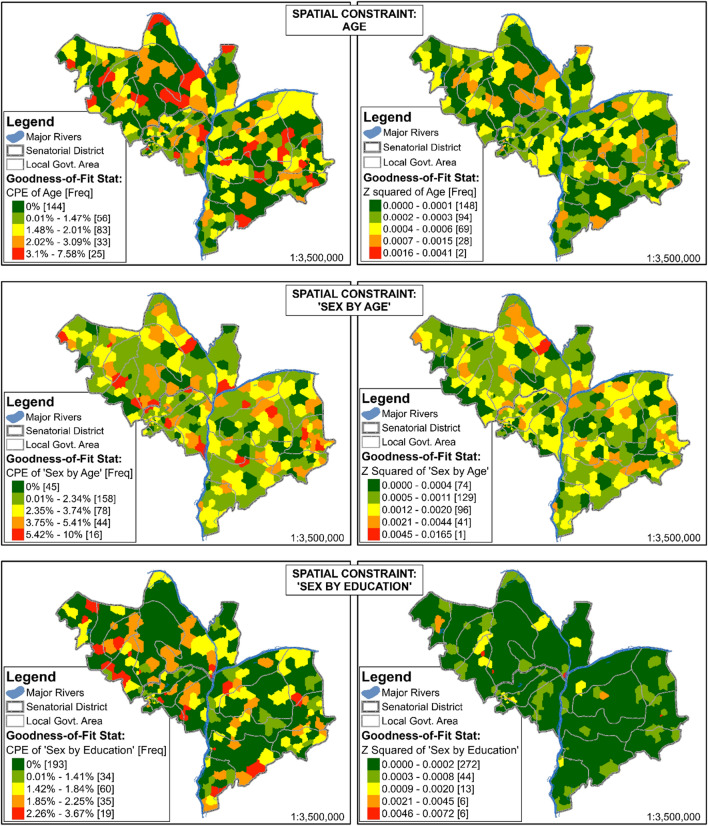
The current study attempts to overcome these challenges through innovative utilisation of gridded demographic datasets for SAEs as well as the mapping of standard HIV/AIDS indicators in LMICs using spatial microsimulation (SMS).
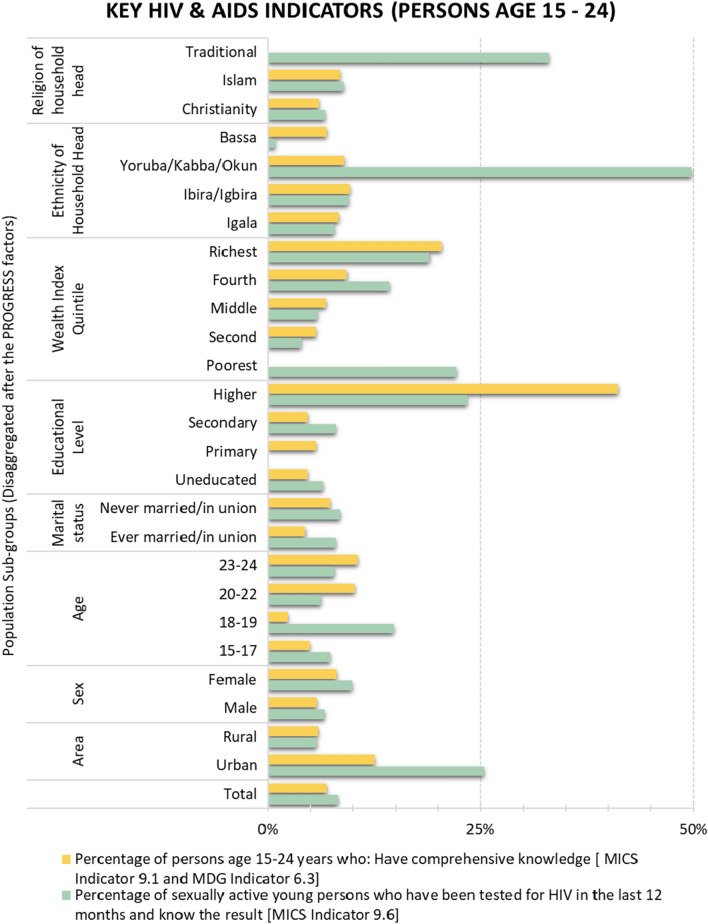
The result is a spatially enriched synthetic individual-level population of the study area as well as microscale estimates of four standard HIV/AIDS and sexual behaviour indicators. The analysis of these indicators follows similar studies with the added advantage of mapping fine-grained spatial patterns to facilitate precise geographical targeting of relevant interventions. In doing so, the need to explicate socio-spatial variations through proper socioeconomic disaggregation of data is reiterated.
In addition to creating SAEs of standard health-related indicators from disparate multivariate data, the outputs make it possible to establish more robust links (even at individual levels) with other mesoscale models, thereby enabling spatial analytics to be more responsive to evidence-based policymaking in LMICs. It is hoped that international organisations concerned with producing SDG-related indicators for LMICs move towards SAEs of such metrics using methods like SMS.
精确定位地理位置已被公认为实现许多可持续发展目标(SDGs)的不可或缺的干预策略。对于与健康相关的目标(如减少艾滋病毒/艾滋病大流行)来说更是如此,该目标在各种空间尺度上(包括微观尺度)都存在显著的空间异质性。尽管中低收入国家(LMICs)的数据存在严重限制,但有必要对与健康相关的指标(如艾滋病毒/艾滋病)进行精细尺度的估计。现有的小区域估计(SAE)仅有限地综合了艾滋病毒/艾滋病大流行的空间和社会行为方面,或者没有充分立足于国际可持续发展倡议指标框架。因此,它们的政策相关性有限,尤其是因为它们无法提供相关指标的必要精细尺度社会空间分解。
本研究试图通过创新利用网格化人口数据集进行 SAE,以及利用空间微观模拟(SMS)在 LMICs 中绘制标准艾滋病毒/艾滋病指标来克服这些挑战。
这是一个具有丰富空间信息的研究区域综合个体人口以及四个标准艾滋病毒/艾滋病和性行为指标的微观估计。对这些指标的分析遵循类似的研究,具有绘制细粒度空间模式的优势,以促进相关干预措施的精确定位。在这样做的过程中,重申了通过适当的数据社会经济分解来阐明社会空间变化的必要性。
除了从各种多变量数据中创建标准健康相关指标的 SAE 外,这些输出还使得与其他中尺度模型建立更稳健的联系(甚至在个体层面上)成为可能,从而使空间分析能够更好地响应 LMICs 的基于证据的决策制定。希望关注为 LMICs 生成与可持续发展目标相关指标的国际组织转向使用 SMS 等方法进行此类指标的 SAE。