Division of Hematopoietic Disease Control, Institute of Medical Science, The University of Tokyo, Tokyo.
Division of Cellular Therapy, Institute of Medical Science, The University of Tokyo, Tokyo.
Haematologica. 2024 Apr 1;109(4):1107-1120. doi: 10.3324/haematol.2023.282915.
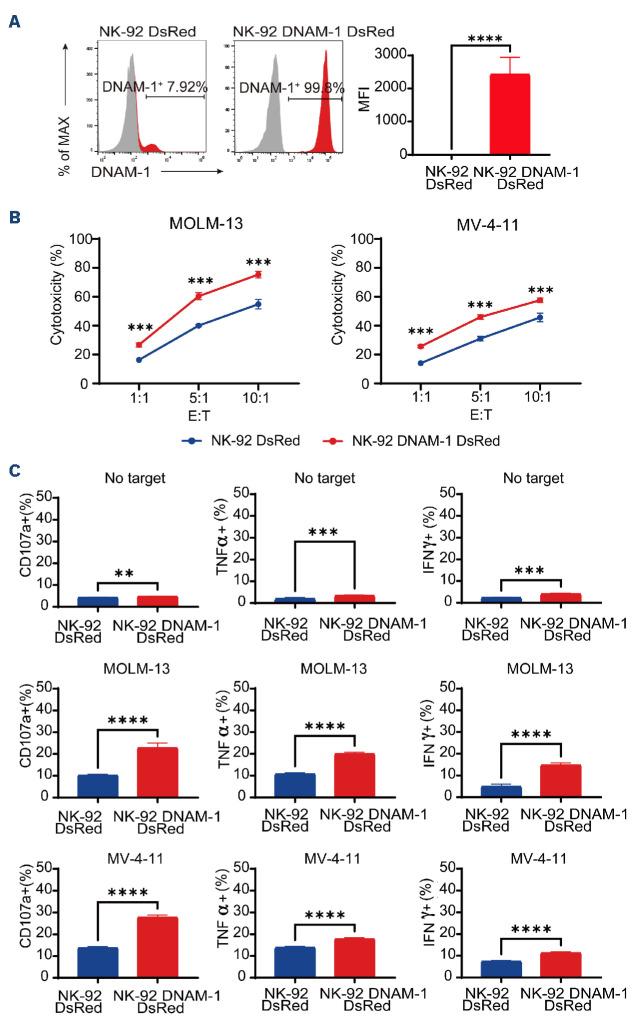
Acute myeloid leukemia (AML) is a hematologic malignancy that frequently relapses, even if remission can be achieved with intensive chemotherapy. One known relapse mechanism is the escape of leukemic cells from immune surveillance. Currently, there is no effective immunotherapy for AML because of the lack of specific antigens. Here, we aimed to elucidate the association between CD155 and CD112 in AML cell lines and primary AML samples and determine the therapeutic response. Briefly, we generated NK-92 cell lines (NK-92) with modified DNAX-associated molecule 1 (DNAM-1) and T-cell immunoglobulin and ITIM domain (TIGIT), which are receptors of CD155 and CD112, respectively. Analysis of 200 cases of AML indicated that the survival of patients with high expression of CD112 was shorter than that of patients with low expression. NK-92 DNAM-1 exhibited enhanced cytotoxic activity against AML cell lines and primary cells derived from patients with AML. DNAM-1 induction in NK-92 cells enhanced the expression of cytotoxicity-related genes, thus overcoming the inhibitory activity of TIGIT. Between CD155 and CD112, CD112 is an especially important target for natural killer (NK)-cell therapy of AML. Using a xenograft model, we confirmed the enhanced antitumor effect of NK-92 DNAM-1 compared with that of NK-92 alone. We also discovered that CD112 (Nectin-2), an immune checkpoint molecule belonging to the Nectin/Nectin-like family, functions as a novel target of immunotherapy. In conclusion, modification of the DNAM-1/CD112 axis in NK cells may be an effective novel immunotherapy for AML. Furthermore, our findings suggest that the levels of expression of these molecules are potential prognostic markers in AML.
急性髓系白血病(AML)是一种血液系统恶性肿瘤,即使通过强化化疗可以缓解,也经常复发。一种已知的复发机制是白血病细胞逃避免疫监视。目前,由于缺乏特异性抗原,AML 没有有效的免疫疗法。在这里,我们旨在阐明 AML 细胞系和原发性 AML 样本中 CD155 和 CD112 之间的关联,并确定治疗反应。简而言之,我们生成了具有修饰的 DNAX 相关分子 1(DNAM-1)和 T 细胞免疫球蛋白和 ITIM 结构域(TIGIT)的 NK-92 细胞系(NK-92),它们分别是 CD155 和 CD112 的受体。对 200 例 AML 的分析表明,CD112 高表达患者的生存率短于 CD112 低表达患者。NK-92 DNAM-1 对 AML 细胞系和源自 AML 患者的原代细胞表现出增强的细胞毒性作用。NK-92 细胞中 DNAM-1 的诱导增强了与细胞毒性相关的基因的表达,从而克服了 TIGIT 的抑制活性。在 CD155 和 CD112 之间,CD112 是 AML 的自然杀伤(NK)细胞治疗的一个特别重要的靶标。通过异种移植模型,我们证实了 NK-92 DNAM-1 与 NK-92 单独相比增强了抗肿瘤作用。我们还发现,CD112(Nectin-2),一种属于 Nectin/Nectin-like 家族的免疫检查点分子,是一种新的免疫治疗靶标。总之,NK 细胞中 DNAM-1/CD112 轴的修饰可能是 AML 的一种有效的新型免疫疗法。此外,我们的研究结果表明,这些分子的表达水平可能是 AML 的潜在预后标志物。