Durgin Caitlyn J, Huhn Andrew S, Bergeria Cecilia L, Finan Patrick H, Campbell Claudia M, Antoine Denis G, Dunn Kelly E
Department of Psychiatry and Behavioral Sciences, Johns Hopkins University School of Medicine, 5510 Nathan Shock Dr, Baltimore MD 21224, USA.
Department of Anesthesiology, University of Virginia, Charlottesville, VA, USA.
Drug Alcohol Depend Rep. 2023 Sep 1;8:100188. doi: 10.1016/j.dadr.2023.100188. eCollection 2023 Sep.
Inter-individual differences in opioid sensitivity may underlie different opioid risk profiles but have often been researched in persons who have current or past opioid use disorder or physical dependence. This study examined how opioid sensitivity manifests across various assessments of opioid effects in a primarily opioid-naïve population.
Data were harmonized from two within-subject, double-blind trials wherein healthy participants ( = 123) received placebo and 4 mg oral hydromorphone. Demographics, self-report ratings, observer ratings, physiological, and cold pressor measures were collected. Participants were categorized as being responsive or nonresponsive to the opioid dose tested and compared using mixed-models, Pearson product correlations, and paired t-tests.
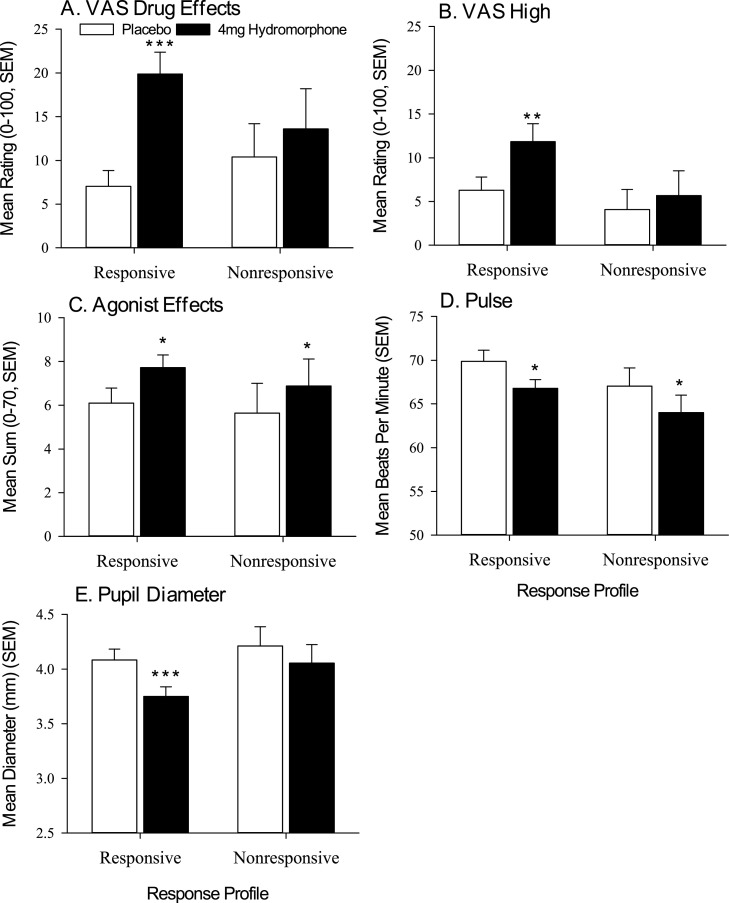
Participants were 49.6% female, mean 33.0 (SD=9.3) years old, and 44.7% Black/African American and 41.5% White, with 89.4% reporting no prior exposure to opioids. Within-subject sensitivity to opioids varied depending on the measure. One in five participants did not respond subjectively to the 4 mg hydromorphone dose based on their "Drug Effects" rating. Persons who were responsive showed more evidence of drug-dependent effects than did persons who were not responsive on ratings of Bad Effects (= .03), feeling High (= .01), Nausea (= .03), pupil diameter (< 0.01), and on the circular lights task (< 0.001).
This study provides initial evidence that the experience of opioids may be domain specific. Data suggest potentially clinically meaningful differences exist regarding opioid response patterns, evident following one dose among opioid inexperienced individuals.
个体对阿片类药物的敏感性差异可能是不同阿片类药物风险特征的基础,但这类差异通常是在目前或过去患有阿片类药物使用障碍或身体依赖的人群中进行研究的。本研究调查了在主要未使用过阿片类药物的人群中,阿片类药物敏感性在阿片类药物效应的各种评估中是如何表现的。
数据来自两项受试者内双盲试验,其中健康参与者(n = 123)接受了安慰剂和4毫克口服氢吗啡酮。收集了人口统计学、自我报告评分、观察者评分、生理指标和冷加压测量数据。参与者被分类为对所测试的阿片类药物剂量有反应或无反应,并使用混合模型、皮尔逊积差相关和配对t检验进行比较。
参与者中49.6%为女性,平均年龄33.0岁(标准差 = 9.3),44.7%为黑人/非裔美国人,41.5%为白人,89.4%报告以前未接触过阿片类药物。受试者内对阿片类药物的敏感性因测量指标而异。根据“药物效应”评分,五分之一的参与者对4毫克氢吗啡酮剂量没有主观反应。有反应的人在不良效应评分(p = 0.03)、兴奋感评分(p = 0.01)、恶心评分(p = 0.03)、瞳孔直径(p < 0.01)和圆形灯光任务评分(p < 0.001)上比无反应的人表现出更多药物依赖效应的证据。
本研究提供了初步证据,表明阿片类药物的体验可能具有领域特异性。数据表明,在未使用过阿片类药物的个体中,一剂药物后就明显存在关于阿片类药物反应模式的潜在临床意义差异。