Tawfik Mona K, Badran Dahlia I, Keshawy Mohammed M, Makary Samy, Abdo Mohamed
Department of Pharmacology, Faculty of Medicine, Suez Canal University, Ismailia, Egypt.
Department of Biochemistry, Faculty of Medicine, Suez Canal University, Ismailia, Egypt.
Arch Med Sci. 2023 Feb 1;19(5):1508-1519. doi: 10.5114/aoms/158534. eCollection 2023.
Obesity is one of the most burdensome health problems and is closely linked to leptin resistance. The study examined whether an alternate-day high-fat diet (ADF) and/or GLP-1 agonist (exenatide) modulate brain leptin resistance caused by a high-fat diet (HFD).
Sixty adult male mice were divided into 6 groups: (i) normal palatable diet (NPD), (ii) exenatide control (NPD received exenatide) (iii) HFD, (iv) ADF treated, (v) exenatide treated, (vi) ADF and exenatide treated. All animal groups were fed a HFD for 8 weeks, before they received treatment (ADF and/or exenatide) for 8 additional weeks. Body weight was assessed at the start and at the end of the experiment. Lipid profile, brain leptin and its receptor expression with the leptin-sensitive pathway, JAK2/STAT3/SOCS3/PTP1B, fasting blood glucose (FBG), serum insulin, liver metabolic handling via its regulators IRS1/PI3K/ for hyperinsulinemia/obesity-induced modification, and liver enzymes were determined at the end of the experiment.
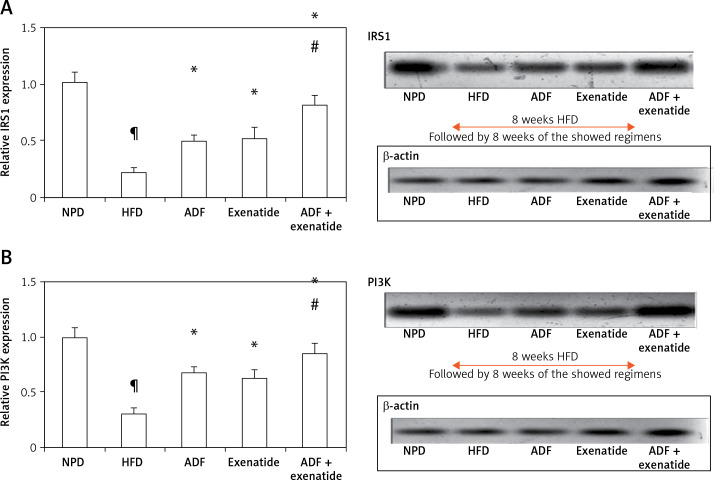
ADF and exenatide reduced body weight and FBG in HFD-obese mice ( < 0.05). The combined ADF and exenatide regimen enhanced the brain anorexic leptin/JAK2/STAT3 and attenuated the SOCS3/PTP1B pathway ( < 0.05). The ADF/exenatide anorexigenic brain effect also modulated liver glucose via IRS1/PI3K/GLUT4 expression ( < 0.05), attenuating and expression ( < 0.05). Liver enzymes and the histopathological profile confirmed the improvement.
In HFD caloric consumption, a combination of ADF and GLP-1 agonist enhances the brain leptin anorexigenic effect with the improvement of the metabolic sequelae of hyperinsulinemia, hyperlipidemia and liver steatosis.
肥胖是最具负担的健康问题之一,且与瘦素抵抗密切相关。本研究探讨隔日高脂饮食(ADF)和/或胰高血糖素样肽-1激动剂(艾塞那肽)是否能调节高脂饮食(HFD)引起的脑瘦素抵抗。
将60只成年雄性小鼠分为6组:(i)正常可口饮食(NPD)组,(ii)艾塞那肽对照组(NPD组接受艾塞那肽),(iii)高脂饮食组,(iv)ADF处理组,(v)艾塞那肽处理组,(vi)ADF和艾塞那肽联合处理组。所有动物组均先给予高脂饮食8周,然后再接受8周的处理(ADF和/或艾塞那肽)。在实验开始和结束时评估体重。在实验结束时测定血脂谱、脑瘦素及其受体表达以及瘦素敏感通路JAK2/STAT3/SOCS3/PTP1B、空腹血糖(FBG)、血清胰岛素、肝脏通过其调节因子IRS1/PI3K/对高胰岛素血症/肥胖诱导修饰的代谢处理情况以及肝酶。
ADF和艾塞那肽可降低高脂饮食诱导肥胖小鼠的体重和FBG(<0.05)。ADF和艾塞那肽联合方案增强了脑内厌食性瘦素/JAK2/STAT3信号通路,并减弱了SOCS3/PTP1B信号通路(<0.05)。ADF/艾塞那肽的厌食性脑效应还通过IRS1/PI3K/GLUT4表达调节肝脏葡萄糖代谢(<0.05),减弱了 和 的表达(<0.05)。肝酶和组织病理学特征证实了这种改善。
在高脂饮食热量摄入情况下,ADF和胰高血糖素样肽-1激动剂联合使用可增强脑内瘦素的厌食性效应,同时改善高胰岛素血症、高脂血症和肝脂肪变性的代谢后遗症。