Alonso Alvaro, Morris Alanna A, Naimi Ashley I, Alam Aniqa B, Li Linzi, Subramanya Vinita, Chen Lin Yee, Lutsey Pamela L
Department of Epidemiology, Rollins School of Public Health, Emory University, Atlanta, GA.
Department of Medicine, School of Medicine, Emory University, Atlanta, GA.
medRxiv. 2023 Sep 10:2023.09.08.23295280. doi: 10.1101/2023.09.08.23295280.
To evaluate utilization of sodium-glucose cotransporter-2 inhibitors (SGLT2i) and angiotensin receptor neprilysin inhibitors (ARNi) in patients with atrial fibrillation (AF) and heart failure (HF).
We analyzed the MarketScan databases for the period 1/1/2021 to 6/30/2022. Validated algorithms were used to identify patients with AF and HF, and to classify patients into HF with reduced ejection fraction (HFrEF) or preserved ejection fraction (HFpEF). We assessed the prevalence of SGLT2i and ARNi use overall and by HF type. Additionally, we explored correlates of lower utilization, including demographics and comorbidities.
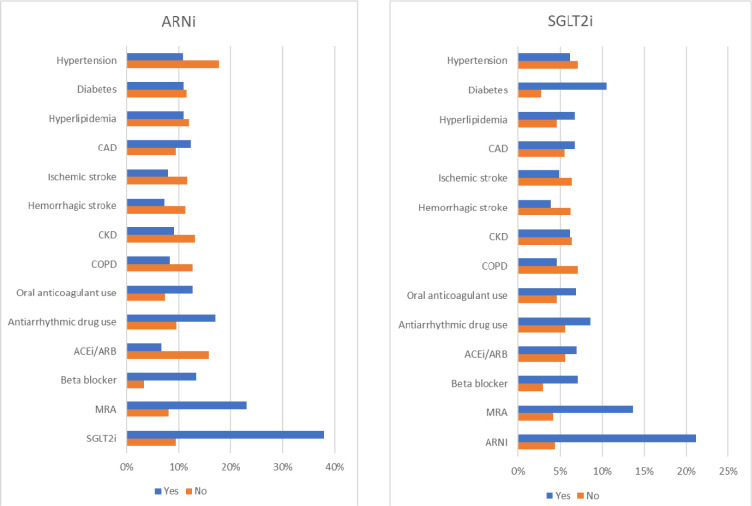
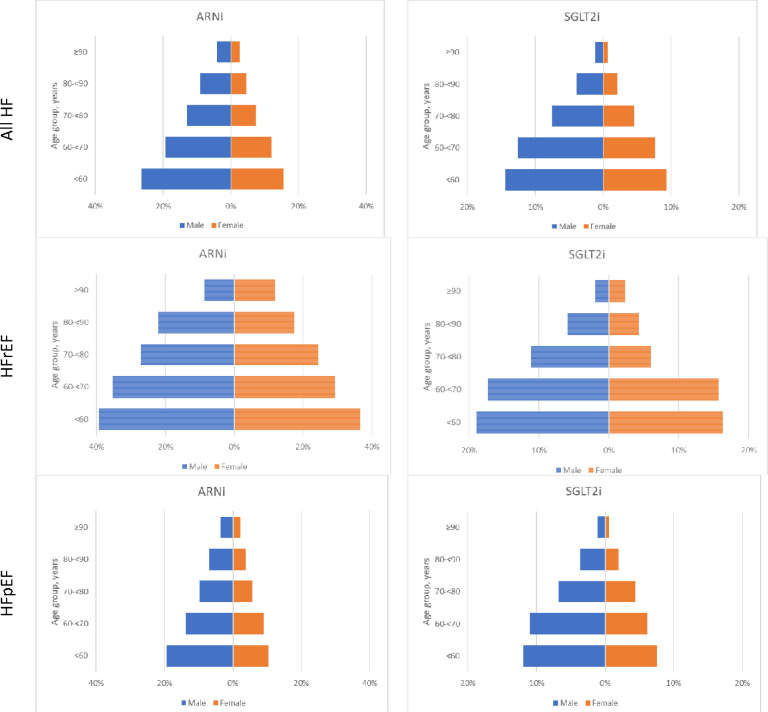
The study population included 60,927 patients (mean age 75, 43% female) diagnosed with AF and HF (85% with HFpEF, 15% with HFrEF). Prevalence of ARNi use was 11% overall (30% in HFrEF, 8% in HFpEF), while the corresponding figure was 6% for SGLT2i (13% in HFrEF, 5% in HFpEF). Use of both medications increased over the study period: ARNi from 9% to 12% (from 22% to 29% in HFrEF, from 6% to 8% in HFpEF), and SGLT2i from 3% to 9% (from 6% to 16% in HFrEF, from 2% to 7% in HFpEF). Female sex, older age, and specific comorbidities were associated with lower utilization of these two medication types overall and by HF type.
Use of ARNi and SGLT2i in patients with AF and HF is suboptimal, particularly among females and older individuals, though utilization is increasing. These results underscore the need for understanding reasons for these disparities and developing interventions to improve adoption of evidence-based therapies among patients with comorbid AF and HF.
评估钠-葡萄糖协同转运蛋白2抑制剂(SGLT2i)和血管紧张素受体脑啡肽酶抑制剂(ARNi)在心房颤动(AF)合并心力衰竭(HF)患者中的使用情况。
我们分析了2021年1月1日至2022年6月30日期间的MarketScan数据库。使用经过验证的算法来识别AF合并HF的患者,并将患者分为射血分数降低的心力衰竭(HFrEF)或射血分数保留的心力衰竭(HFpEF)。我们评估了SGLT2i和ARNi的总体使用情况以及按HF类型的使用情况。此外,我们探讨了使用较少的相关因素,包括人口统计学和合并症。
研究人群包括60927例诊断为AF合并HF的患者(平均年龄75岁,43%为女性)(85%为HFpEF,15%为HFrEF)。ARNi的总体使用率为11%(HFrEF中为30%,HFpEF中为8%),而SGLT2i的相应数字为6%(HFrEF中为13%,HFpEF中为5%)。在研究期间,两种药物的使用均有所增加:ARNi从9%增加到12%(HFrEF中从22%增加到29%,HFpEF中从6%增加到8%),SGLT2i从3%增加到9%(HFrEF中从6%增加到16%,HFpEF中从2%增加到7%)。总体而言,以及按HF类型来看,女性、老年和特定合并症与这两种药物类型的较低使用率相关。
AF合并HF患者中ARNi和SGLT2i的使用情况不理想,尤其是在女性和老年人中,尽管使用率在上升。这些结果强调了需要了解这些差异的原因,并制定干预措施,以提高AF合并HF患者对循证治疗的采用率。