Division of Gastroenterology and Liver Diseases, University of Southern California Keck School of Medicine, Los Angeles, California, USA.
Institute for Addiction Science, University of Southern California, Los Angeles, California, USA.
Hepatology. 2024 Mar 1;79(3):666-673. doi: 10.1097/HEP.0000000000000604. Epub 2023 Sep 20.
The multisociety consensus nomenclature has renamed NAFLD to steatotic liver disease (SLD) with various subclassifications. There is a paucity of data regarding how the new nomenclature modifies our understanding of disease prevalence and patient phenotypes.
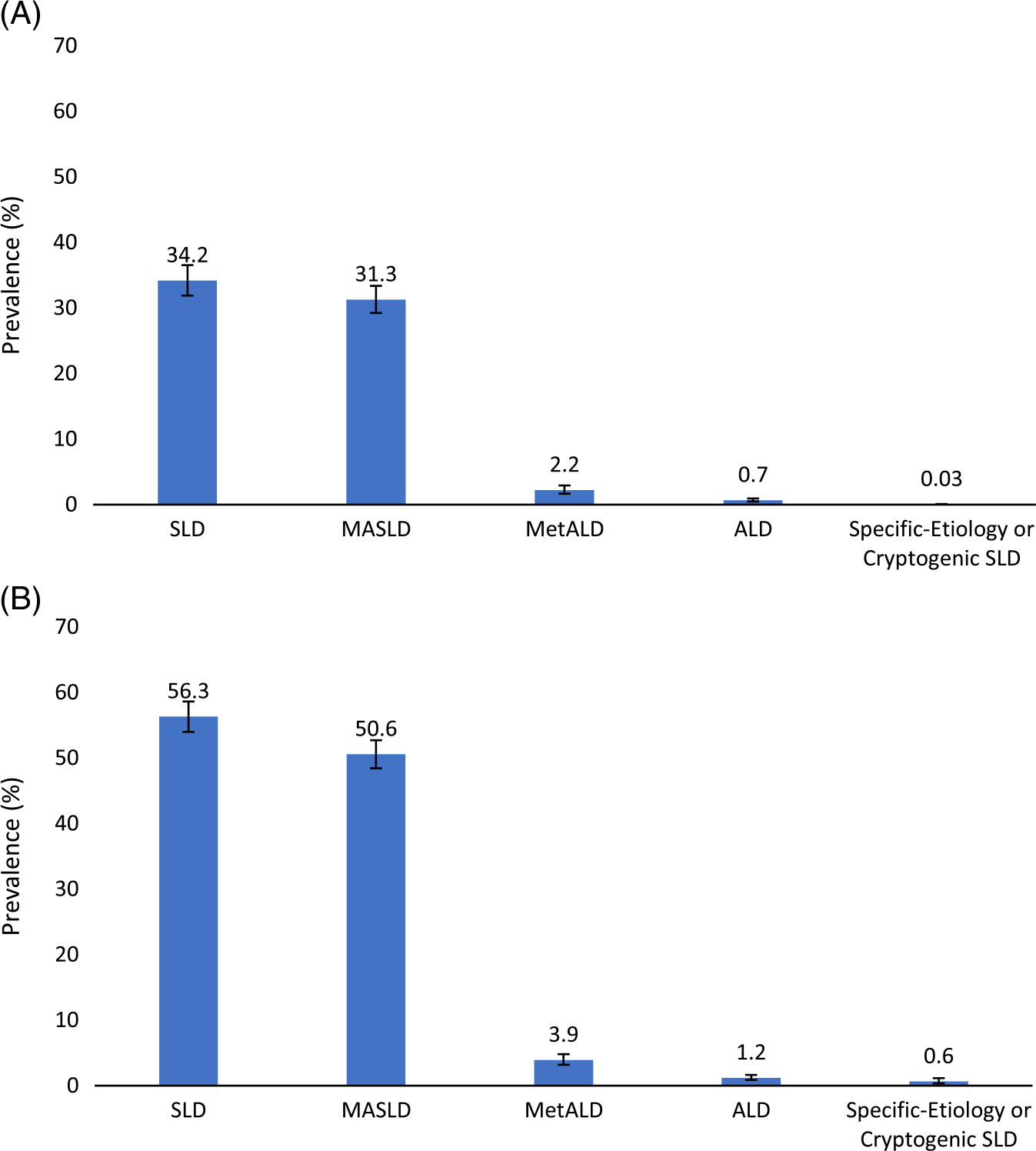
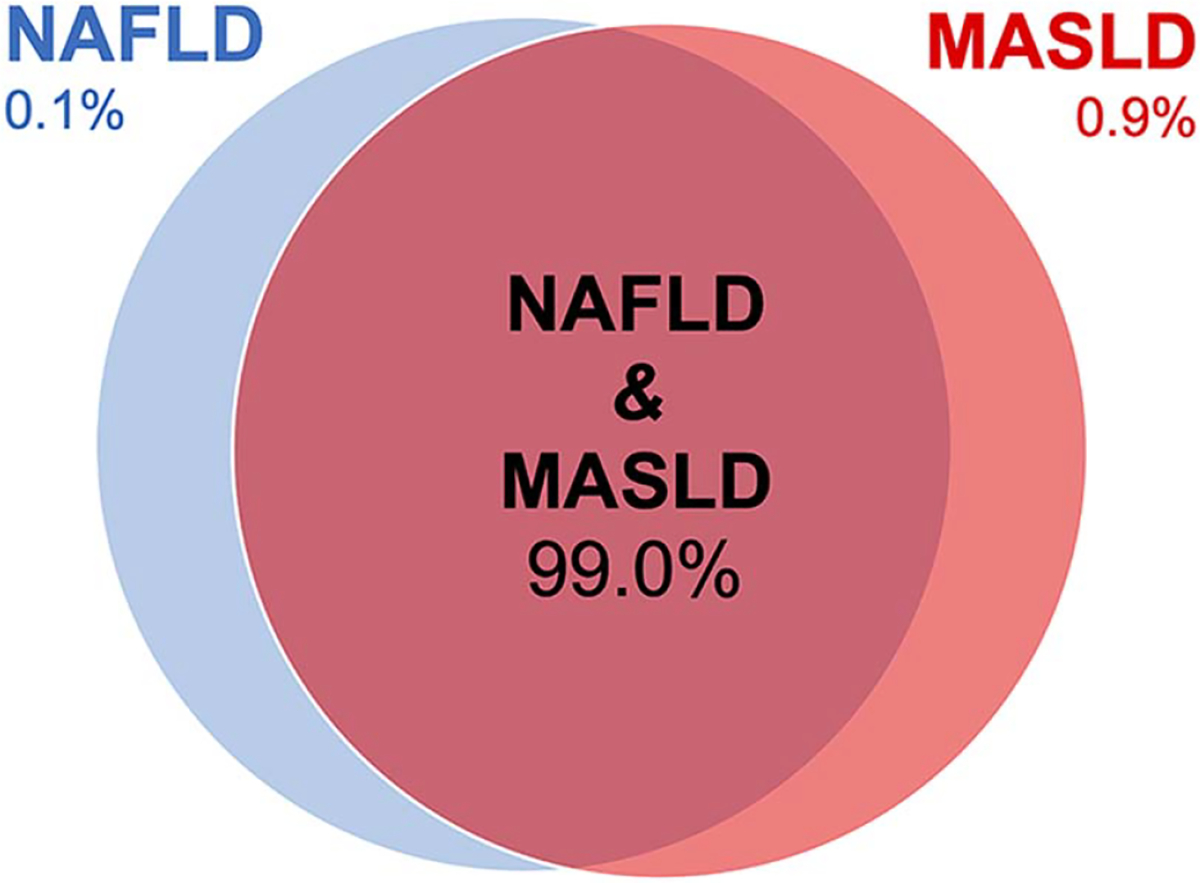
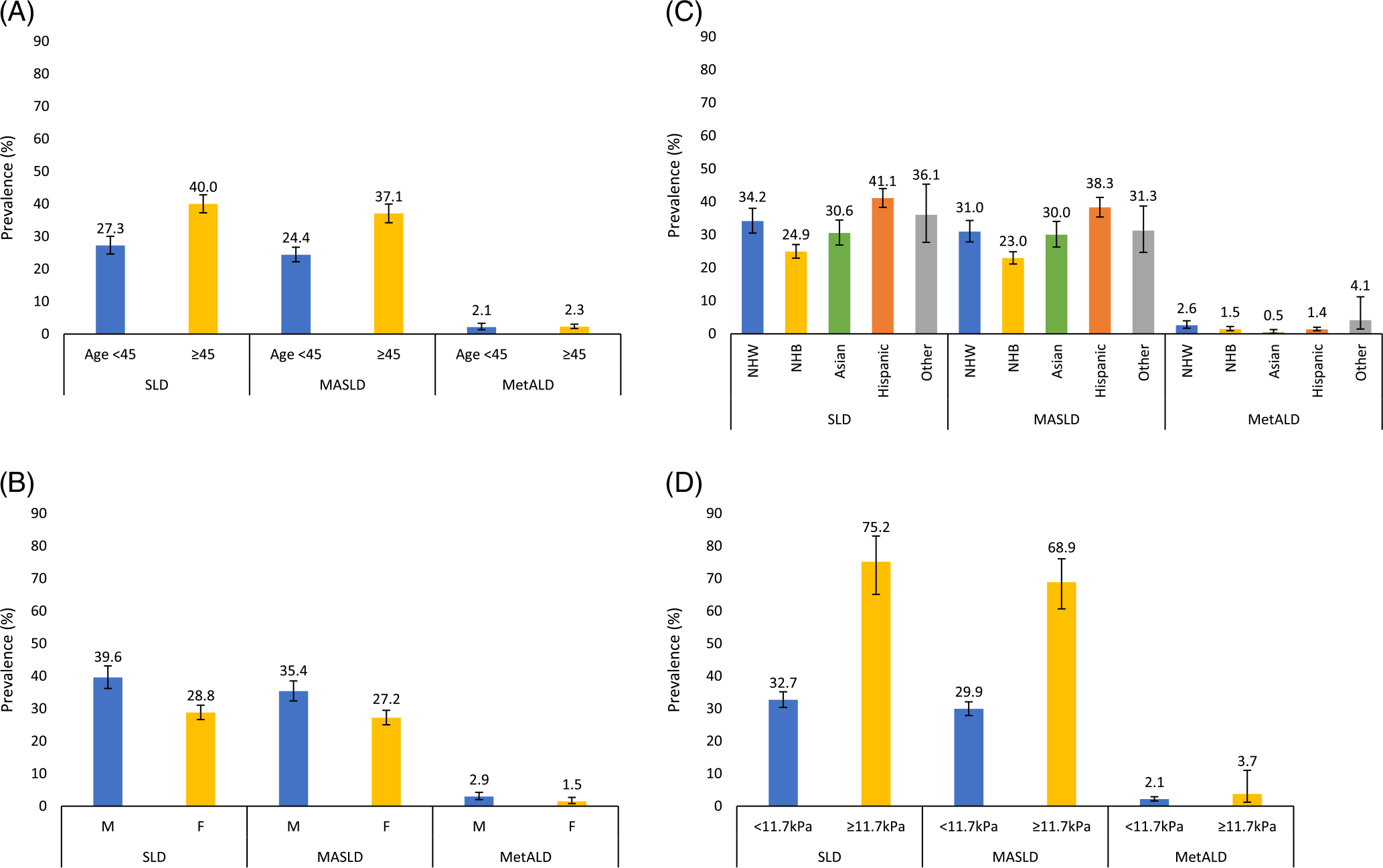
Using the National Health and Nutrition Examination Survey from January 2017 to March 2020, we included all participants aged 18 years or above with complete vibration-controlled transient elastography measures. SLD and its subclassifications [metabolic dysfunction-associated SLD (MASLD), MASLD + increased alcohol intake (MetALD), alcohol-associated liver disease (ALD), etiology-specific/cryptogenic] were defined according to consensus nomenclature. National SLD prevalence and subclassifications were estimated, and among key subgroups [age, sex, race/ethnicity, advanced liver fibrosis (liver stiffness measurement [LSM] ≥11.7 kPa)]. Among 7367 participants, 2549 had SLD (mean age 51 y, 57.7% male, 63.2% non-Hispanic White). The estimated prevalence of SLD was 34.2% (95% CI 31.9%-36.5%): MASLD 31.3% (29.2%-33.4%), MetALD 2% (1.6%-2.9%), ALD 0.7% (0.5-0.9%), etiology-specific/cryptogenic 0.03% (0.01%-0.08%). In exploratory analyses, participants classified as non-SLD with (vs. without) advanced fibrosis had a higher mean number of metabolic risk factors [2.7 (2.3-3.1) vs. 2.0 (1.9-2.0)] and a higher proportion with average alcohol use ≥20 g/d (women)/≥30 g/d (men) [20.9% (6.2%-51.3%) vs. 7.2% (6.1%-8.4%)]. In another exploratory analysis, increasing quantities of alcohol use remaining below the threshold for MASLD + increased alcohol intake were associated with advanced liver fibrosis in men, but not women. There was 99% overlap in cases of NAFLD and MASLD.
Our findings highlight the utility of the new consensus nomenclature to address deficiencies present with the old nomenclature, and identify areas that require research to further refine classifications of SLD.
多学会共识命名法将非酒精性脂肪性肝病(NAFLD)重新命名为脂肪性肝病(SLD),并进行了各种亚分类。关于新命名法如何改变我们对疾病流行和患者表型的理解,数据仍然很少。
我们使用了 2017 年 1 月至 2020 年 3 月的全国健康和营养检查调查(NHANES),纳入了所有年龄在 18 岁及以上且具有完整振动控制瞬态弹性成像测量的参与者。根据共识命名法,将 SLD 及其亚分类[代谢功能障碍相关 SLD(MASLD)、MASLD+增加酒精摄入(MetALD)、酒精相关性肝病(ALD)、病因特异性/隐匿性]定义为 SLD。估计了全国性 SLD 的患病率和亚分类,并在关键亚组[年龄、性别、种族/民族、晚期肝纤维化(肝硬度测量[LSM]≥11.7kPa)]中进行了评估。在 7367 名参与者中,有 2549 人患有 SLD(平均年龄 51 岁,男性占 57.7%,非西班牙裔白人占 63.2%)。SLD 的估计患病率为 34.2%(95%CI 31.9%-36.5%):MASLD 为 31.3%(29.2%-33.4%),MetALD 为 2%(1.6%-2.9%),ALD 为 0.7%(0.5%-0.9%),病因特异性/隐匿性为 0.03%(0.01%-0.08%)。在探索性分析中,被归类为非 SLD 但有晚期纤维化的参与者的平均代谢风险因素数量较高[2.7(2.3-3.1)比 2.0(1.9-2.0)],且平均酒精摄入量≥20g/d(女性)/≥30g/d(男性)的比例较高[20.9%(6.2%-51.3%)比 7.2%(6.1%-8.4%)]。在另一项探索性分析中,男性中,饮酒量逐渐增加但仍低于 MASLD+增加酒精摄入的阈值与晚期肝纤维化有关,但女性中则没有。NAFLD 和 MASLD 的病例有 99%的重叠。
我们的研究结果突出了新共识命名法的实用性,它解决了旧命名法存在的缺陷,并确定了需要进一步研究以进一步完善 SLD 分类的领域。