Department of Biosciences and Nutrition, Karolinska Institutet, 141 52 Huddinge, Sweden.
Acc Chem Res. 2023 Oct 3;56(19):2653-2663. doi: 10.1021/acs.accounts.3c00370. Epub 2023 Sep 21.
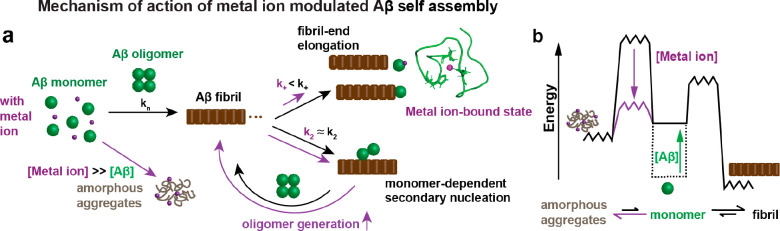
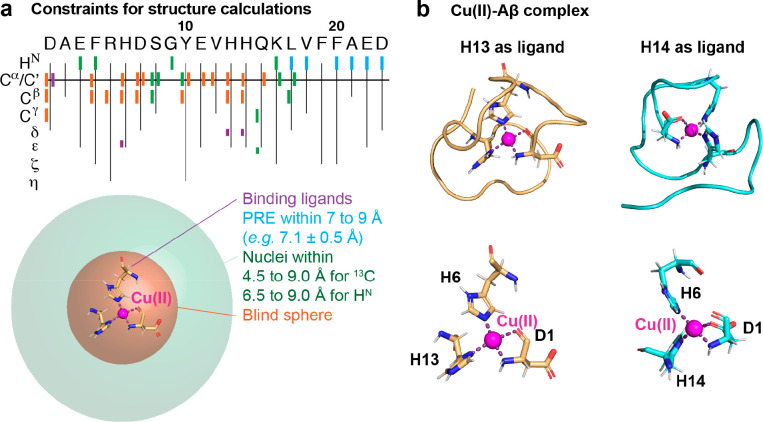
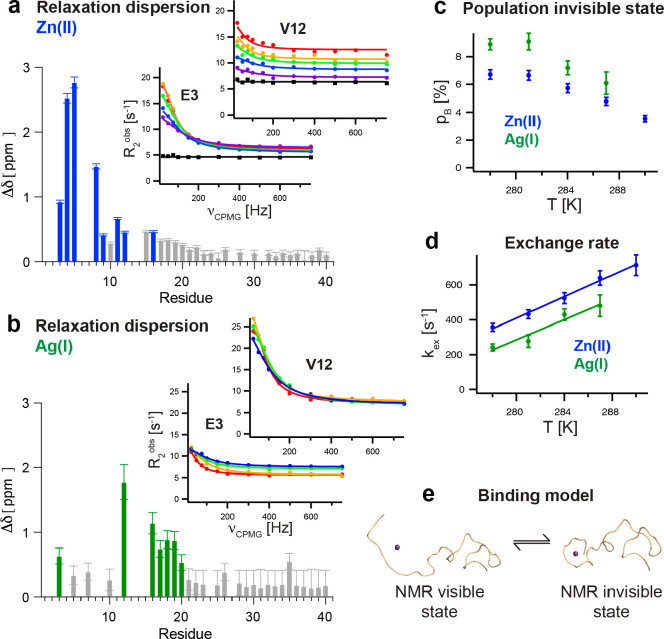
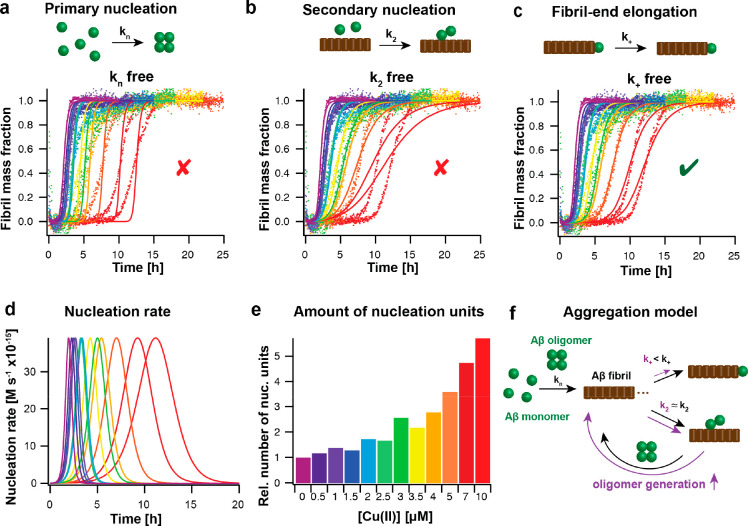
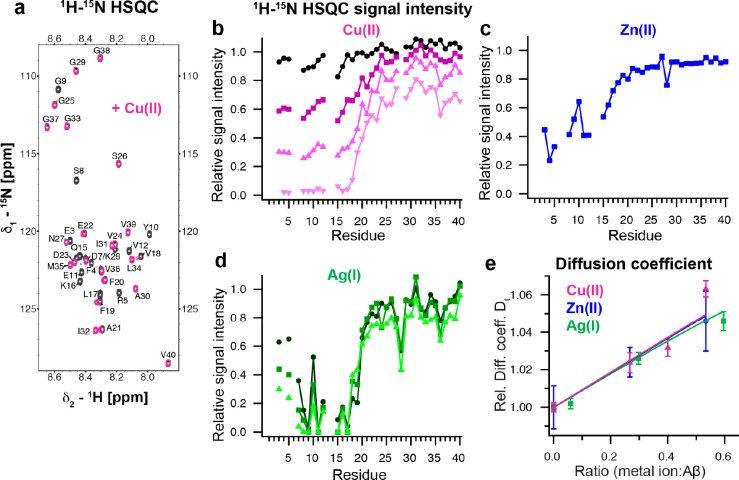
Metal ions have been identified as key factors modulating the aggregation of amyloid-β peptide (Aβ) implicated in Alzheimer's disease (AD). The presence of elevated levels of metal ions in the amyloid plaques in AD patients supports the notion that the dysfunction of metal homeostasis is connected to the development of AD pathology. Here, recent findings from high- and low-resolution biophysical techniques are put into perspective, providing detailed insights into the molecular structures and dynamics of metal-bound Aβ complexes and the effect of metal ions on the Aβ aggregation process. In particular, the development of theoretical kinetic models deducing different microscopic nucleation events from the macroscopic aggregation behavior has enabled deciphering of the effect of metal ions on specific nucleation processes. In addition to these macroscopic measurements of bulk aggregation to quantify microscopic rates, recent NMR studies have revealed details about the structures and dynamics of metal-Aβ complexes, thereby linking structural events to bulk aggregation. Interestingly, transition-metal ions, such as copper, zinc, and silver ions, form a compact complex with the N-terminal part of monomeric Aβ, respectively, where the metal-bound "folded" state is in dynamic equilibrium with an "unfolded" state. The rates and thermodynamic features of these exchange dynamics have been determined by using NMR relaxation dispersion experiments. Additionally, the application of specifically tailored paramagnetic NMR experiments on the Cu(II)-Aβ complex has been fruitful in obtaining structural constraints within the blind sphere of conventional NMR experiments. This enables the determination of molecular structures of the "folded" Cu(II)-coordinated N-terminal region of Aβ. Furthermore, the discussed transition-metal ions modulate Aβ self-assembly in a concentration-dependent manner, where low metal ion concentrations inhibit Aβ fibril formation, while at high metal ion concentrations other processes occur, resulting in amorphous aggregate formation. Remarkably, the metal-Aβ interaction predominately reduces one specific nucleation step, the fibril-end elongation, whereas primary and surface-catalyzed secondary nucleation mechanisms are less affected. Specific inhibition of fibril-end elongation theoretically predicts an enhanced generation of Aβ oligomers, which is an interesting contribution to understanding metal-Aβ-associated neurotoxic effects. Taken together, the metal binding process creates a metal-bound Aβ complex, which is seemingly inert to aggregation. This process hence efficiently reduces the aggregation-prone peptide pool, which on the macroscopic level is reflected as slower aggregation kinetics. Thus, the specific binding of metals to the Aβ monomer can be linked to the macroscopic inhibitory effect on Aβ bulk aggregation, providing a molecular understanding of the Aβ aggregation mechanism in the presence of metal ions, where the metal ion can be seen as a minimalist agent against Aβ self-assembly. These insights can help to target Aβ aggregation , where metal ions are key factors modulating the Aβ self-assembly and Aβ-associated neurotoxicity.
金属离子已被确定为调节淀粉样β肽(Aβ)聚集的关键因素,淀粉样β肽与阿尔茨海默病(AD)有关。AD 患者的淀粉样斑块中存在高水平的金属离子,这支持了金属内稳态功能障碍与 AD 病理发展有关的观点。在这里,高分辨率和低分辨率生物物理技术的最新发现被置于透视视角下,提供了对金属结合 Aβ 复合物的分子结构和动力学以及金属离子对 Aβ 聚集过程的影响的详细了解。特别是,理论动力学模型的发展从宏观聚合行为推断出不同的微观成核事件,从而能够解释金属离子对特定成核过程的影响。除了这些对大量聚集进行宏观测量以量化微观速率外,最近的 NMR 研究还揭示了金属-Aβ 复合物的结构和动力学的详细信息,从而将结构事件与大量聚集联系起来。有趣的是,过渡金属离子,如铜、锌和银离子,分别与单体 Aβ 的 N 端部分形成紧密的复合物,其中金属结合的“折叠”状态与“未折叠”状态处于动态平衡。通过使用 NMR 弛豫分散实验,已经确定了这些交换动力学的速率和热力学特征。此外,在 Cu(II)-Aβ 复合物上应用专门设计的顺磁 NMR 实验在获得常规 NMR 实验盲区内的结构约束方面取得了丰硕成果。这使得能够确定“折叠”Cu(II)配位的 Aβ N 端区域的分子结构。此外,讨论中的过渡金属离子以浓度依赖的方式调节 Aβ 自组装,其中低浓度的金属离子抑制 Aβ 纤维形成,而在高浓度的金属离子下,会发生其他过程,导致无定形聚集体形成。值得注意的是,金属-Aβ 相互作用主要抑制一个特定的成核步骤,即纤维末端延伸,而初级和表面催化的次级成核机制受影响较小。纤维末端延伸的特异性抑制在理论上预测了 Aβ 低聚物的生成增加,这是对理解金属-Aβ 相关神经毒性作用的一个有趣贡献。总之,金属结合过程会产生金属结合的 Aβ 复合物,该复合物似乎对聚集没有反应。因此,该过程有效地减少了易于聚集的肽库,这在宏观水平上反映为聚合动力学较慢。因此,金属与 Aβ 单体的特异性结合可以与 Aβ 大量聚集的宏观抑制作用联系起来,为存在金属离子时 Aβ 聚集机制提供了分子理解,其中金属离子可以被视为对抗 Aβ 自组装的极简主义剂。这些见解可以帮助靶向 Aβ 聚集,其中金属离子是调节 Aβ 自组装和 Aβ 相关神经毒性的关键因素。