Institute of Sport Sciences, University of Lausanne, Lausanne 1015, Switzerland.
Institute of Hypoxia Research, New Delhi 110067, India.
J Sport Health Sci. 2024 May;13(3):297-310. doi: 10.1016/j.jshs.2023.09.007. Epub 2023 Sep 19.
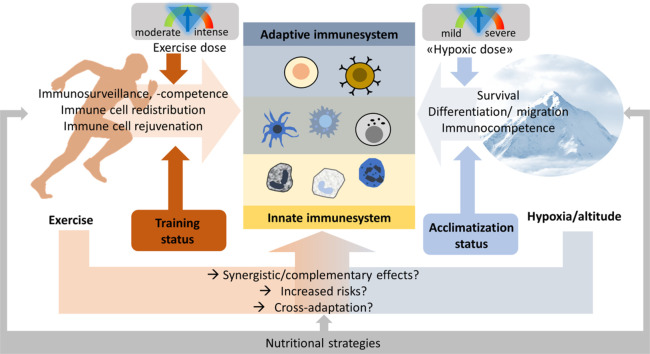
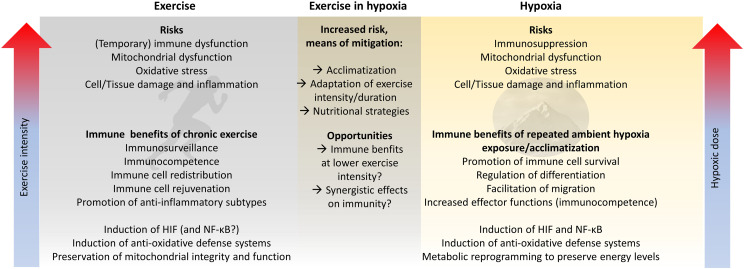
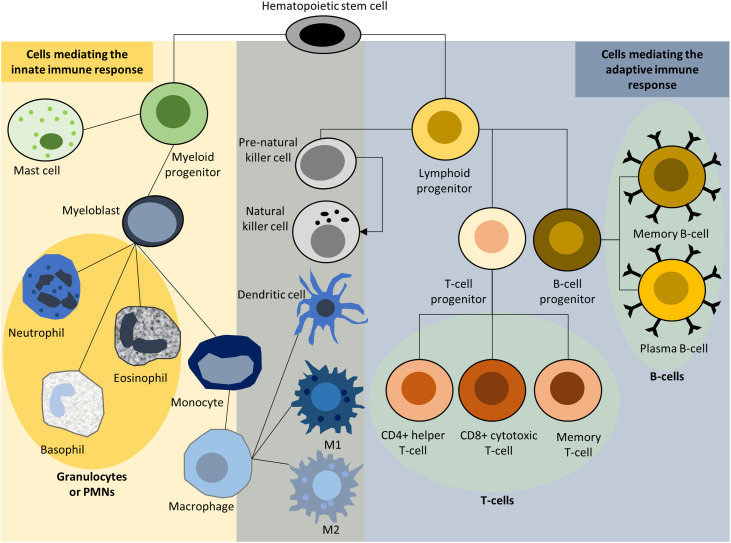
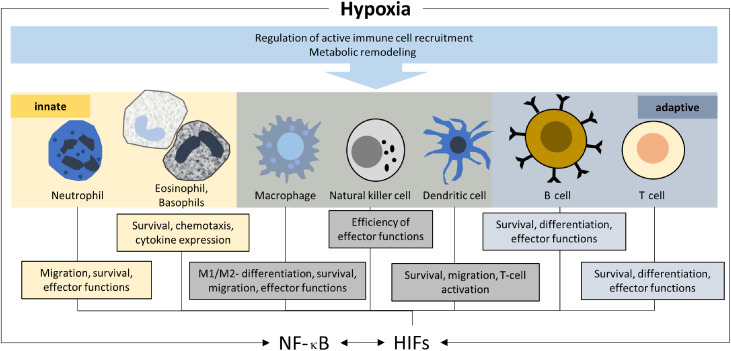
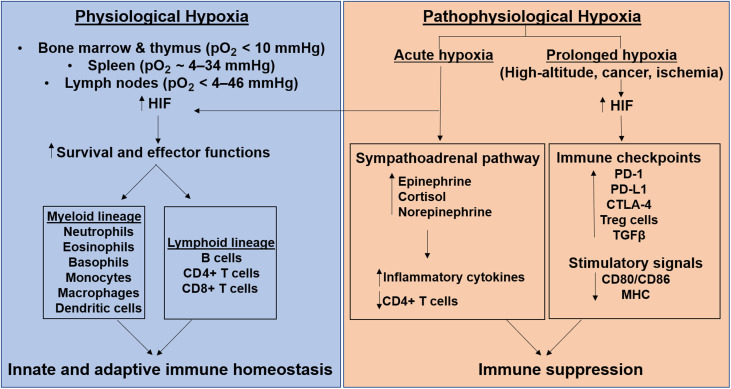
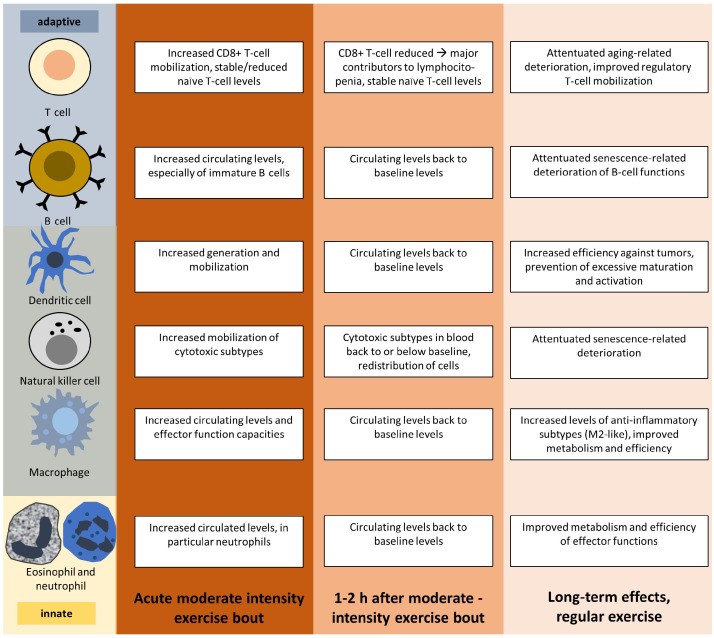
Immune outcomes are key mediators of many health benefits of exercise and are determined by exercise type, dose (frequency/duration, intensity), and individual characteristics. Similarly, reduced availability of ambient oxygen (hypoxia) modulates immune functions depending on the hypoxic dose and the individual capacity to respond to hypoxia. How combined exercise and hypoxia (e.g., high-altitude training) sculpts immune responses is not well understood, although such combinations are becoming increasingly popular. Therefore, in this paper, we summarize the impact on immune responses of exercise and of hypoxia, both independently and together, with a focus on specialized cells in the innate and adaptive immune system. We review the regulation of the immune system by tissue oxygen levels and the overlapping and distinct immune responses related to exercise and hypoxia, then we discuss how they may be modulated by nutritional strategies. Mitochondrial, antioxidant, and anti-inflammatory mechanisms underlie many of the adaptations that can lead to improved cellular metabolism, resilience, and overall immune functions by regulating the survival, differentiation, activation, and migration of immune cells. This review shows that exercise and hypoxia can impair or complement/synergize with each other while regulating immune system functions. Appropriate acclimatization, training, and nutritional strategies can be used to avoid risks and tap into the synergistic potentials of the poorly studied immune consequences of exercising in a hypoxic state.
免疫结果是运动对许多健康益处的关键介导因素,其取决于运动类型、剂量(频率/持续时间、强度)和个体特征。同样,环境氧气(缺氧)的减少会根据缺氧剂量和个体对缺氧的适应能力来调节免疫功能。尽管这种组合越来越受欢迎,但联合运动和缺氧(例如,高原训练)如何塑造免疫反应还不是很清楚。因此,在本文中,我们总结了运动和缺氧对免疫反应的独立和共同影响,重点关注先天和适应性免疫系统中的特化细胞。我们回顾了免疫系统受组织氧水平调节的情况,以及与运动和缺氧相关的重叠和独特的免疫反应,然后讨论了它们如何通过营养策略进行调节。线粒体、抗氧化和抗炎机制是许多适应的基础,这些适应可以通过调节免疫细胞的存活、分化、激活和迁移来改善细胞代谢、弹性和整体免疫功能。本综述表明,运动和缺氧可以相互损害或互补/协同,同时调节免疫系统功能。适当的适应、训练和营养策略可以用来避免风险,并利用在缺氧状态下运动的免疫后果这一研究不足的领域的协同潜力。