
分支模型的谱系分化为基础的神经发生潜力的肠胶质细胞。
A branching model of lineage differentiation underpinning the neurogenic potential of enteric glia.
机构信息
Nervous System Development and Homeostasis Laboratory, the Francis Crick Institute, 1 Midland Road, London, NW1 1AT, UK.
Experimental Drug Development Centre A*STAR 10 Biopolis Road, Chromos, 138670, Singapore.
出版信息
Nat Commun. 2023 Sep 22;14(1):5904. doi: 10.1038/s41467-023-41492-3.
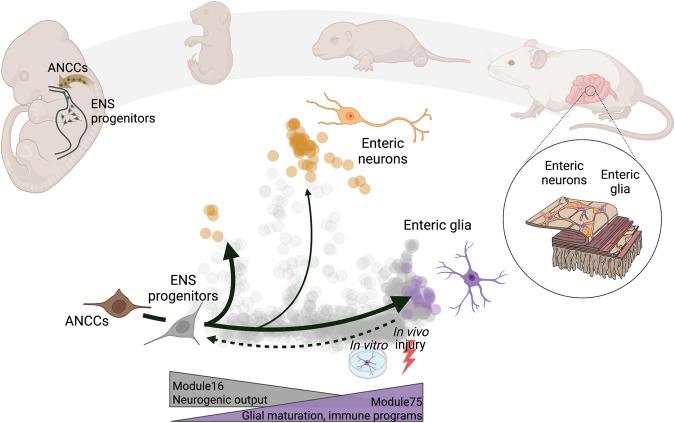
Glial cells have been proposed as a source of neural progenitors, but the mechanisms underpinning the neurogenic potential of adult glia are not known. Using single cell transcriptomic profiling, we show that enteric glial cells represent a cell state attained by autonomic neural crest cells as they transition along a linear differentiation trajectory that allows them to retain neurogenic potential while acquiring mature glial functions. Key neurogenic loci in early enteric nervous system progenitors remain in open chromatin configuration in mature enteric glia, thus facilitating neuronal differentiation under appropriate conditions. Molecular profiling and gene targeting of enteric glial cells in a cell culture model of enteric neurogenesis and a gut injury model demonstrate that neuronal differentiation of glia is driven by transcriptional programs employed in vivo by early progenitors. Our work provides mechanistic insight into the regulatory landscape underpinning the development of intestinal neural circuits and generates a platform for advancing glial cells as therapeutic agents for the treatment of neural deficits.
胶质细胞被认为是神经祖细胞的来源,但成年胶质细胞的神经发生潜力的机制尚不清楚。通过单细胞转录组谱分析,我们表明肠胶质细胞代表了自主神经嵴细胞在沿着允许它们保留神经发生潜力同时获得成熟胶质功能的线性分化轨迹转变时所达到的细胞状态。早期肠神经系统祖细胞中的关键神经发生基因座在成熟肠胶质细胞中仍保持开放染色质构型,从而在适当条件下促进神经元分化。在肠神经发生的细胞培养模型和肠道损伤模型中对肠胶质细胞的分子谱分析和基因靶向表明,胶质细胞的神经元分化是由体内早期祖细胞使用的转录程序驱动的。我们的工作为肠道神经回路发育的调控景观提供了机制上的见解,并为将胶质细胞作为治疗神经缺陷的治疗剂提供了一个平台。


 Zotero 插件