Dario Health, Caesarea, Israel.
Joslin Diabetes Center, Harvard Medical School, Boston, MA, United States.
J Med Internet Res. 2023 Sep 22;25:e47350. doi: 10.2196/47350.
Depression and anxiety are the main sources of work and social disabilities as well as health-related problems around the world. Digital therapeutic solutions using cognitive behavioral therapy have demonstrated efficacy in depression and anxiety. A common goal of digital health apps is to increase user digital engagement to improve outcomes. However, there is a limited understanding of the association between digital platform components and clinical outcomes.
The aim of the study is to investigate the contribution of specific digital engagement tools to mental health conditions. We hypothesized that participation in coaching sessions and breathing exercises would be associated with a reduction in depression and anxiety.
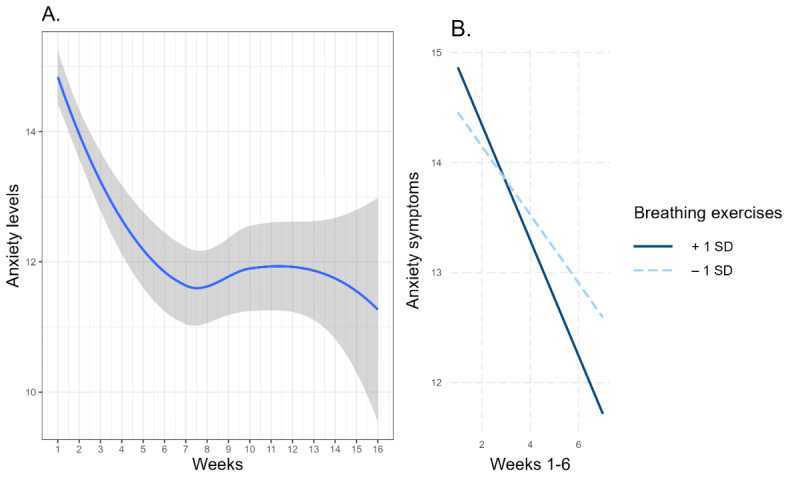
Depression and general anxiety symptoms were evaluated in real-world data cohorts using the digital health platform for digital intervention and monitoring change. This retrospective real-world analysis of users on a mobile platform-based treatment followed two cohorts of people: (1) users who started with moderate levels of depression and completed at least 2 depression assessments (n=519) and (2) users who started with moderate levels of anxiety and completed at least 2 anxiety assessments (n=474). Levels of depression (Patient Health Questionnaire-9) and anxiety (Generalized Anxiety Disorder-7) were tracked throughout the first 16 weeks. A piecewise mixed-effects model was applied to model the trajectories of the Patient Health Questionnaire-9 and the Generalized Anxiety Disorder-7 mean scores in 2 segments (1-6 weeks and 7-16 weeks). Finally, simple slope analysis was used for the interpretation of the interactions probing the moderators: coaching sessions and breathing exercises in both depression and anxiety cohorts.
Analysis revealed a significant decrease in depression symptoms (β=-.37, 95% CI -0.46 to 0.28; P≤.001) during the period of weeks 1-6 of app use, which was maintained during the period of 7-16 weeks. Coach interaction significantly moderated the reduction in depression symptoms during the period of weeks 1-6 (β=-.03, 95% CI -0.05 to -0.001; P=.02). A significant decrease in anxiety symptoms (β=-.41, 95% CI -0.50 to -0.33; P≤.001) was revealed during the period of 1-6 weeks, which was maintained during the period of 7-16 weeks. Breathing exercises significantly moderated the reduction in anxiety symptoms during the period of 1-6 weeks (β=-.07, 95% CI -0.14 to -0.01; P=.04).
This study demonstrated general improvement followed by a period of stability of depression and anxiety symptoms associated with cognitive behavioral therapy-based digital intervention. Interestingly, engagement with a coaching session but not a breathing exercise was associated with a reduction in depression symptoms. Moreover, breathing exercise but not engagement with a coaching session was associated with a reduction of anxiety symptoms. These findings emphasize the importance of using a personalized approach to behavioral health during digital health interventions.

抑郁和焦虑是全世界工作和社交障碍以及与健康相关问题的主要来源。使用认知行为疗法的数字治疗解决方案已证明对抑郁和焦虑有效。数字健康应用程序的共同目标是提高用户的数字参与度以改善结果。然而,对于数字平台组件与临床结果之间的关联,人们的理解有限。
本研究旨在调查特定数字参与工具对心理健康状况的贡献。我们假设,参加辅导课程和呼吸练习将与抑郁和焦虑的减轻有关。
使用数字健康平台进行数字干预和监测变化,在真实世界数据队列中评估抑郁和一般焦虑症状。对基于移动平台的治疗的用户进行了这一回顾性真实世界分析,研究了两个队列:(1)开始时有中度抑郁并完成至少 2 次抑郁评估的用户(n=519);(2)开始时有中度焦虑并完成至少 2 次焦虑评估的用户(n=474)。在最初的 16 周内,跟踪了抑郁(患者健康问卷-9)和焦虑(广泛性焦虑障碍-7)的水平。应用分段混合效应模型对 2 个时间段(1-6 周和 7-16 周)的患者健康问卷-9和广泛性焦虑障碍-7平均分数的轨迹进行建模。最后,对教练课程和呼吸练习在抑郁和焦虑队列中的交互作用进行简单斜率分析,以解释交互作用。
分析显示,在使用应用程序的第 1-6 周期间,抑郁症状显著下降(β=-.37,95%置信区间(CI):-0.46 至 0.28;P≤.001),在第 7-16 周期间保持不变。教练互动显著调节了第 1-6 周期间抑郁症状的减轻(β=-.03,95%CI:-0.05 至-0.001;P=.02)。在第 1-6 周期间,焦虑症状显著下降(β=-.41,95%CI:-0.50 至-0.33;P≤.001),在第 7-16 周期间保持不变。呼吸练习显著调节了第 1-6 周期间焦虑症状的减轻(β=-.07,95%CI:-0.14 至-0.01;P=.04)。
本研究表明,与基于认知行为疗法的数字干预相关的抑郁和焦虑症状通常会有所改善,然后是稳定期。有趣的是,与辅导课程的参与而不是呼吸练习的参与与抑郁症状的减轻有关。此外,呼吸练习而不是与辅导课程的参与与焦虑症状的减轻有关。这些发现强调了在数字健康干预期间使用个性化方法进行行为健康的重要性。