Wu Monica S, Chen Shih-Yin, Wickham Robert E, O'Neil-Hart Shane, Chen Connie, Lungu Anita
Lyra Health, Burlingame, CA, United States.
Department of Psychological Sciences, Northern Arizona University, Flagstaff, AZ, United States.
JMIR Ment Health. 2021 Oct 21;8(10):e32100. doi: 10.2196/32100.
Depression and anxiety are leading causes of disability worldwide, but access to quality mental health care is limited by myriad factors. Cognitive-behavioral coaching is rooted in evidence-based principles and has the potential to address some of these unmet care needs. Harnessing technology to facilitate broader dissemination within a blended care model shows additional promise for overcoming barriers to care.
The aim of this study is to evaluate the outcomes of a blended care coaching (BCC) program for clients presenting with moderate levels of anxiety and depression in real-world settings.
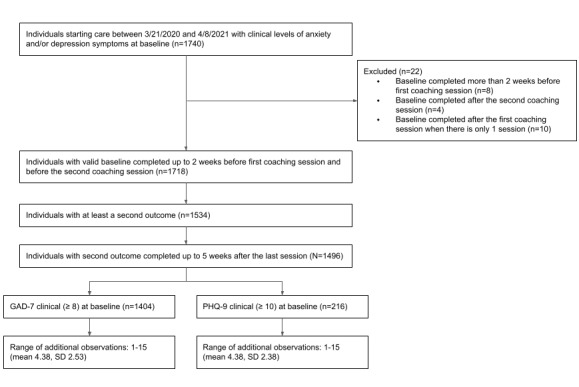
This study examined retrospective data from US-based individuals (N=1496) who presented with moderate levels of depression and anxiety symptoms and who received blended care coaching services. Using a short-term framework, clients met with coaches via a secure video conference platform and also received digital video lessons and exercises. To evaluate the effectiveness of the BCC program, mixed effects modeling was used to examine growth trajectories of anxiety and depression scores over the course of care.
Out of the total sample of 1496 clients, 75.9% (n=1136) demonstrated reliable improvement, and 88.6% (n=1326) recovered based on either the Generalized Anxiety Disorder-7 scale (anxiety) or Patient Health Questionnaire-9 (depression). On average, clients exhibited a significant decline in anxiety and depression symptoms during the initial weeks of coaching, with a continued decline over subsequent weeks at a lower rate. Engaging in a coaching session was associated with lower anxiety (b=-1.04) and depression (b=-0.79) symptoms in the same week, as well as lower anxiety (b=-0.74) and depression (b=-0.91) symptoms the following week (P<.001).
The BCC program demonstrated strong outcomes in decreasing symptomology for clients presenting with moderate levels of anxiety and depression. When clients received coaching sessions, significant decreases in symptoms were observed, reflecting the importance of session attendance. Additionally, the steepest declines in symptoms tended to occur during the initial weeks of coaching, emphasizing the importance of client buy-in and early engagement. Collectively, these findings have implications for addressing unmet mental health care needs in a more accessible, cost-effective manner.
抑郁症和焦虑症是全球致残的主要原因,但获得高质量心理健康护理受到诸多因素的限制。认知行为辅导植根于循证原则,有潜力满足一些未得到满足的护理需求。利用技术在混合护理模式中促进更广泛传播,对于克服护理障碍显示出更大的前景。
本研究的目的是评估在现实环境中为中度焦虑和抑郁患者提供的混合护理辅导(BCC)项目的效果。
本研究检查了来自美国的1496名个体的回顾性数据,这些个体有中度抑郁和焦虑症状并接受了混合护理辅导服务。采用短期框架,客户通过安全的视频会议平台与辅导师会面,还接受数字视频课程和练习。为评估BCC项目的有效性,使用混合效应模型来检查护理过程中焦虑和抑郁评分的增长轨迹。
在1496名客户的总样本中,75.9%(n = 1136)表现出可靠的改善,88.6%(n = 1326)根据广泛性焦虑障碍-7量表(焦虑)或患者健康问卷-9(抑郁)康复。平均而言,客户在辅导的最初几周内焦虑和抑郁症状显著下降,在随后几周以较低速率持续下降。在同一周参加辅导课程与较低的焦虑(b = -1.04)和抑郁(b = -0.79)症状相关,在接下来的一周也与较低的焦虑(b = -0.74)和抑郁(b = -0.91)症状相关(P <.001)。
BCC项目在减轻中度焦虑和抑郁患者的症状方面显示出显著效果。当客户接受辅导课程时,观察到症状显著减轻,这反映了参加课程的重要性。此外,症状最急剧的下降往往发生在辅导的最初几周,强调了客户接受和早期参与的重要性。总体而言,这些发现对于以更易获得、更具成本效益的方式满足未得到满足的心理健康护理需求具有启示意义。