Department of Medicine, University of Wisconsin School of Medicine and Public Health, Madison, WI.
Carbone Cancer Center, University of Wisconsin School of Medicine and Public Health, Madison, WI.
Blood. 2023 Nov 30;142(22):1879-1894. doi: 10.1182/blood.2023020142.
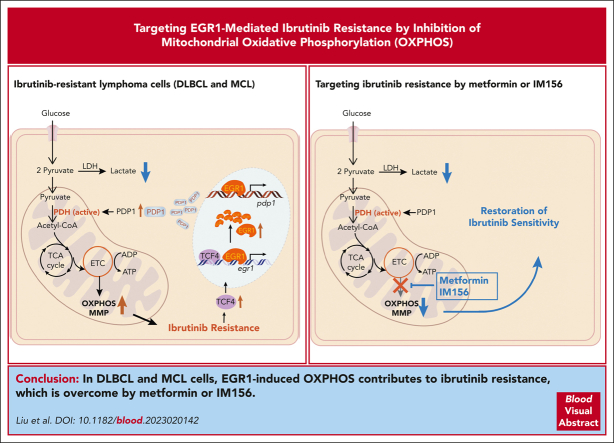
The use of Bruton tyrosine kinase inhibitors, such as ibrutinib, to block B-cell receptor signaling has achieved a remarkable clinical response in several B-cell malignancies, including mantle cell lymphoma (MCL) and diffuse large B-cell lymphoma (DLBCL). Acquired drug resistance, however, is significant and affects the long-term survival of these patients. Here, we demonstrate that the transcription factor early growth response gene 1 (EGR1) is involved in ibrutinib resistance. We found that EGR1 expression is elevated in ibrutinib-resistant activated B-cell-like subtype DLBCL and MCL cells and can be further upregulated upon ibrutinib treatment. Genetic and pharmacological analyses revealed that overexpressed EGR1 mediates ibrutinib resistance. Mechanistically, TCF4 and EGR1 self-regulation induce EGR1 overexpression that mediates metabolic reprogramming to oxidative phosphorylation (OXPHOS) through the transcriptional activation of PDP1, a phosphatase that dephosphorylates and activates the E1 component of the large pyruvate dehydrogenase complex. Therefore, EGR1-mediated PDP1 activation increases intracellular adenosine triphosphate production, leading to sufficient energy to enhance the proliferation and survival of ibrutinib-resistant lymphoma cells. Finally, we demonstrate that targeting OXPHOS with metformin or IM156, a newly developed OXPHOS inhibitor, inhibits the growth of ibrutinib-resistant lymphoma cells both in vitro and in a patient-derived xenograft mouse model. These findings suggest that targeting EGR1-mediated metabolic reprogramming to OXPHOS with metformin or IM156 provides a potential therapeutic strategy to overcome ibrutinib resistance in relapsed/refractory DLBCL or MCL.
布鲁顿酪氨酸激酶抑制剂(如伊布替尼)的使用阻断了 B 细胞受体信号通路,在几种 B 细胞恶性肿瘤中取得了显著的临床疗效,包括套细胞淋巴瘤(MCL)和弥漫性大 B 细胞淋巴瘤(DLBCL)。然而,获得性耐药是显著的,影响了这些患者的长期生存。在这里,我们证明转录因子早期生长反应基因 1(EGR1)参与了伊布替尼耐药。我们发现,伊布替尼耐药的激活 B 细胞样亚型 DLBCL 和 MCL 细胞中 EGR1 的表达上调,并且在伊布替尼处理后可以进一步上调。遗传和药理学分析表明,过表达的 EGR1 介导了伊布替尼耐药。从机制上讲,TCF4 和 EGR1 的自我调控诱导了 EGR1 的过表达,通过转录激活磷酸酶 PDP1 介导代谢重编程为氧化磷酸化(OXPHOS),PDP1 可使丙酮酸脱氢酶复合物的 E1 成分去磷酸化并激活。因此,EGR1 介导的 PDP1 激活增加了细胞内三磷酸腺苷的产生,从而为增强伊布替尼耐药淋巴瘤细胞的增殖和存活提供了足够的能量。最后,我们证明用二甲双胍或新开发的 OXPHOS 抑制剂 IM156 靶向 OXPHOS 抑制伊布替尼耐药淋巴瘤细胞的体外和患者来源的异种移植小鼠模型中的生长。这些发现表明,用二甲双胍或 IM156 靶向 EGR1 介导的代谢重编程为 OXPHOS 提供了一种克服复发/难治性 DLBCL 或 MCL 中伊布替尼耐药的潜在治疗策略。