Clinical Research Centre, Zhujiang Hospital, Southern Medical University, Guangzhou, China.
Menzies Institute for Medical Research, University of Tasmania, Hobart, Australia.
Arthritis Res Ther. 2023 Sep 23;25(1):178. doi: 10.1186/s13075-023-03167-8.
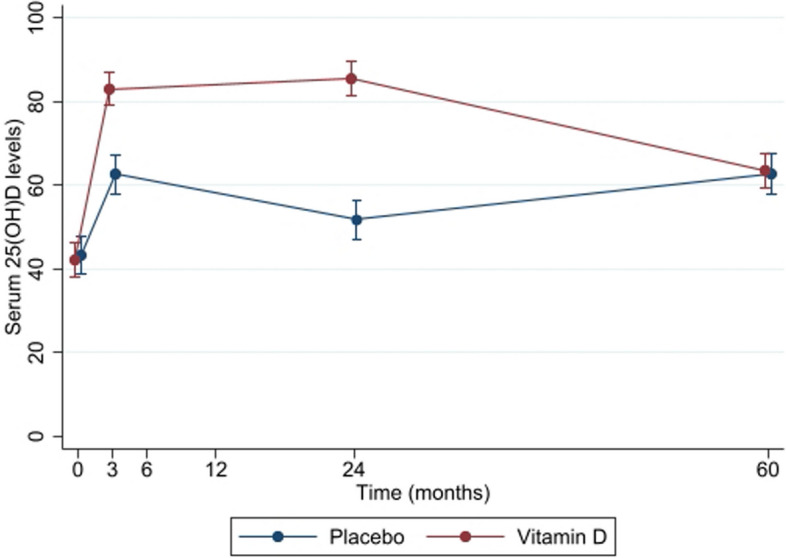
This study aimed to investigate the long-term effect of vitamin D supplementation compared to placebo over 5 years in participants with knee osteoarthritis (OA). We also aimed to describe the effect of maintaining sufficient serum vitamin D levels over five years in knee OA.
Participants (n = 173) from the Hobart centre of the Vitamin D Effects on Osteoarthritis (VIDEO) trial were extensively followed up 3 years after the cessation of 2-year investigational treatment. Participants were classified as maintaining sufficient vitamin D (n = 79) and not maintaining sufficient vitamin D (n = 61) groups.
There was no significant difference in change in the knee symptoms, depression, and serum levels of IL6 and hs-CRP between both comparisons after 3 years of cessation of the clinical trial. However, among participants who reported no knee surgery (KS), there was a significant improvement in WOMAC function (β: - 83.7, 95% CI: - 167.3, 0) and depression scores (β: - 1.3, 95% CI: - 2.3, - 0.2) in vitamin D group compared to the placebo group. Similarly, those who maintained adequate vitamin D levels over 5 years had significantly less WOMAC knee pain (β: - 33.9, 95% CI: - 65.7, - 2) and physical dysfunction (β: - 105.5, 95% CI: - 198.2, - 12.8) than participants with vitamin D deficiency over 5 years.
Vitamin D supplementation over 2 years or maintaining vitamin D sufficiency for 5 years was not associated with statistically significant differences in change in knee symptom scores over 5 years. However, among participants who did not report KS, 2-year vitamin D supplementation and maintaining sufficient vitamin D was linked to modest improvements in knee symptoms and depression scores in knee OA.
本研究旨在探讨维生素 D 补充剂与安慰剂相比在膝骨关节炎(OA)患者中长达 5 年的长期效果。我们还旨在描述在 5 年内维持足够的血清维生素 D 水平对膝骨关节炎的影响。
来自维生素 D 对骨关节炎影响(VIDEO)试验霍巴特中心的参与者(n=173)在停止为期 2 年的研究治疗后 3 年进行了广泛的随访。参与者被分为维持足够维生素 D(n=79)和未维持足够维生素 D(n=61)组。
在临床试验停止 3 年后,两组间在膝关节症状、抑郁、血清 IL6 和 hs-CRP 水平方面的变化没有显著差异。然而,在没有膝关节手术(KS)的参与者中,维生素 D 组在 WOMAC 功能(β:-83.7,95%CI:-167.3,0)和抑郁评分(β:-1.3,95%CI:-2.3,-0.2)方面有显著改善,与安慰剂组相比。同样,在 5 年内维持足够维生素 D 水平的参与者的 WOMAC 膝关节疼痛(β:-33.9,95%CI:-65.7,-2)和身体功能障碍(β:-105.5,95%CI:-198.2,-12.8)明显少于 5 年内维生素 D 缺乏的参与者。
2 年的维生素 D 补充或 5 年内维持足够的维生素 D 与 5 年内膝关节症状评分的变化无统计学显著差异。然而,在没有 KS 的参与者中,2 年的维生素 D 补充和维持足够的维生素 D 与膝关节骨关节炎膝关节症状和抑郁评分的适度改善有关。