Li Mingzhuo, Tang Fang, Lao Jiahui, Yang Yang, Cao Jia, Song Ru, Wu Peng, Wang Yibing
Department of Plastic Surgery, The First Affiliated Hospital of Shandong First Medical University & Shandong Provincial Qianfoshan Hospital, Jinan, China.
Center for Big Data Research in Health and Medicine, The First Affiliated Hospital of Shandong First Medical University & Shandong Provincial Qianfoshan Hospital, Jinan, China.
Int Wound J. 2023 Sep 24;21(2). doi: 10.1111/iwj.14376.
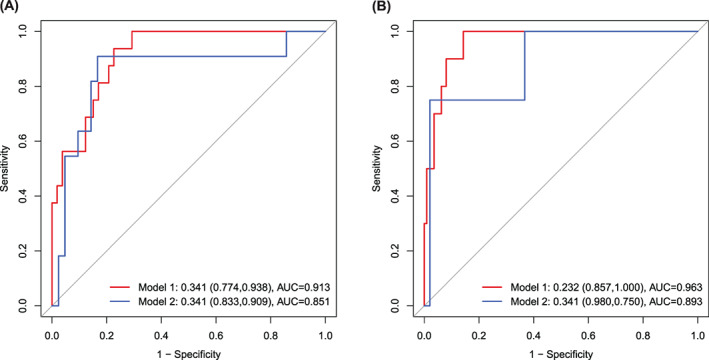
The current methods for the prediction of mortality and amputation for inpatients with diabetic foot (DF) use only conventional, simple variables, which limits their performance. Here, we used a random survival forest (RSF) model and multicomponent variables to improve the prediction of mortality and amputation for these patients. We performed a retrospective cohort study of 175 inpatients with DF who were recruited between 2014 and 2021. Thirty-one predictors in six categories were considered as potential covariates. Seventy percent (n = 122) of the participants were randomly selected to constitute a training set, and 30% (n = 53) were assigned to a testing set. The RSF model was used to screen appropriate variables for their value as predictors of 2-year all-cause mortality and amputation, and a multicomponent prediction model was established. Model performance was evaluated using the area under the curve (AUC) and the Hosmer-Lemeshow test. The AUCs were compared using the Delong test. Seventeen variables were selected to predict mortality and 23 were selected to predict amputation. Uric acid and alanine transaminase were the top two most useful variables for the prediction of mortality, whereas urine protein and platelet were the top variables for the prediction of amputation. The AUCs were 0.913 and 0.851 for the prediction of mortality for the training and testing sets, respectively; and the equivalent AUCs were 0.963 and 0.893 for the prediction of amputation. There were no significant differences between the AUCs for the training and testing sets for both the mortality and amputation models. These models showed a good degree of fit. Thus, the RSF model can predict mortality and amputation in inpatients with DF. This multicomponent prediction model could help clinicians consider predictors of different dimensions to effectively prevent DF from clinical outcomes .
目前用于预测糖尿病足(DF)住院患者死亡率和截肢率的方法仅使用传统的简单变量,这限制了它们的性能。在此,我们使用随机生存森林(RSF)模型和多组分变量来改善对这些患者死亡率和截肢率的预测。我们对2014年至2021年间招募的175例DF住院患者进行了一项回顾性队列研究。将六个类别的31个预测因子视为潜在协变量。70%(n = 122)的参与者被随机选择构成一个训练集,30%(n = 53)被分配到一个测试集。使用RSF模型筛选合适的变量作为2年全因死亡率和截肢率的预测因子,并建立了一个多组分预测模型。使用曲线下面积(AUC)和Hosmer-Lemeshow检验评估模型性能。使用DeLong检验比较AUC。选择了17个变量来预测死亡率,23个变量来预测截肢率。尿酸和丙氨酸转氨酶是预测死亡率最有用的前两个变量,而尿蛋白和血小板是预测截肢率的前两个变量。训练集和测试集预测死亡率的AUC分别为0.913和0.851;预测截肢率的等效AUC分别为0.963和0.893。死亡率和截肢率模型的训练集和测试集的AUC之间均无显著差异。这些模型显示出良好的拟合度。因此,RSF模型可以预测DF住院患者的死亡率和截肢率。这种多组分预测模型可以帮助临床医生考虑不同维度的预测因子,以有效预防DF的临床结局。