Hou Wenpin, Zhang Mingyu, Ji Yuelong, Hong Xiumei, Wang Guoying, Xu Richard, Liang Liming, Saria Suchi, Ji Hongkai
Department of Biostatistics, Johns Hopkins University Bloomberg School of Public Health, Baltimore, MD, USA.
Department of Biostatistics, Columbia University School of Public Health, NY City, NY, USA.
Precis Nutr. 2022 Dec 7;1(3):e00017. doi: 10.1097/PN9.0000000000000017. eCollection 2022 Dec.
Most studies on the association of exposure to cigarette smoking and childhood overweight or obesity (OWO) were based on maternal self-reported smoking status, and few were based on objective biomarkers. The concordance of self-report smoking, and maternal and cord blood biomarkers of cigarette smoking as well as their effects on children's long-term risk of overweight and obesity are unclear.
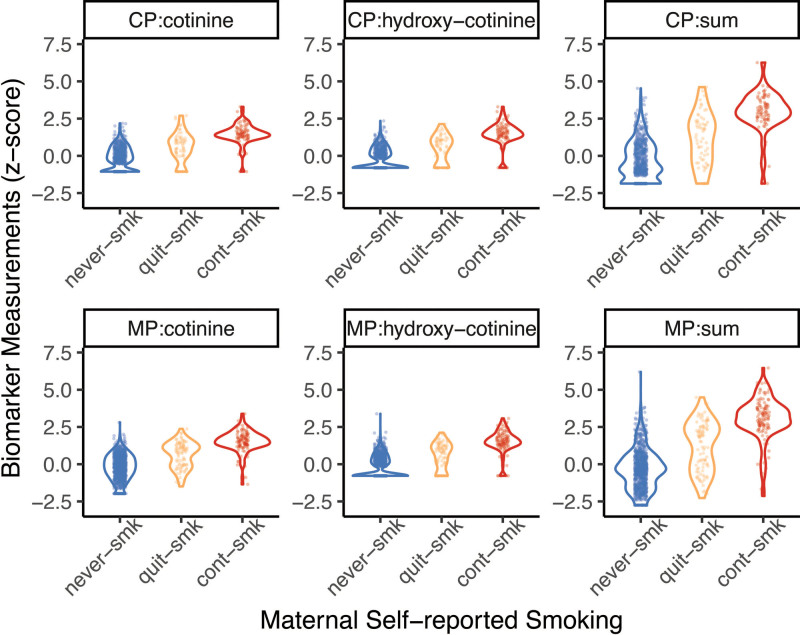
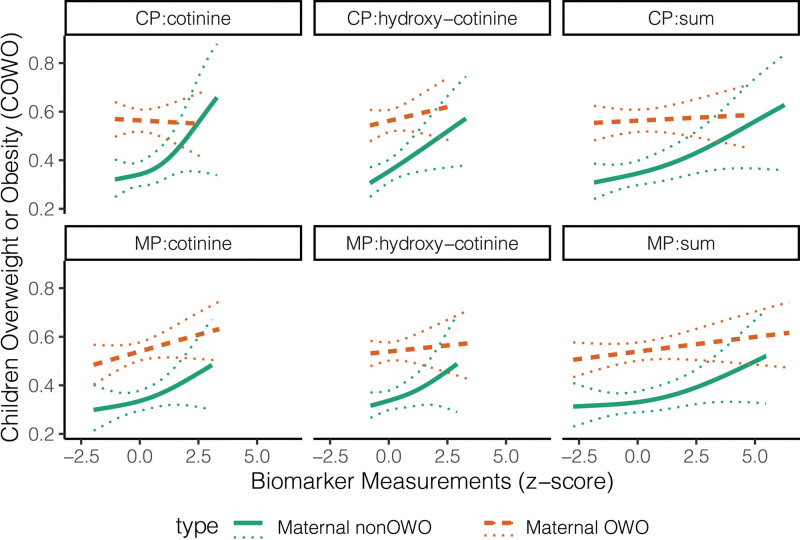
In this study, we analyzed data from 2351 mother-child pairs in the Boston Birth Cohort, a sample of US predominantly Black, indigenous, and people of color (BIPOC) that enrolled children at birth and followed prospectively up to age 18 years. smoking exposure was measured by maternal self-report and by maternal and cord plasma biomarkers of smoking: cotinine and hydroxycotinine. We assessed the individual and joint associations of each smoking exposure measure and maternal OWO with childhood OWO using multinomial logistic regressions. We used nested logistic regressions to investigate the childhood OWO prediction performance when adding maternal and cord plasma biomarkers as input covariates on top of self-reported data.
Our results demonstrated that cigarette smoking exposure defined by self-report and by maternal or cord metabolites was consistently associated with increased risk of long-term child OWO. Children with cord hydroxycotinine in the fourth quartile ( first quartile) had 1.66 (95% confidence interval [CI] 1.03-2.66) times the odds for overweight and 1.57 (95% CI 1.05-2.36) times the odds for obesity. The combined effect of maternal OWO and smoking on offspring risk of obesity is 3.66 (95% CI 2.37-5.67) if using self-reported smoking. Adding maternal and cord plasma biomarker information to self-reported data improved the prediction accuracy of long-term child OWO risk.
This longitudinal birth cohort study of US BIPOC underscored the role of maternal smoking as an obesogen for offspring OWO risk. Our findings call for public health intervention strategies to focus on maternal smoking - as a highly modifiable target, including smoking cessation and countermeasures (such as optimal nutrition) that may alleviate the increasing obesity burden in the United States and globally.
大多数关于接触吸烟与儿童超重或肥胖(OWO)之间关联的研究是基于母亲自我报告的吸烟状况,而基于客观生物标志物的研究较少。自我报告吸烟情况、母亲和脐带血吸烟生物标志物之间的一致性及其对儿童长期超重和肥胖风险的影响尚不清楚。
在本研究中,我们分析了波士顿出生队列中2351对母婴的数据,该队列是一个以美国黑人、原住民和有色人种(BIPOC)为主的样本,在儿童出生时进行登记,并前瞻性随访至18岁。吸烟暴露通过母亲自我报告以及母亲和脐带血血浆吸烟生物标志物:可替宁和羟基可替宁来测量。我们使用多项逻辑回归评估每种吸烟暴露测量指标以及母亲OWO与儿童OWO的个体和联合关联。我们使用嵌套逻辑回归来研究在自我报告数据之上添加母亲和脐带血血浆生物标志物作为输入协变量时儿童OWO的预测性能。
我们的结果表明,通过自我报告以及母亲或脐带代谢物定义的吸烟暴露与儿童长期OWO风险增加始终相关。脐带血羟基可替宁处于第四四分位数(第一四分位数)的儿童超重几率是其1.66倍(95%置信区间[CI]1.03 - 2.66),肥胖几率是其1.57倍(95%CI 1.05 - 2.36)。如果使用自我报告吸烟情况,母亲OWO和吸烟对后代肥胖风险的综合效应为3.66(95%CI 2.37 - 5.67)。在自我报告数据中添加母亲和脐带血血浆生物标志物信息可提高儿童长期OWO风险的预测准确性。
这项针对美国BIPOC的纵向出生队列研究强调了母亲吸烟作为后代OWO风险致肥胖物的作用。我们的研究结果呼吁公共卫生干预策略关注母亲吸烟——作为一个高度可改变的目标,包括戒烟以及可能减轻美国和全球日益增加的肥胖负担的对策(如最佳营养)。