Departments of Epidemiology and Biostatistics, Harvard T.H. Chan School of Public Health, Boston, MA, USA.
Center On the Early Life Origins of Disease, Department of Population, Family and Reproductive Health, Johns Hopkins Bloomberg School of Public Health, Baltimore, MD, USA.
BMC Med. 2023 Aug 23;21(1):317. doi: 10.1186/s12916-023-03003-5.
Maternal pre-pregnancy obesity is an established risk factor for childhood obesity. Investigating epigenetic alterations induced by maternal obesity during fetal development could gain mechanistic insight into the developmental origins of childhood obesity. While obesity disproportionately affects underrepresented racial and ethnic mothers and children in the USA, few studies investigated the role of prenatal epigenetic programming in intergenerational obesity of these high-risk populations.
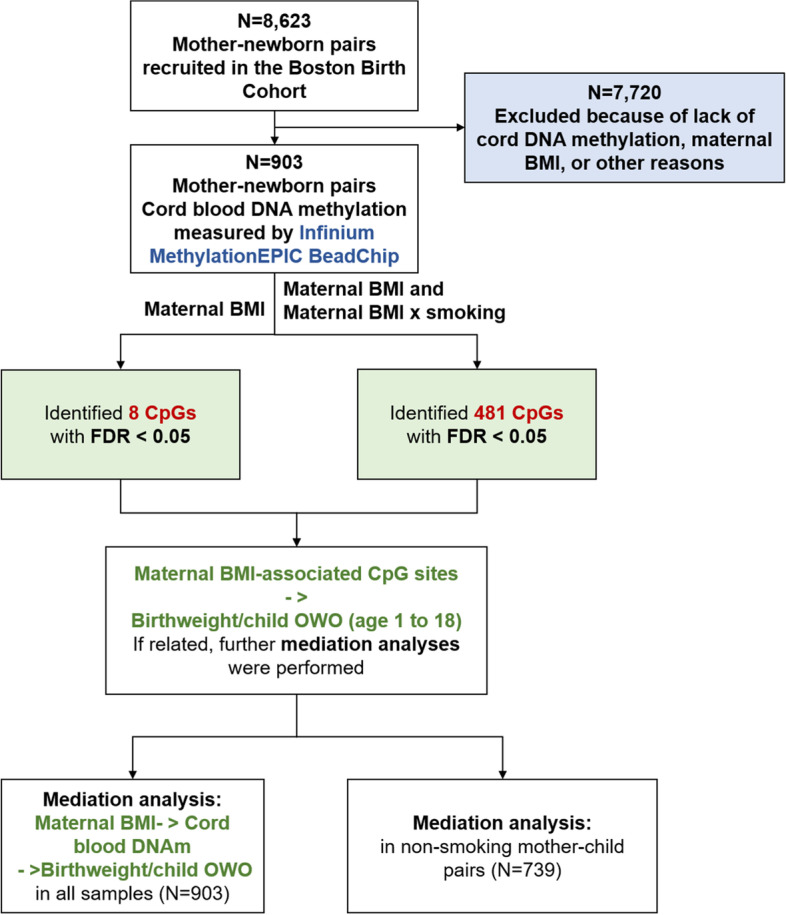
This study included 903 mother-child pairs from the Boston Birth Cohort, a predominantly urban, low-income minority birth cohort. Mother-infant dyads were enrolled at birth and the children were followed prospectively to age 18 years. Infinium Methylation EPIC BeadChip was used to measure epigenome-wide methylation level of cord blood. We performed an epigenome-wide association study of maternal pre-pregnancy body mass index (BMI) and cord blood DNA methylation (DNAm). To quantify the degree to which cord blood DNAm mediates the maternal BMI-childhood obesity, we further investigated whether maternal BMI-associated DNAm sites impact birthweight or childhood overweight or obesity (OWO) from age 1 to age 18 and performed corresponding mediation analyses.
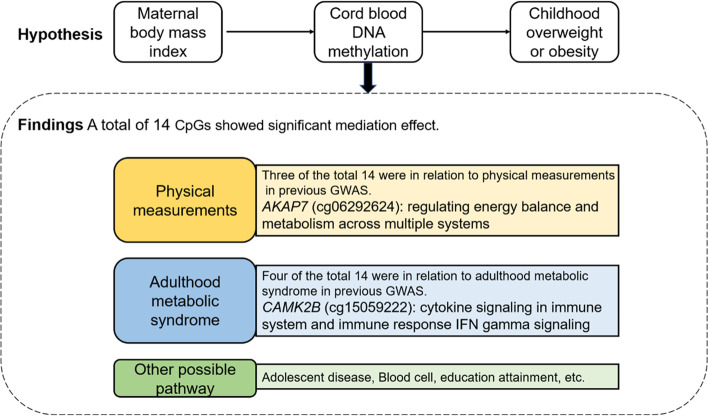
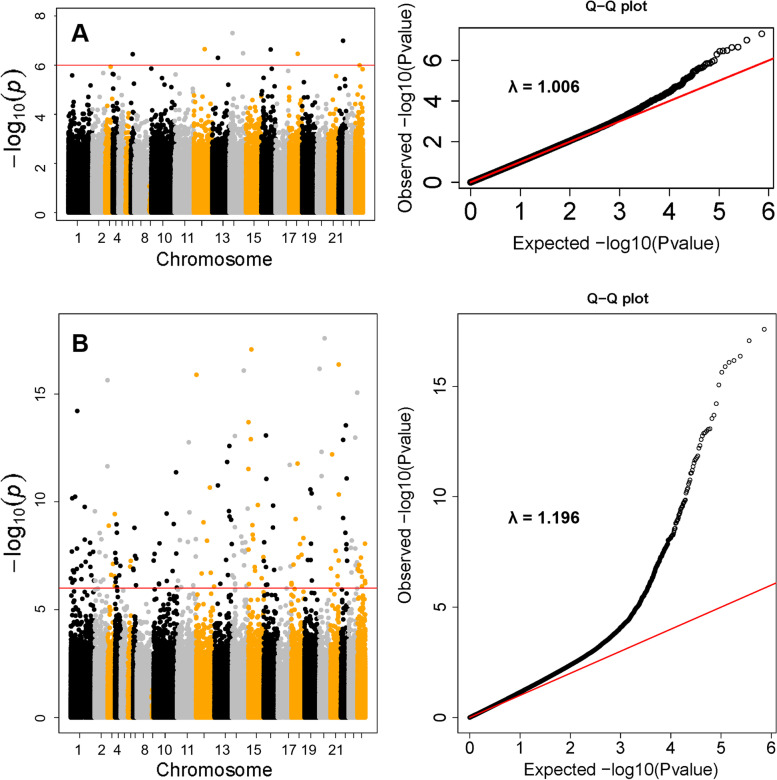
The study sample contained 52.8% maternal pre-pregnancy OWO and 63.2% offspring OWO at age 1-18 years. Maternal BMI was associated with cord blood DNAm at 8 CpG sites (genome-wide false discovery rate [FDR] < 0.05). After accounting for the possible interplay of maternal BMI and smoking, 481 CpG sites were discovered for association with maternal BMI. Among them 123 CpGs were associated with childhood OWO, ranging from 42% decrease to 87% increase in OWO risk for each SD increase in DNAm. A total of 14 identified CpG sites showed a significant mediation effect on the maternal BMI-child OWO association (FDR < 0.05), with mediating proportion ranging from 3.99% to 25.21%. Several of these 14 CpGs were mapped to genes in association with energy balance and metabolism (AKAP7) and adulthood metabolic syndrome (CAMK2B).
This prospective birth cohort study in a high-risk yet understudied US population found that maternal pre-pregnancy OWO significantly altered DNAm in newborn cord blood and provided suggestive evidence of epigenetic involvement in the intergenerational risk of obesity.
母体孕前肥胖是儿童肥胖的既定危险因素。研究母体肥胖在胎儿发育过程中引起的表观遗传改变,可以深入了解儿童肥胖的发育起源。尽管肥胖在美国不成比例地影响代表性不足的少数族裔和种族的母亲和儿童,但很少有研究调查产前表观遗传编程在这些高风险人群中代际肥胖中的作用。
本研究纳入了来自波士顿出生队列的 903 对母婴对,这是一个以城市为主、低收入的少数族裔出生队列。母婴二人组在出生时被招募,并对儿童进行前瞻性随访至 18 岁。使用 Infinium Methylation EPIC BeadChip 测量脐带血的全基因组甲基化水平。我们对母体孕前体重指数 (BMI) 和脐带血 DNA 甲基化 (DNAm) 进行了全基因组关联研究。为了量化脐带血 DNAm 介导母体 BMI-儿童肥胖的程度,我们进一步研究了母体 BMI 相关的 DNAm 位点是否影响出生体重或儿童从 1 岁到 18 岁的超重或肥胖 (OWO),并进行了相应的中介分析。
研究样本中,52.8%的母体孕前超重,63.2%的后代在 1-18 岁时超重。母体 BMI 与脐带血 8 个 CpG 位点的 DNAm 相关(全基因组假发现率 [FDR] < 0.05)。在考虑了母体 BMI 和吸烟的可能相互作用后,发现 481 个 CpG 位点与母体 BMI 相关。其中 123 个 CpG 与儿童 OWO 相关,每个 DNAm 的标准差增加,OWO 风险增加 42%至 87%。共有 14 个鉴定出的 CpG 位点对母体 BMI-儿童 OWO 关联具有显著的中介作用(FDR < 0.05),中介比例为 3.99%至 25.21%。这些 CpG 位点中的几个映射到与能量平衡和代谢相关的基因 (AKAP7) 和成年代谢综合征 (CAMK2B)。
本研究在一个高风险但研究不足的美国人群中进行了前瞻性出生队列研究,发现母体孕前超重显著改变了新生儿脐带血中的 DNAm,并提供了表观遗传参与肥胖代际风险的提示性证据。