Natae Shewaye Fituma, Merzah Mohammed Abdulridha, Sándor János, Ádány Róza, Bereczky Zsuzsanna, Fiatal Szilvia
Department of Public Health and Epidemiology, Faculty of Medicine, University of Debrecen, Debrecen, Hungary.
Doctoral School of Health Sciences, University of Debrecen, Debrecen, Hungary.
Front Cardiovasc Med. 2023 Sep 6;10:1224462. doi: 10.3389/fcvm.2023.1224462. eCollection 2023.
Venous thrombosis (VT) is multifactorial trait that contributes to the global burden of cardiovascular diseases. Although abundant single nucleotide polymorphisms (SNPs) provoke the susceptibility of an individual to VT, research has found that the five most strongly associated SNPs, namely, rs6025 ( Leiden), rs2066865 (), rs2036914 (), rs8176719 (), and rs1799963 (), play the greatest role. Association and risk prediction models are rarely established by using merely the five strongly associated SNPs. This study aims to explore the combined VT risk predictability of the five SNPs and well-known non-genetic VT risk factors such as aging and obesity in the Hungarian population.
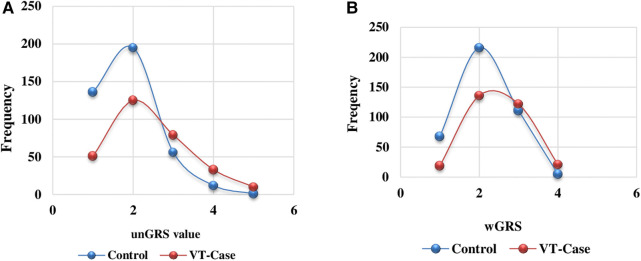
SNPs were genotyped in the VT group ( = 298) and control group ( = 400). Associations were established using standard genetic models. Genetic risk scores (GRS) [unweighted GRS (unGRS), weighted GRS (wGRS)] were also computed. Correspondingly, the areas under the receiver operating characteristic curves (AUCs) for genetic and non-genetic risk factors were estimated to explore their VT risk predictability in the study population.
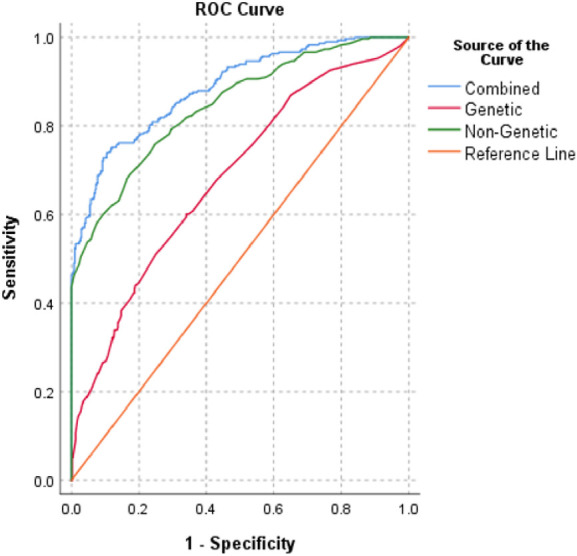
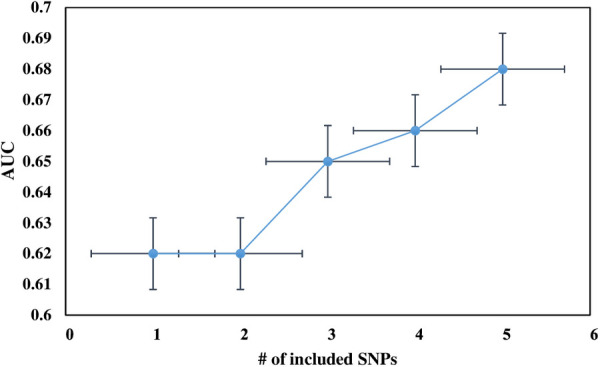
rs6025 was the most prevalent VT risk allele in the Hungarian population. Its risk allele frequency was 3.52-fold higher in the VT group than that in the control group [adjusted odds ratio (AOR) = 3.52, 95% CI: 2.50-4.95]. Using all genetic models, we found that rs6025 and rs2036914 remained significantly associated with VT risk after multiple correction testing was performed. However, rs8176719 remained statistically significant only in the multiplicative (AOR = 1.33, 95% CI: 1.07-1.64 and genotypic models (AOR = 1.77, 95% CI: 1.14-2.73). In addition, rs2066865 lost its significant association with VT risk after multiple correction testing was performed. Conversely, the prothrombin mutation (rs1799963) did not show any significant association. The AUC of Leiden mutation (rs6025) showed better discriminative accuracy than that of other SNPs (AUC = 0.62, 95% CI: 0.57-0.66). The wGRS was a better predictor for VT than the unGRS (AUC = 0.67 vs. 0.65). Furthermore, combining genetic and non-genetic VT risk factors significantly increased the AUC to 0.89 with statistically significant differences ( = 3.924, < 0.0001).
Our study revealed that the five strongly associated SNPs combined with non-genetic factors could efficiently predict individual VT risk susceptibility. The combined model was the best predictor of VT risk, so stratifying high-risk individuals based on their genetic profiling and well-known non-modifiable VT risk factors was important for the effective and efficient utilization of VT risk preventive and control measures. Furthermore, we urged further study that compares the VT risk predictability in the Hungarian population using the formerly discovered VT SNPs with the novel strongly associated VT SNPs.
静脉血栓形成(VT)是一种多因素性状,对全球心血管疾病负担有影响。尽管大量单核苷酸多态性(SNP)会引发个体对VT的易感性,但研究发现,五个关联最强的SNP,即rs6025(莱顿)、rs2066865()、rs2036914()、rs8176719()和rs1799963(),发挥着最大作用。很少仅使用这五个关联强的SNP来建立关联和风险预测模型。本研究旨在探讨这五个SNP与匈牙利人群中衰老和肥胖等知名非遗传VT风险因素相结合对VT风险的联合预测能力。
对VT组(n = 298)和对照组(n = 400)进行SNP基因分型。使用标准遗传模型建立关联。还计算了遗传风险评分(GRS)[未加权GRS(unGRS)、加权GRS(wGRS)]。相应地,估计遗传和非遗传风险因素的受试者工作特征曲线下面积(AUC),以探讨它们在研究人群中的VT风险预测能力。
rs6025是匈牙利人群中最常见的VT风险等位基因。其风险等位基因频率在VT组中比对照组高3.52倍[调整优势比(AOR)= 3.52,95%置信区间:2.50 - 4.95]。使用所有遗传模型,我们发现在进行多次校正检验后,rs6025和rs2036914与VT风险仍显著相关。然而,rs8176719仅在乘法模型(AOR = 1.33,95%置信区间:1.07 - 1.64)和基因型模型(AOR = 1.77,95%置信区间:1.14 - 2.73)中具有统计学意义。此外,在进行多次校正检验后,rs2066865与VT风险的显著关联消失。相反,凝血酶原突变(rs1799963)未显示任何显著关联。莱顿突变(rs6025)的AUC显示出比其他SNP更好的判别准确性(AUC = 0.62,95%置信区间:0.57 - 0.66)。wGRS对VT的预测比unGRS更好(AUC = 0.67对0.65)。此外,将遗传和非遗传VT风险因素相结合可使AUC显著提高至0.89,差异具有统计学意义(Z = 3.924,P < 0.0001)。
我们的研究表明,这五个关联强的SNP与非遗传因素相结合可有效预测个体VT风险易感性。联合模型是VT风险的最佳预测指标,因此根据个体的基因谱和知名的不可改变的VT风险因素对高危个体进行分层,对于有效利用VT风险预防和控制措施非常重要。此外,我们敦促进一步研究,比较使用先前发现的VT SNP与新发现的关联强的VT SNP对匈牙利人群VT风险的预测能力。