Meng Xian Sai, Chen Tao, Wang Xin Yan, Lu Xu, Hu Jia, Shen Juan, Guo Jun
Department of Cardiovascular, The Sixth Medical Center of Chinese PLA General Hospital, Beijing, China.
Front Cardiovasc Med. 2023 Sep 8;10:1219611. doi: 10.3389/fcvm.2023.1219611. eCollection 2023.
With an increasing number of patients undergoing left atrial appendage occlusion (LAAO), more attention is being paid to relieving clinical symptoms and improving the quality of life of these patients. For patients with atrial fibrillation (AF), direct current cardioversion (DCCV) is an alternate, nonpharmacological choice to restore sinus rhythm and relieve clinical symptoms.
The purpose of this study was to assess the feasibility and safety of the DCCV at the time of LAAO for patients with AF.
Forty patients were enrolled in the DCCV group undergoing the DCCV at the time of LAAO. The control group undergoing LAAO alone was formed by 1:1 matching.
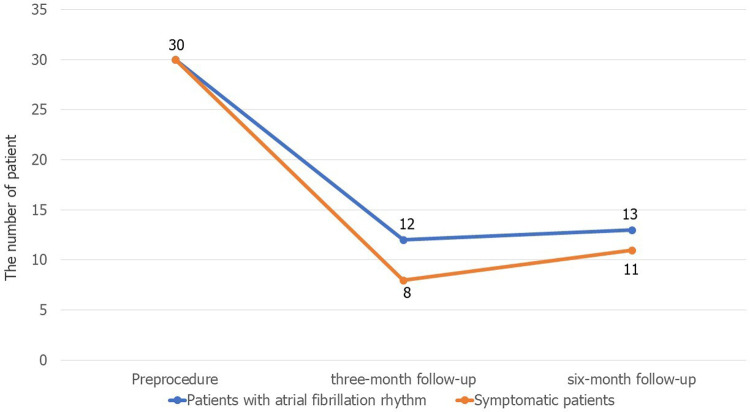
In the DCCV group, cardioversion was immediately successful in 30 (75%) patients, of which 12 (40%) had AF recurrence at the three-month follow-up. The failed-DCCV group was older (73.70 ± 4.74 vs. 62.20 ± 9.01 years old, = 0.000), had a faster postcardioversion heart rate (88.80 ± 16.58 vs. 70.97 ± 14.73 times, = 0.03), and had a higher mean HAS-BLED score (4.00 vs. 3.00, = 0.01) than the successful-DCCV group. No patients experienced periprocedural pericardial effusion, occluder displacement, device embolism, or >5 mm peridevice leakage. One patient experienced a transient ischemic attack (TIA) in the DCCV group during the follow-up.
The DCCV at the time of LAAO is feasible and safe for AF patients with contraindications for catheter ablation or AF recurrence after previous catheter ablation to restore the sinus rhythm and relieve clinical symptoms. The DCCV at the time of LAAO is more likely to succeed for younger patients and patients with lower HAS-BLED scores.
随着接受左心耳封堵术(LAAO)的患者数量不断增加,人们越来越关注缓解这些患者的临床症状并提高其生活质量。对于心房颤动(AF)患者,直流电复律(DCCV)是恢复窦性心律并缓解临床症状的一种替代性非药物选择。
本研究旨在评估AF患者在LAAO时进行DCCV的可行性和安全性。
40例患者纳入DCCV组,在LAAO时进行DCCV。通过1:1匹配形成仅接受LAAO的对照组。
在DCCV组中,30例(75%)患者复律即刻成功,其中12例(40%)在3个月随访时出现房颤复发。失败的DCCV组患者年龄更大(73.70±4.74岁 vs. 62.20±9.01岁,P = 0.000),复律后心率更快(88.80±16.58次 vs. 70.97±14.73次,P = 0.03),且平均HAS - BLED评分更高(4.00 vs. 3.00,P = 0.01),高于成功的DCCV组。没有患者发生围手术期心包积液、封堵器移位、器械栓塞或器械周围渗漏>5 mm。DCCV组有1例患者在随访期间发生短暂性脑缺血发作(TIA)。
对于有导管消融禁忌证或既往导管消融后房颤复发的AF患者,在LAAO时进行DCCV以恢复窦性心律并缓解临床症状是可行且安全的。LAAO时进行DCCV在年轻患者和HAS - BLED评分较低的患者中更有可能成功。