Ravala Sandeep K, Adame-Garcia Sendi Rafael, Li Sheng, Chen Chun-Liang, Cianfrocco Michael A, Gutkind J Silvio, Cash Jennifer N, Tesmer John J G
Departments of Biological Sciences and of Medicinal Chemistry and Molecular Pharmacology, Purdue University, West Lafayette, Indiana 47907, United States.
Department of Pharmacology and Moores Cancer Center, University of California, San Diego, San Diego, CA 92093, USA.
bioRxiv. 2024 Apr 17:2023.09.15.557836. doi: 10.1101/2023.09.15.557836.
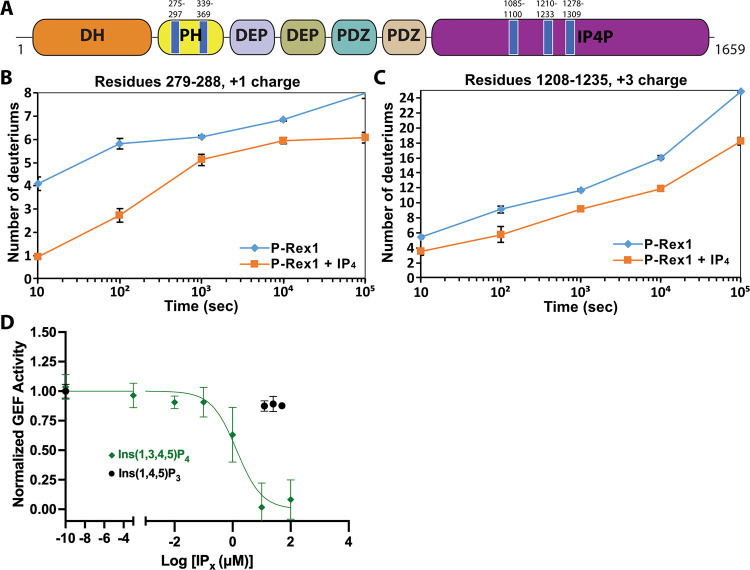
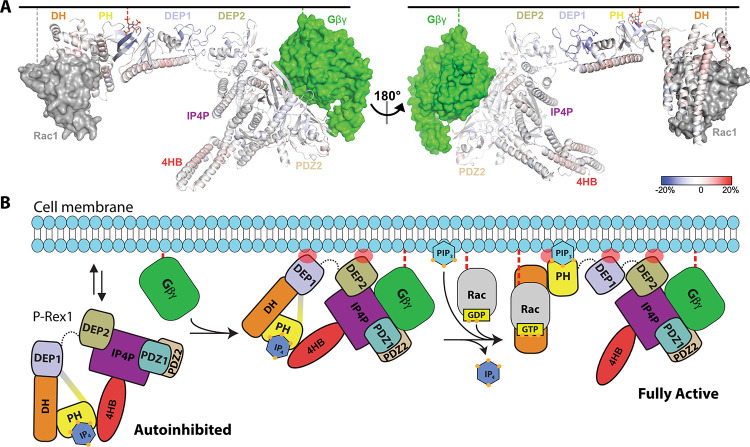
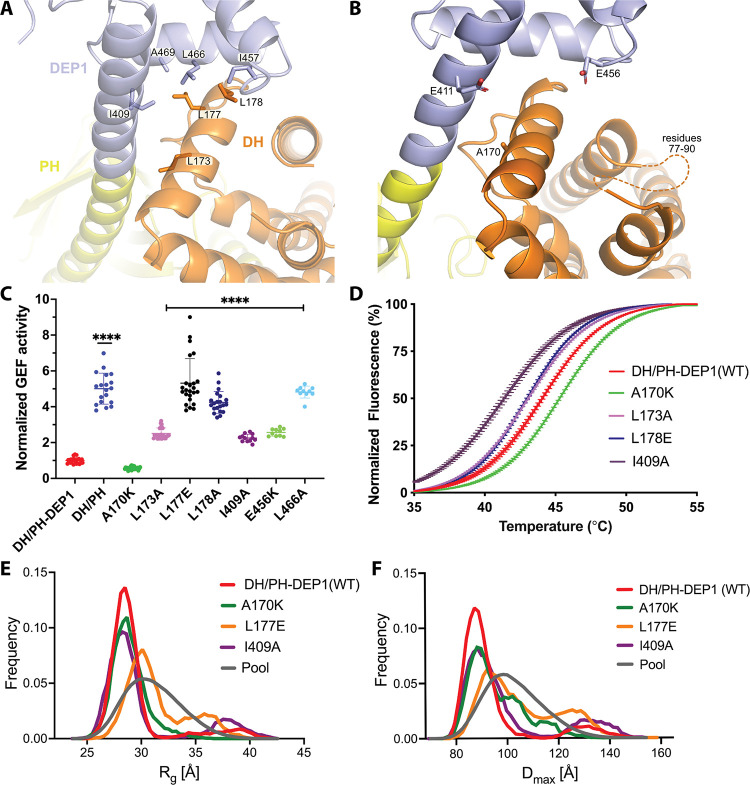
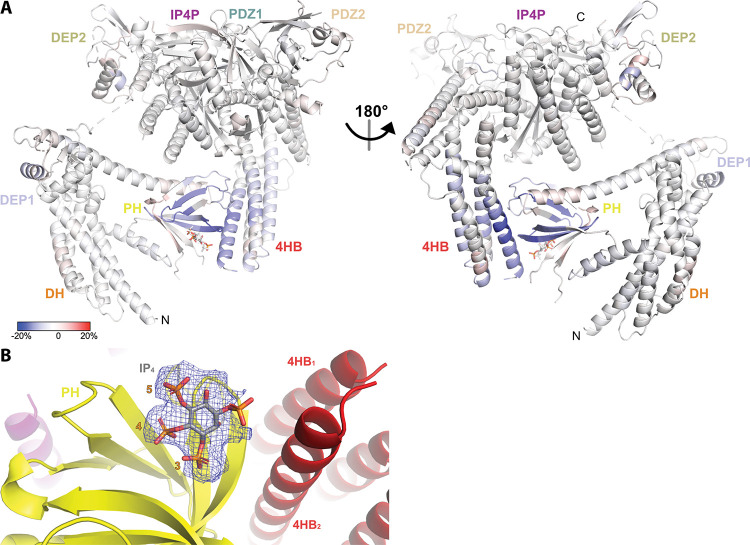
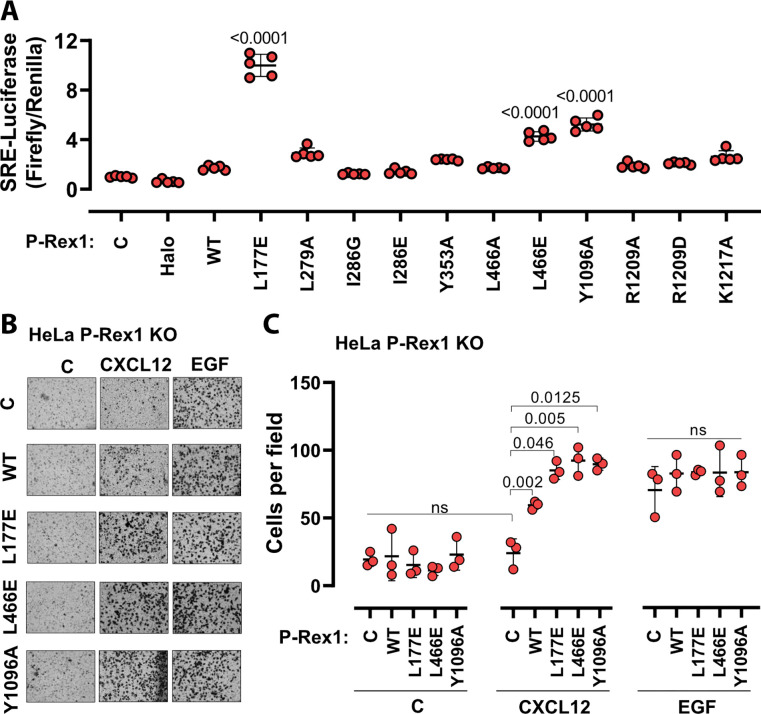
PIP-dependent Rac exchanger 1 (P-Rex1) is abundantly expressed in neutrophils and plays central roles in chemotaxis and cancer metastasis by serving as a guanine-nucleotide exchange factor (GEF) for Rac. The enzyme is synergistically activated by PIP and the heterotrimeric Gβγ subunits, but mechanistic details remain poorly understood. While investigating the regulation of P-Rex1 by PIP, we discovered that Ins(1,3,4,5)P (IP) inhibits P-Rex1 activity and induces large decreases in backbone dynamics in diverse regions of the protein. Cryo-electron microscopy analysis of the P-Rex1·IP complex revealed a conformation wherein the pleckstrin homology (PH) domain occludes the active site of the Dbl homology (DH) domain. This configuration is stabilized by interactions between the first DEP domain (DEP1) and the DH domain and between the PH domain and a 4-helix bundle (4HB) subdomain that extends from the C-terminal domain of P-Rex1. Disruption of the DH-DEP1 interface in a DH/PH-DEP1 fragment enhanced activity and led to a more extended conformation in solution, whereas mutations that constrain the occluded conformation led to decreased GEF activity. Variants of full-length P-Rex1 in which the DH-DEP1 and PH-4HB interfaces were disturbed exhibited enhanced activity during chemokine-induced cell migration, confirming that the observed structure represents the autoinhibited state in living cells. Interactions with PIP-containing liposomes led to disruption of these interfaces and increased dynamics protein-wide. Our results further suggest that inositol phosphates such as IP help to inhibit basal P-Rex1 activity in neutrophils, similar to their inhibitory effects on phosphatidylinositol-3-kinase.
磷脂酰肌醇-3,4,5-三磷酸(PIP)依赖性Rac交换因子1(P-Rex1)在中性粒细胞中大量表达,通过作为Rac的鸟嘌呤核苷酸交换因子(GEF)在趋化作用和癌症转移中发挥核心作用。该酶由PIP和异源三聚体Gβγ亚基协同激活,但其作用机制细节仍知之甚少。在研究PIP对P-Rex1的调控时,我们发现肌醇-1,3,4,5-四磷酸(IP)抑制P-Rex1活性,并导致该蛋白不同区域的主链动力学大幅下降。对P-Rex1·IP复合物的冷冻电子显微镜分析揭示了一种构象,其中普列克底物蛋白同源(PH)结构域封闭了双鸟苷酸交换因子同源(DH)结构域的活性位点。这种构型通过第一个DEP结构域(DEP1)与DH结构域之间以及PH结构域与从P-Rex1 C末端结构域延伸的4-螺旋束(4HB)亚结构域之间的相互作用而稳定。在DH/PH-DEP1片段中破坏DH-DEP1界面会增强活性,并导致溶液中构象更加伸展,而限制封闭构象的突变会导致GEF活性降低。全长P-Rex1中DH-DEP1和PH-4HB界面受到干扰的变体在趋化因子诱导的细胞迁移过程中表现出增强的活性,证实观察到的结构代表活细胞中的自抑制状态。与含PIP的脂质体相互作用导致这些界面的破坏,并增加了整个蛋白的动力学。我们的结果进一步表明,肌醇磷酸酯如IP有助于抑制中性粒细胞中P-Rex1的基础活性,类似于它们对磷脂酰肌醇-3-激酶的抑制作用。