Stein-O'Brien Genevieve L, Palaganas Ryan, Meyer Ernest M, Redding-Ochoa Javier, Pletnikova Olga, Guo Haidan, Bell William R, Troncoso Juan C, Huganir Richard L, Morris Meaghan
McKusick-Nathans Institute of Genetic Medicine, Johns Hopkins School of Medicine, Baltimore, MD, USA.
Single Cell Training and Analysis Center, Johns Hopkins University School of Medicine, Baltimore, MD, USA.
medRxiv. 2023 Sep 12:2023.09.12.23295440. doi: 10.1101/2023.09.12.23295440.
Tau pathology is common in age-related neurodegenerative diseases. Tau pathology in primary age-related tauopathy (PART) and in Alzheimer's disease (AD) has a similar biochemical structure and anatomic distribution, which is distinct from tau pathology in other diseases. However, the molecular changes associated with intraneuronal tau pathology in PART and AD, and whether these changes are similar in the two diseases, is largely unexplored.
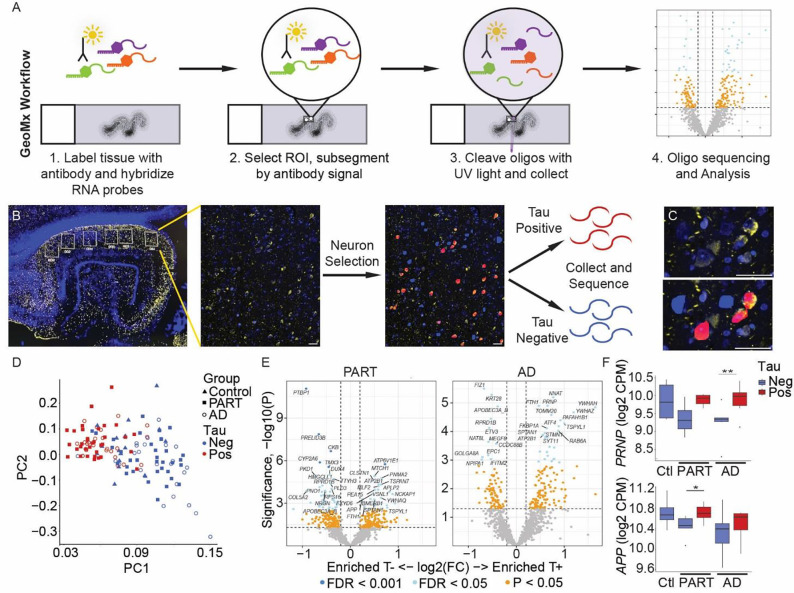
Using GeoMx spatial transcriptomics, mRNA was quantified in CA1 pyramidal neurons with tau pathology and adjacent neurons without tau pathology in 6 cases of PART and 6 cases of AD, and compared to 4 control cases without pathology. Transcriptional changes were analyzed for differential gene expression and for coordinated patterns of gene expression associated with both disease state and intraneuronal tau pathology.
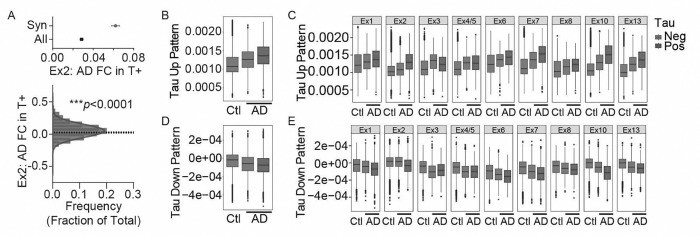
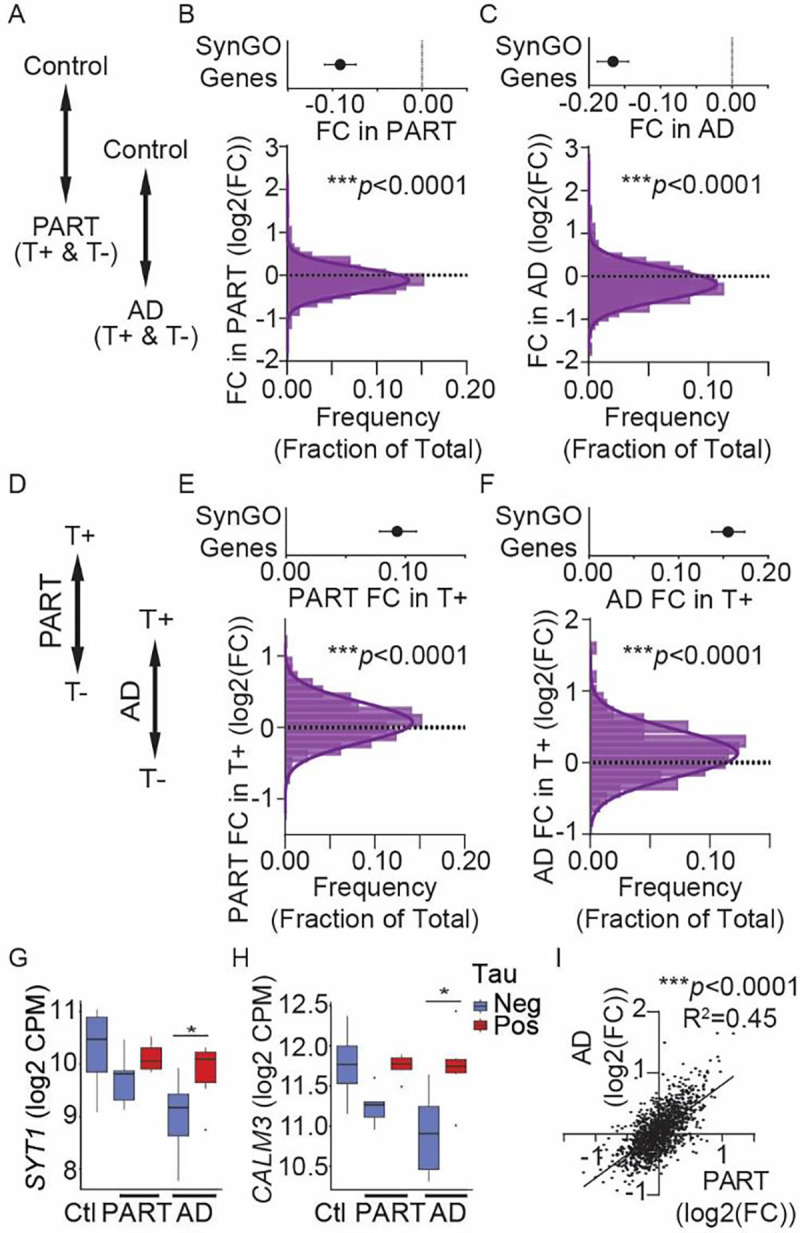
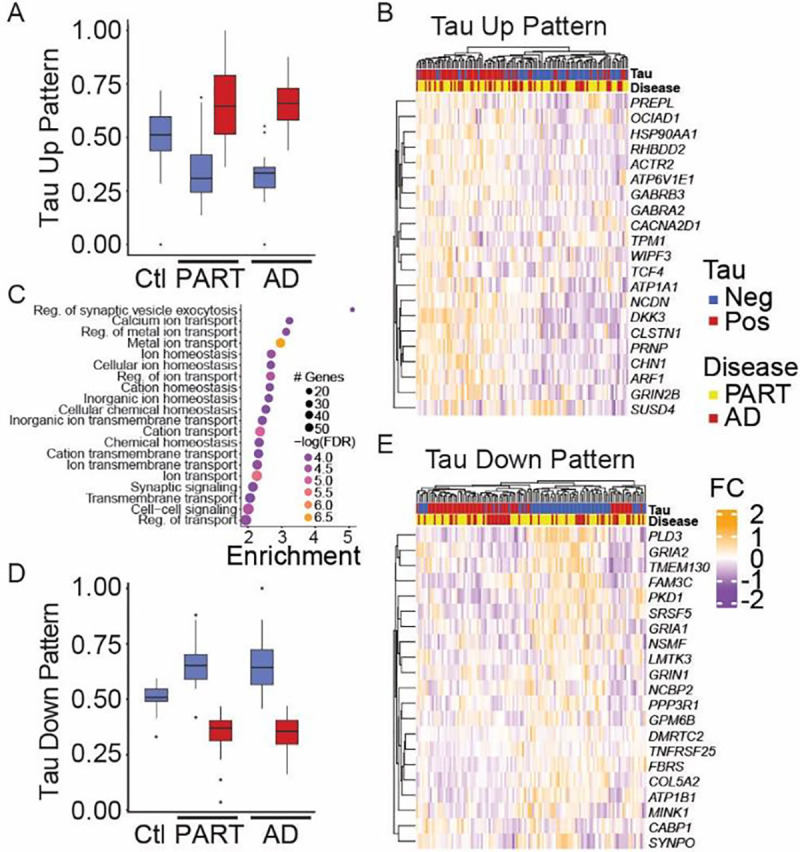
Synaptic gene changes and two novel gene expression signatures associated with intraneuronal tau were identified in PART and AD. Overall, gene expression changes associated with intraneuronal tau pathology were similar in PART and AD. Synaptic gene expression was decreased overall in neurons in AD and PART compared to control cases. However, this decrease was largely driven by neurons lacking tau pathology. Synaptic gene expression was increased in tau-positive neurons compared to tau-negative neurons in disease. Two novel gene expression signatures associated with intraneuronal tau were identified by examining coordinated patterns of gene expression. Genes in the up-regulated expression pattern were enriched in calcium regulation and synaptic function pathways, specifically in synaptic exocytosis. These synaptic gene changes and intraneuronal tau expression signatures were confirmed in a published transcriptional dataset of cortical neurons with tau pathology in AD.
PART and AD show similar transcriptional changes associated with intraneuronal tau pathology in CA1 pyramidal neurons, raising the possibility of a mechanistic relationship between the tau pathology in the two diseases. Intraneuronal tau pathology was also associated with increased expression of genes associated with synaptic function and calcium regulation compared to tau-negative disease neurons. The findings highlight the power of molecular analysis stratified by pathology in neurodegenerative disease and provide novel insight into common molecular pathways associated with intraneuronal tau in PART and AD.
tau蛋白病理改变在年龄相关性神经退行性疾病中很常见。原发性年龄相关性tau蛋白病(PART)和阿尔茨海默病(AD)中的tau蛋白病理改变具有相似的生化结构和解剖分布,这与其他疾病中的tau蛋白病理改变不同。然而,与PART和AD中神经元内tau蛋白病理改变相关的分子变化,以及这两种疾病中的这些变化是否相似,在很大程度上尚未得到探索。
使用GeoMx空间转录组学技术,对6例PART和6例AD中具有tau蛋白病理改变的CA1锥体神经元和相邻无tau蛋白病理改变的神经元中的mRNA进行定量,并与4例无病理改变的对照病例进行比较。分析转录变化,以检测差异基因表达以及与疾病状态和神经元内tau蛋白病理改变相关的基因表达协调模式。
在PART和AD中鉴定出与神经元内tau蛋白相关的突触基因变化和两种新的基因表达特征。总体而言,PART和AD中与神经元内tau蛋白病理改变相关的基因表达变化相似。与对照病例相比,AD和PART中神经元的突触基因表达总体上降低。然而,这种降低主要由缺乏tau蛋白病理改变的神经元驱动。在疾病中,与tau阴性神经元相比,tau阳性神经元的突触基因表达增加。通过检查基因表达的协调模式,鉴定出两种与神经元内tau蛋白相关的新的基因表达特征。上调表达模式中的基因在钙调节和突触功能途径中富集,特别是在突触胞吐作用中。这些突触基因变化和神经元内tau蛋白表达特征在已发表的AD中具有tau蛋白病理改变的皮质神经元转录组数据集中得到了证实。
PART和AD在CA1锥体神经元中显示出与神经元内tau蛋白病理改变相关的相似转录变化,这增加了两种疾病中tau蛋白病理改变之间存在机制联系的可能性。与tau阴性疾病神经元相比,神经元内tau蛋白病理改变还与突触功能和钙调节相关基因的表达增加有关。这些发现突出了在神经退行性疾病中按病理分层进行分子分析的作用,并为PART和AD中与神经元内tau蛋白相关的共同分子途径提供了新的见解。