Richardson Timothy E, Orr Miranda E, Orr Timothy C, Rohde Susan K, Ehrenberg Alexander J, Thorn Emma L, Christie Thomas D, Flores-Almazan Victoria, Afzal Robina, De Sanctis Claudia, Maldonado-Díaz Carolina, Hiya Satomi, Canbeldek Leyla, Kulumani Mahadevan Lakshmi Shree, Slocum Cheyanne, Samanamud Jorge, Clare Kevin, Scibetta Nicholas, Yokoda Raquel T, Koenigsberg Daniel, Marx Gabriel A, Kauffman Justin, Goldstein Adam, Selmanovic Enna, Drummond Eleanor, Wisniewski Thomas, White Charles L, Goate Alison M, Crary John F, Farrell Kurt, Alosco Michael L, Mez Jesse, McKee Ann C, Stein Thor D, Bieniek Kevin F, Kautz Tiffany F, Daoud Elena V, Walker Jamie M
Department of Pathology, Molecular, and Cell-Based Medicine, Icahn School of Medicine at Mount Sinai, New York, New York, USA.
Department of Neurology, Washington University School of Medicine, St. Louis, Missouri, USA.
Alzheimers Dement. 2025 Feb;21(2):e14487. doi: 10.1002/alz.14487. Epub 2024 Dec 31.
Alzheimer's disease (AD), primary age-related tauopathy (PART), and chronic traumatic encephalopathy (CTE) all feature hyperphosphorylated tau (p-tau)-immunoreactive neurofibrillary degeneration, but differ in neuroanatomical distribution and progression of neurofibrillary degeneration and amyloid beta (Aβ) deposition.
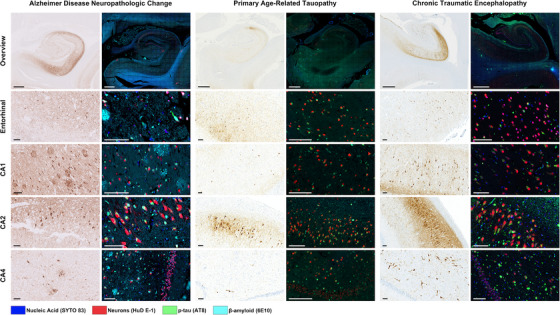
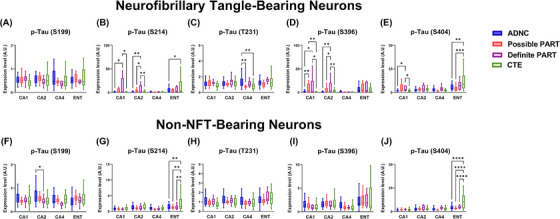
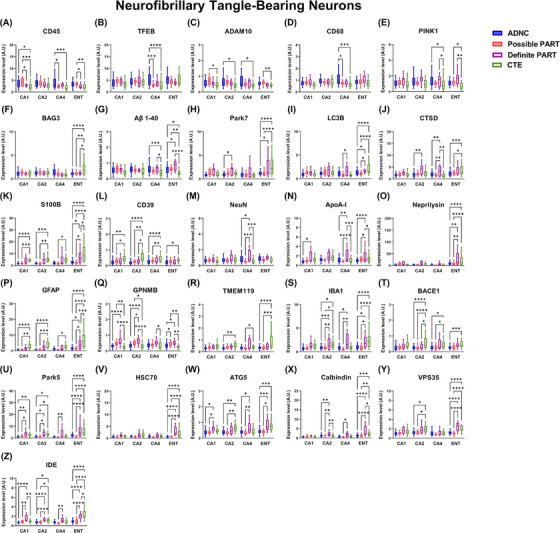
We used Nanostring GeoMx Digital Spatial Profiling to compare the expression of 70 proteins in neurofibrillary tangle (NFT)-bearing and non-NFT-bearing neurons in hippocampal CA1, CA2, and CA4 subregions and entorhinal cortex of cases with autopsy-confirmed AD (n = 8), PART (n = 7), and CTE (n = 5).
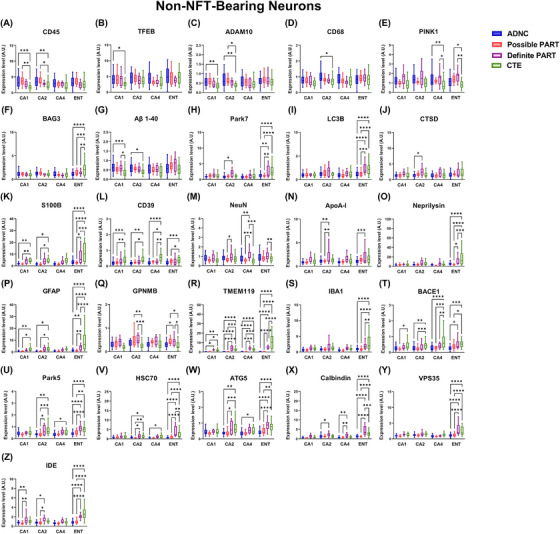
There were numerous subregion-specific differences related to Aβ processing, autophagy/proteostasis, inflammation, gliosis, oxidative stress, neuronal/synaptic integrity, and p-tau epitopes among these different disorders.
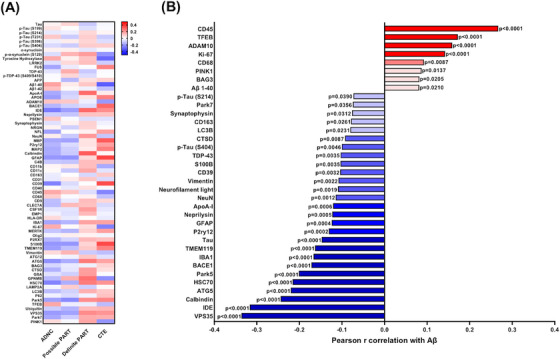
These results suggest that there are subregion-specific proteomic differences among the neurons of these disorders, which appear to be influenced to a large degree by the presence of hippocampal Aβ. These proteomic differences may play a role in the differing hippocampal p-tau distribution and pathogenesis of these disorders.
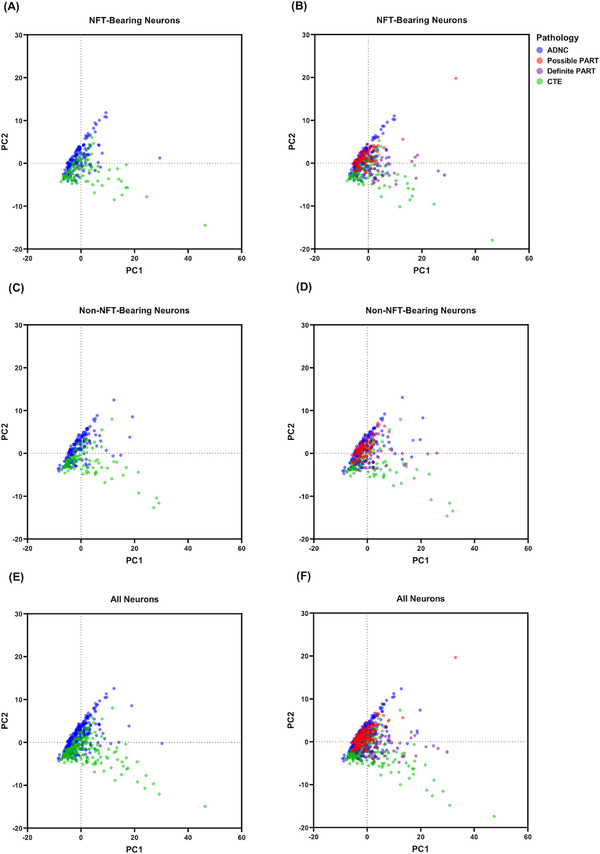
Alzheimer's disease neuropathologic change (ADNC), possible primary age-related tauopathy (PART), definite PART, and chronic traumatic encephalopathy (CTE) can be differentiated based on the proteomic composition of their neurofibrillary tangle (NFT)- and non-NFT-bearing neurons. The proteome of these NFT- and non-NFT-bearing neurons is largely correlated with the presence or absence of amyloid beta (Aβ). Neurons in CTE and definite PART (Aβ-independent pathologies) share numerous proteomic similarities that distinguish them from ADNC and possible PART (Aβ-positive pathologies).
阿尔茨海默病(AD)、原发性年龄相关性tau蛋白病(PART)和慢性创伤性脑病(CTE)均以过度磷酸化tau蛋白(p-tau)免疫反应性神经原纤维变性为特征,但在神经原纤维变性和淀粉样β蛋白(Aβ)沉积的神经解剖分布及进展方面存在差异。
我们使用纳米孔GeoMx数字空间分析技术,比较了经尸检确诊的AD(n = 8)、PART(n = 7)和CTE(n = 5)病例的海马CA1、CA2和CA4亚区以及内嗅皮质中含神经原纤维缠结(NFT)和不含NFT的神经元中70种蛋白质的表达情况。
在这些不同疾病中,存在许多与Aβ处理、自噬/蛋白质稳态、炎症、神经胶质增生、氧化应激、神经元/突触完整性和p-tau表位相关的亚区特异性差异。
这些结果表明,这些疾病的神经元之间存在亚区特异性蛋白质组差异,这在很大程度上似乎受海马Aβ存在的影响。这些蛋白质组差异可能在这些疾病不同的海马p-tau分布和发病机制中起作用。
阿尔茨海默病神经病理改变(ADNC)、可能的原发性年龄相关性tau蛋白病(PART)、确诊的PART和慢性创伤性脑病(CTE)可根据其含神经原纤维缠结(NFT)和不含NFT的神经元的蛋白质组组成进行区分。这些含NFT和不含NFT的神经元的蛋白质组在很大程度上与淀粉样β蛋白(Aβ)的存在与否相关。CTE和确诊的PART(与Aβ无关的病理)中的神经元具有许多蛋白质组相似性,这使它们与ADNC和可能的PART(Aβ阳性病理)区分开来。