Naghdi Neda, Elliott James M, Weber Michael H, Fehlings Michael G, Fortin Maryse
Department of Health, Kinesiology & Applied Physiology, Concordia University, Montreal, QC, Canada.
The Kolling Institute, The University of Sydney, Sydney, NSW, Australia.
Front Neurol. 2023 Sep 7;14:1209475. doi: 10.3389/fneur.2023.1209475. eCollection 2023.
This study aimed to examine whether preoperative cervical muscle size, composition, and asymmetry from magnetic resonance imaging (MRI) can predict post-operative outcomes in patients with degenerative cervical myelopathy (DCM).
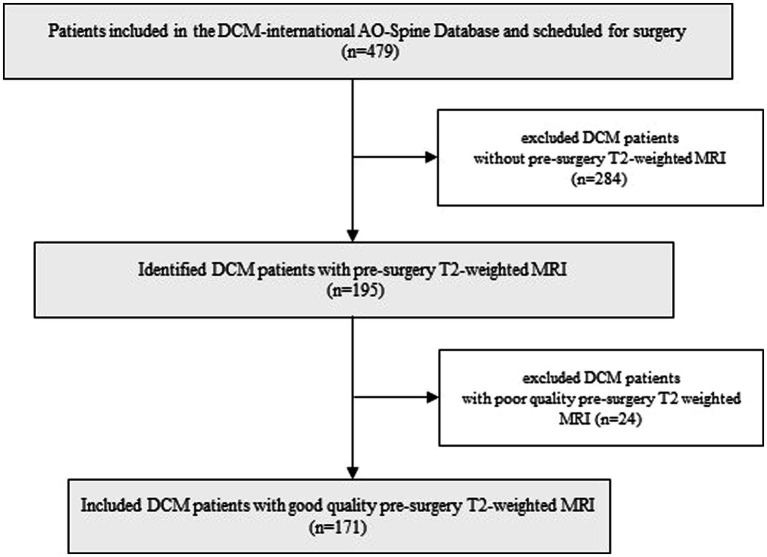
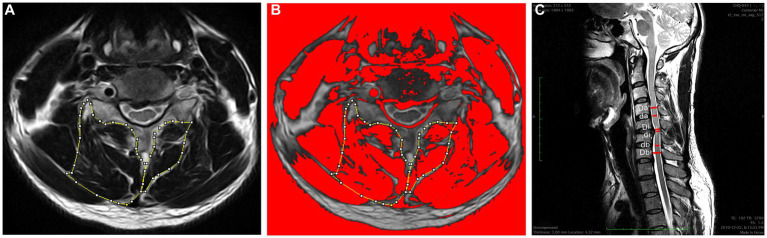
A total of 171 patients with DCM were included. Relative total cross-sectional area (RCSA), functional CSA (fat-free area, FCSA), ratio of FCSA/CSA (fatty infiltration) and asymmetry of the multifidus (MF) and semispinalis cervicis (SCer) together (MF + SCer), and cervical muscle as a group (MF, SCer, semispinalis capitis, and splenius capitis) were obtained from T2-weighted axial MR images at the mid-disk, at the level of maximum cord compression and the level below. Univariate and multivariate linear regression analyses were used to assess the relationship between baseline cervical muscle measurements of interest with the modified Japanese Orthopedic Association (mJOA), Nurick Classification, Neck Disability Index (NDI), and SF-36 health survey at 6-month and 12-month post-surgery.
Lower RCSA of MF + SCer, less CSA MF + SCer asymmetry and greater FCSA/CSA for the cervical muscle group (e.g., less fatty infiltration), and younger age were significant predictors of higher mJOA scores (e.g., less disability) at 6-month and 12-month post-surgery (all < 0.05). Greater CSA asymmetry in MF + SCer and lower FCSA/CSA (e.g., more fatty infiltration) for the cervical muscle group were significant predictors of higher Nurick scores (e.g., more disability) at 6-month and 12-month post-surgery (all < 0.05). Lower FCSA MF + Scer asymmetry, lower FCSA/CSA asymmetry of the muscle group, and greater RCSA MF + SCer were significant predictors of higher NDI scores at 6-month and 12-month post-surgery. Finally, greater FCSA/CSA asymmetry of the MF + SCer, greater FCSA asymmetry of the muscle group, greater RCSA of the muscle group, and greater CSA asymmetry of MF + SCer were significant predictors of lower post-operative SF-36 scores at 6- and 12-month post-surgery.
Our result suggested that cervical paraspinal muscle morphology, specifically greater asymmetry, and fatty infiltration may be important predictors of functional recovery and post-surgical outcomes in patients with DCM.
本研究旨在探讨磁共振成像(MRI)测量的术前颈部肌肉大小、组成及不对称性是否能够预测退行性颈椎病(DCM)患者的术后结果。
共纳入171例DCM患者。从T2加权轴向MR图像的椎间盘中部、脊髓最大受压水平及下方水平获取多裂肌(MF)和颈半棘肌(SCer)共同的相对总横截面积(RCSA)、功能性横截面积(无脂肪区域,FCSA)、FCSA/CSA比值(脂肪浸润)以及不对称性,还有颈部肌肉整体(MF、SCer、头半棘肌和头夹肌)的相关数据。采用单因素和多因素线性回归分析评估感兴趣的基线颈部肌肉测量值与改良日本骨科学会(mJOA)评分、Nurick分级、颈部残疾指数(NDI)以及术后6个月和12个月的SF-36健康调查之间的关系。
术后6个月和12个月时,MF + SCer的RCSA较低、MF + SCer的CSA不对称性较小、颈部肌肉组的FCSA/CSA较大(如脂肪浸润较少)以及年龄较小是mJOA评分较高(如残疾程度较轻)的显著预测因素(均P < 0.05)。术后6个月和12个月时,MF + SCer的CSA不对称性较大以及颈部肌肉组的FCSA/CSA较低(如脂肪浸润较多)是Nurick评分较高(如残疾程度较重)的显著预测因素(均P < 0.05)。术后6个月和12个月时,MF + Scer的FCSA不对称性较低、肌肉组的FCSA/CSA不对称性较低以及MF + SCer的RCSA较大是NDI评分较高的显著预测因素。最后,术后6个月和12个月时,MF + SCer 的FCSA/CSA不对称性较大、肌肉组的FCSA不对称性较大、肌肉组的RCSA较大以及MF + SCer的CSA不对称性较大是术后SF-36评分较低的显著预测因素。
我们的结果表明,颈部椎旁肌形态,特别是更大的不对称性和脂肪浸润,可能是DCM患者功能恢复和术后结果的重要预测因素。