Klemm Benjamin, Roshanasan Ardeshir, Piergentili Irene, van Esch Jan H, Eelkema Rienk
Department of Chemical Engineering, Delft University of Technology, Van der Maasweg 9, 2629 HZ Delft, The Netherlands.
J Am Chem Soc. 2023 Oct 4;145(39):21222-21230. doi: 10.1021/jacs.3c02937. Epub 2023 Sep 25.
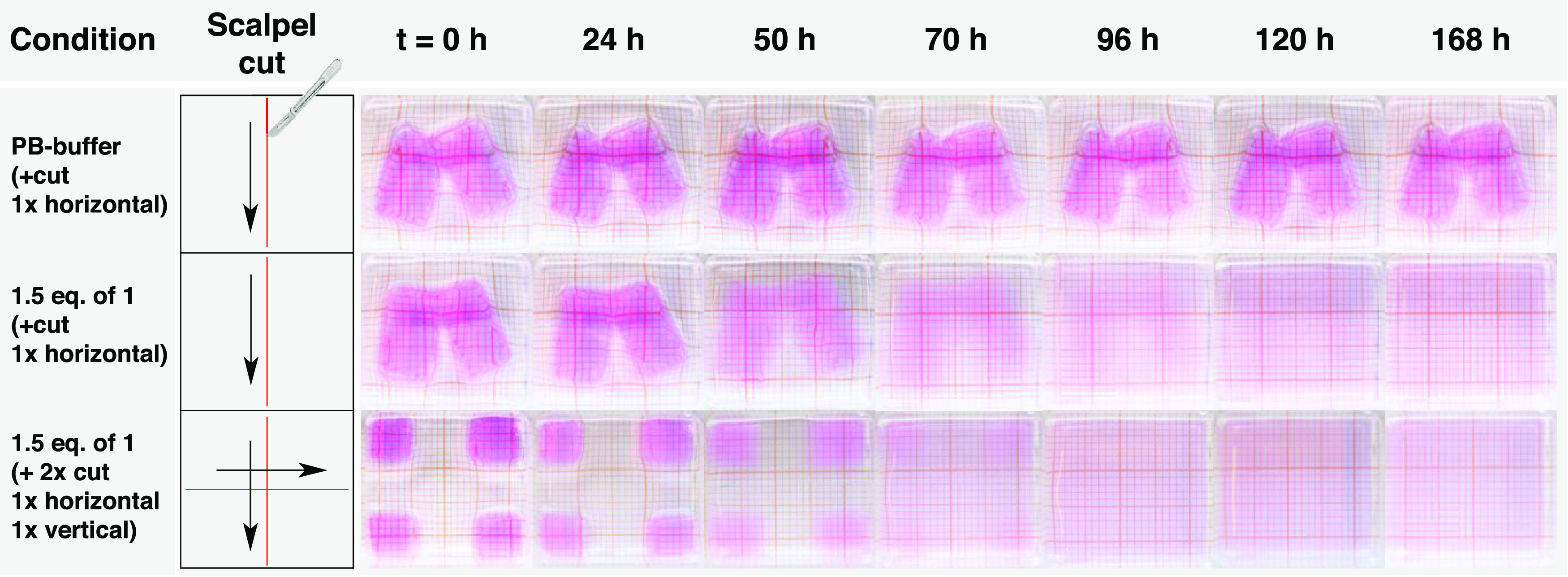
We present an approach for detecting thiol analytes through a self-propagating amplification cycle that triggers the macroscopic degradation of a hydrogel scaffold. The amplification system consists of an allylic phosphonium salt that upon reaction with the thiol analyte releases a phosphine, which reduces a disulfide to form two thiols, closing the cycle and ultimately resulting in exponential amplification of the thiol input. When integrated in a disulfide cross-linked hydrogel, the amplification process leads to physical degradation of the hydrogel in response to thiol analytes. We developed a numerical model to predict the behavior of the amplification cycle in response to varying concentrations of thiol triggers and validated it with experimental data. Using this system, we were able to detect multiple thiol analytes, including a small molecule probe, glutathione, DNA, and a protein, at concentrations ranging from 132 to 0.132 μM. In addition, we discovered that the self-propagating amplification cycle could be initiated by force-generated molecular scission, enabling damage-triggered hydrogel destruction.
我们提出了一种通过自传播放大循环检测硫醇分析物的方法,该循环会引发水凝胶支架的宏观降解。放大系统由烯丙基鏻盐组成,该盐与硫醇分析物反应时会释放出膦,膦会还原二硫键形成两个硫醇,从而闭合循环并最终导致硫醇输入呈指数级放大。当集成到二硫键交联的水凝胶中时,放大过程会导致水凝胶因硫醇分析物而发生物理降解。我们开发了一个数值模型来预测放大循环对不同浓度硫醇触发剂的响应行为,并用实验数据对其进行了验证。使用该系统,我们能够检测多种硫醇分析物,包括小分子探针、谷胱甘肽、DNA和一种蛋白质,浓度范围为132至0.132μM。此外,我们发现自传播放大循环可以由力引发的分子断裂启动,从而实现损伤触发的水凝胶破坏。