Department of Anatomy and Cell Biology, University Medicine Greifswald, Greifswald, Germany.
Fraunhofer Institute for Translational Medicine and Pharmacology ITMP, Hamburg, Germany.
J Am Soc Nephrol. 2023 Dec 1;34(12):1977-1990. doi: 10.1681/ASN.0000000000000235. Epub 2023 Sep 27.
FSGS affects the complex three-dimensional morphology of podocytes, resulting in loss of filtration barrier function and the development of sclerotic lesions. Therapies to treat FSGS are limited, and podocyte-specific drugs are unavailable. To address the need for treatments to delay or stop FSGS progression, researchers are exploring the repurposing of drugs that have been approved by the US Food and Drug Administration (FDA) for other purposes.
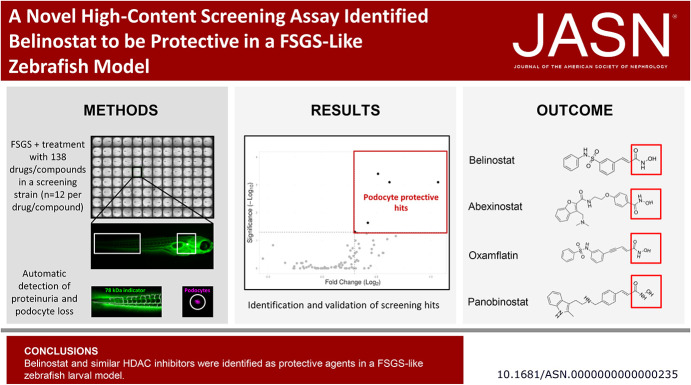
To identify drugs with potential to treat FSGS, we used a specific zebrafish screening strain to combine a high-content screening (HCS) approach with an in vivo model. This zebrafish screening strain expresses nitroreductase and the red fluorescent protein mCherry exclusively in podocytes (providing an indicator for podocyte depletion), as well as a circulating 78 kDa vitamin D-binding enhanced green fluorescent protein fusion protein (as a readout for proteinuria). To produce FSGS-like lesions in the zebrafish, we added 80 µ M metronidazole into the fish water. We used a specific screening microscope in conjunction with advanced image analysis methods to screen a library of 138 drugs and compounds (including some FDA-approved drugs) for podocyte-protective effects. Promising candidates were validated to be suitable for translational studies.
After establishing this novel in vivo HCS assay, we identified seven drugs or compounds that were protective in our FSGS-like model. Validation experiments confirmed that the FDA-approved drug belinostat was protective against larval FSGS. Similar pan-histone deacetylase inhibitors also showed potential to reproduce this effect.
Using an FSGS-like zebrafish model, we developed a novel in vivo HCS assay that identified belinostat and related pan-histone deacetylase inhibitors as potential candidates for treating FSGS.
FSGS 会影响足细胞的复杂三维形态,导致滤过屏障功能丧失和硬化病变的发展。治疗 FSGS 的方法有限,且缺乏针对足细胞的药物。为了寻找能够延缓或阻止 FSGS 进展的治疗方法,研究人员正在探索重新利用已被美国食品和药物管理局 (FDA) 批准用于其他用途的药物。
为了确定具有治疗 FSGS 潜力的药物,我们使用一种特定的斑马鱼筛选株,将高通量筛选 (HCS) 方法与体内模型相结合。这种斑马鱼筛选株在足细胞中特异性表达硝基还原酶和红色荧光蛋白 mCherry(提供足细胞耗竭的指标),以及循环的 78 kDa 维生素 D 结合增强型绿色荧光蛋白融合蛋白(作为蛋白尿的读数)。为了在斑马鱼中产生 FSGS 样病变,我们将 80µM 甲硝唑添加到鱼水中。我们使用特定的筛选显微镜结合先进的图像分析方法,对 138 种药物和化合物(包括一些 FDA 批准的药物)文库进行筛选,以寻找对足细胞具有保护作用的药物。有前途的候选药物经过验证后适合进行转化研究。
在建立了这种新的体内 HCS 测定方法后,我们在我们的 FSGS 样模型中确定了七种具有保护作用的药物或化合物。验证实验证实,FDA 批准的药物贝林司他对幼鱼 FSGS 具有保护作用。类似的泛组蛋白去乙酰化酶抑制剂也显示出具有重现这种效果的潜力。
使用 FSGS 样斑马鱼模型,我们开发了一种新的体内 HCS 测定方法,该方法确定贝林司他和相关的泛组蛋白去乙酰化酶抑制剂是治疗 FSGS 的潜在候选药物。