Department of Urology, Loyola University Medical Center, Maywood, IL, USA.
Department of Urology, Fienberg School of Medicine, Northwestern University, Evanston, IL, USA.
Mol Oncol. 2024 Feb;18(2):291-304. doi: 10.1002/1878-0261.13530. Epub 2023 Oct 5.
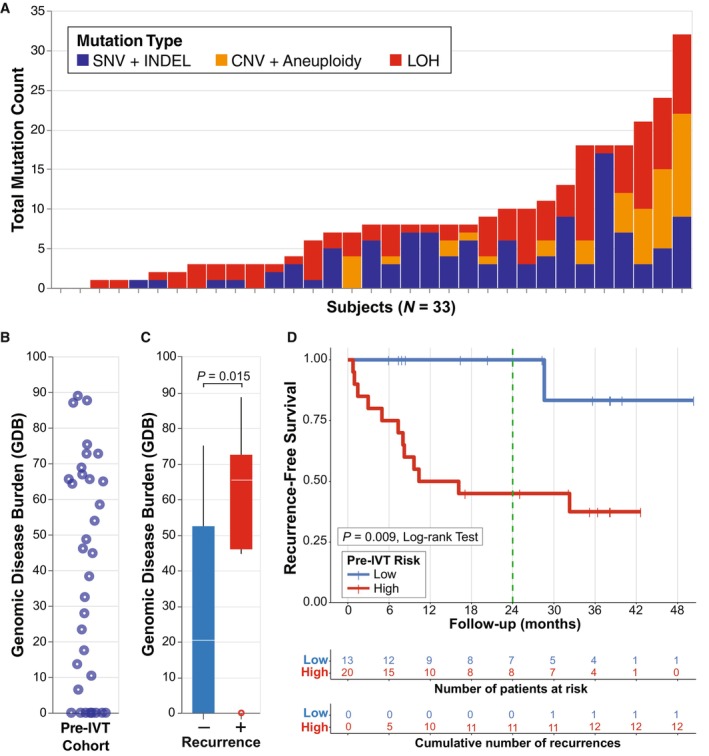
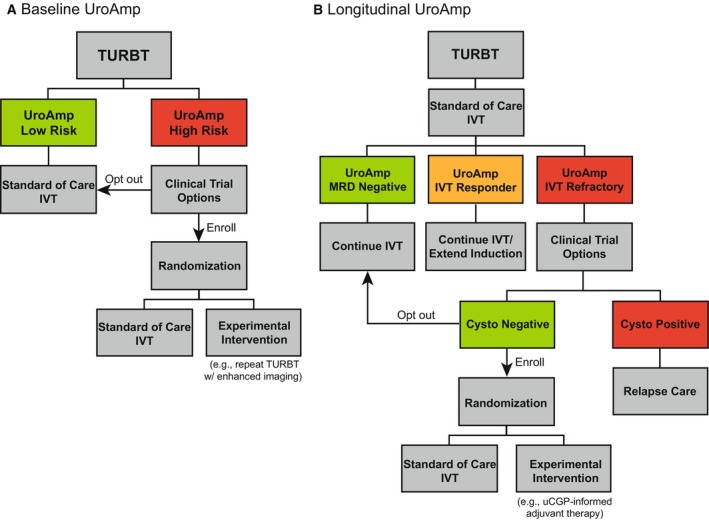
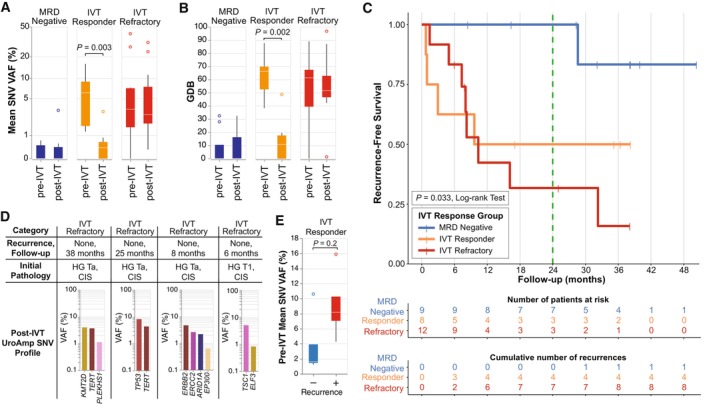
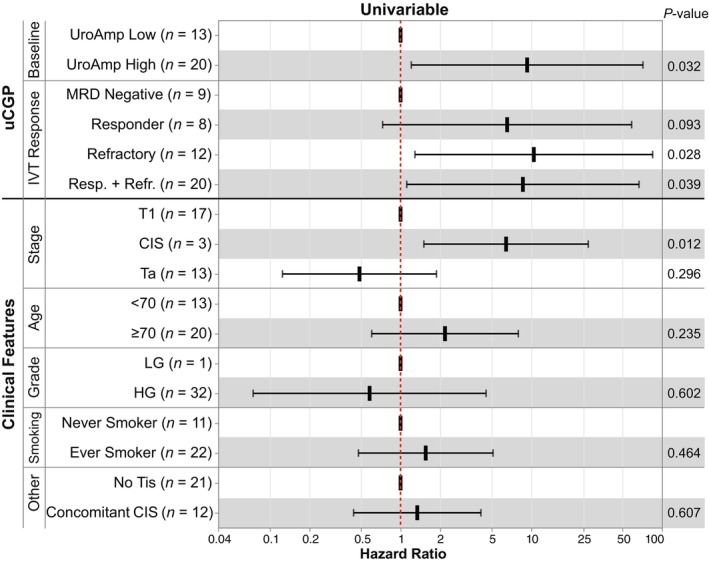
Intravesical therapy (IVT) is the standard of care to decrease risk of recurrence and progression for high-grade nonmuscle-invasive bladder cancer. However, post-IVT recurrence remains common and the ability to risk-stratify patients before or after IVT is limited. In this prospectively designed and accrued cohort study, we examine the utility of urinary comprehensive genomic profiling (uCGP) for predicting recurrence risk following transurethral resection of bladder tumor (TURBT) and evaluating longitudinal IVT response. Urine was collected before and after IVT instillation and uCGP testing was done using the UroAmp™ platform. Baseline uCGP following TURBT identified patients with high (61%) and low (39%) recurrence risk. At 24 months, recurrence-free survival (RFS) was 100% for low-risk and 45% for high-risk patients with a hazard ratio (HR) of 9.3. Longitudinal uCGP classified patients as minimal residual disease (MRD) Negative, IVT Responder, or IVT Refractory with 24-month RFS of 100%, 50%, and 32%, respectively. Compared with MRD Negative patients, IVT Refractory patients had a HR of 10.5. Collectively, uCGP enables noninvasive risk assessment of patients following TURBT and induction IVT. uCGP could inform surveillance cystoscopy schedules and identify high-risk patients in need of additional therapy.
膀胱内治疗 (IVT) 是降低高级别非肌肉浸润性膀胱癌复发和进展风险的标准治疗方法。然而,IVT 后复发仍然很常见,并且在 IVT 之前或之后对患者进行风险分层的能力有限。在这项前瞻性设计和累积队列研究中,我们研究了尿综合基因组分析 (uCGP) 在预测经尿道膀胱肿瘤切除术 (TURBT) 后复发风险和评估纵向 IVT 反应中的效用。在 IVT 灌洗前后采集尿液,并使用 UroAmp™ 平台进行 uCGP 检测。TURBT 后基线 uCGP 确定了高(61%)和低(39%)复发风险的患者。24 个月时,低危患者的无复发生存率 (RFS) 为 100%,高危患者为 45%,风险比 (HR) 为 9.3。纵向 uCGP 将患者分为微小残留疾病 (MRD) 阴性、IVT 应答者和 IVT 抵抗者,24 个月的 RFS 分别为 100%、50%和 32%。与 MRD 阴性患者相比,IVT 抵抗者的 HR 为 10.5。总的来说,uCGP 能够对 TURBT 后和诱导性 IVT 后的患者进行非侵入性风险评估。uCGP 可以为监测膀胱镜检查计划提供信息,并确定需要额外治疗的高危患者。