Bentley Gabriella, Zamir Osnat, Dahabre Rawan, Perry Shlomit, Karademas Evangelos C, Poikonen-Saksela Paula, Mazzocco Ketti, Sousa Berta, Pat-Horenczyk Ruth
School of Social Work and Social Welfare, Hebrew University of Jerusalem, Jerusalem 9190500, Israel.
Department of Psychology, University of Crete and Foundation for Research and Technology, 70013 Heraklion, Greece.
Cancers (Basel). 2023 Sep 15;15(18):4590. doi: 10.3390/cancers15184590.
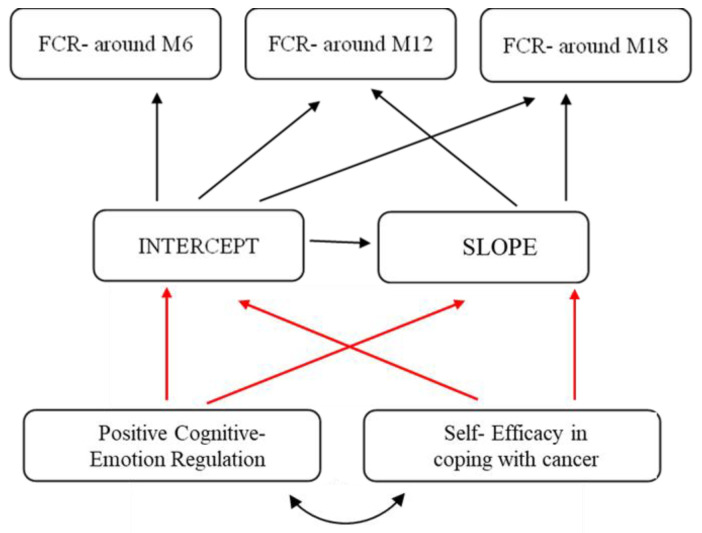
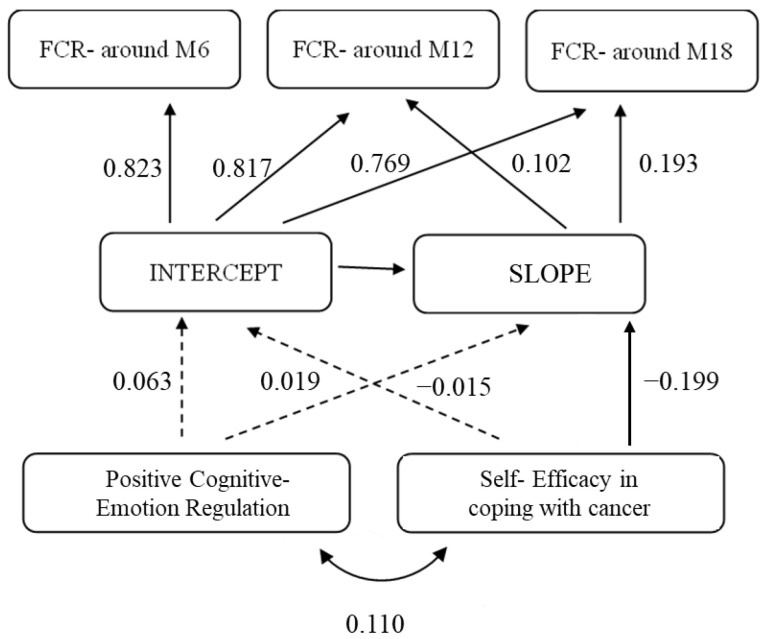
The current study aimed to examine the fear of cancer recurrence (FCR) trajectory and protective predictors in women coping with breast cancer (BC). The study's model investigated whether a higher coping self-efficacy and positive cognitive-emotion regulation at the time of the BC diagnosis would lead to reduced levels of FCR at six months and in later stages (12 and 18 months) post-diagnosis. The sample included 494 women with stages I to III BC from Finland, Italy, Portugal, and Israel. They completed self-report questionnaires, including the Fear of Cancer Recurrence Inventory (FCRI-SF), the Cancer Behavior Inventory-Brief Version (CBI-B), the Cognitive-Emotion Regulation Questionnaire (CERQ short), and medical-social-demographic data. Findings revealed that a higher coping self-efficacy at diagnosis predicted lower FCR levels after six months but did not impact the FCR trajectory over time. Surprisingly, positive cognitive-emotion regulation did not predict FCR levels or changes over 18 months. FCR levels remained stable from six to 18 months post-diagnosis. This study emphasizes the importance of developing specific cancer coping skills, such as coping self-efficacy. Enhancing coping self-efficacy in the first six months after BC diagnosis may lead to lower FCR levels later, as FCR tends to persist in the following year.
本研究旨在探讨应对乳腺癌(BC)的女性的癌症复发恐惧(FCR)轨迹及保护性预测因素。该研究模型调查了在BC诊断时较高的应对自我效能感和积极的认知情绪调节是否会导致诊断后六个月及后期阶段(12个月和18个月)FCR水平降低。样本包括来自芬兰、意大利、葡萄牙和以色列的494例I至III期BC女性。她们完成了自我报告问卷,包括癌症复发恐惧量表(FCRI-SF)、癌症行为量表简版(CBI-B)、认知情绪调节问卷(CERQ简版)以及医学-社会-人口统计学数据。研究结果显示,诊断时较高的应对自我效能感预测了六个月后较低的FCR水平,但并未影响FCR随时间的轨迹。令人惊讶的是,积极的认知情绪调节并未预测18个月内的FCR水平或变化。诊断后六个月至18个月,FCR水平保持稳定。本研究强调了发展特定癌症应对技能(如应对自我效能感)的重要性。由于FCR在接下来的一年中往往会持续存在,在BC诊断后的前六个月提高应对自我效能感可能会导致后期较低的FCR水平。