Stuebs Frederik A, Dietl Anna K, Koch Martin C, Adler Werner, Geppert Carol Immanuel, Hartmann Arndt, Knöll Antje, Mehlhorn Grit, Beckmann Matthias W, Schulmeyer Carla E, Heindl Felix, Emons Julius, Seibold Anja, Behrens Annika S, Gass Paul
Department of Gynecology and Obstetrics, Comprehensive Cancer Center Erlangen-European Metropolitan Area of Nuremberg (CCC ER-EMN), Erlangen University Hospital, Friedrich-Alexander-Universität Erlangen-Nürnberg, Universitaetsstrasse 21-23, 91054 Erlangen, Germany.
Department of Gynecology and Obstetrics, Hospital ANregiomed Ansbach, Escherichstrasse 1, 91522 Ansbach, Germany.
Cancers (Basel). 2023 Sep 19;15(18):4633. doi: 10.3390/cancers15184633.
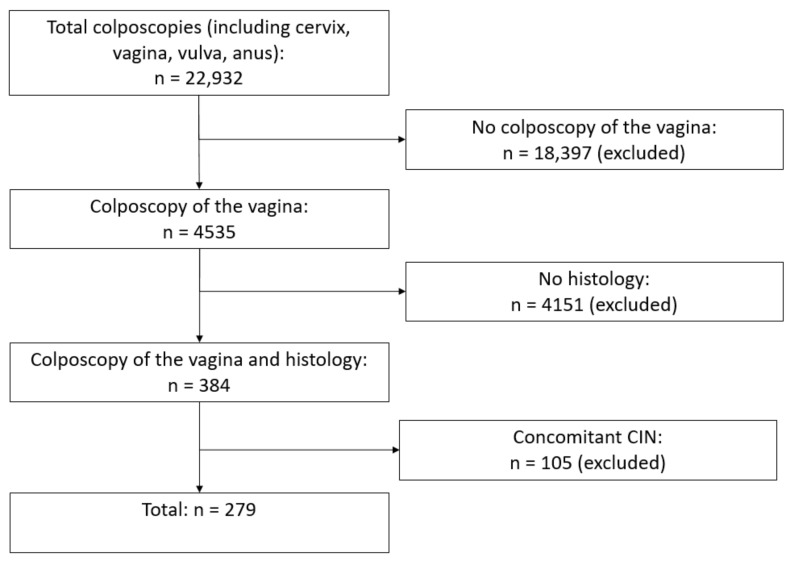
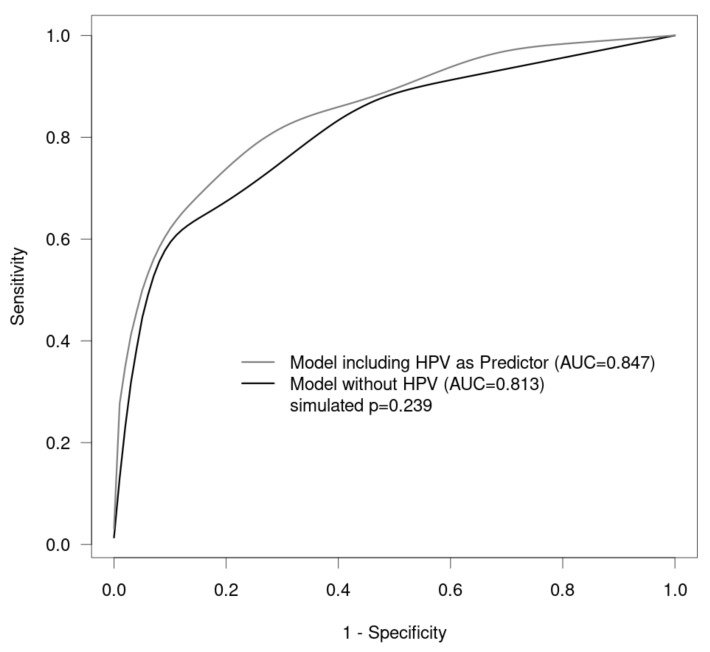
(1) Background: Vaginal intraepithelial neoplasia (VaIN) is a rare premalignant disease caused by persistent human papillomavirus (HPV) infection. Diagnosing VaIN is challenging; abnormal cytology and positive HPV tests are usually the first signs, but published data on their accuracy for detecting it are rare and contradictory. The aim of this study is to compare the results of hrHPV and cytology co-testing with the histological findings of the vagina. (2) Methods: In the certified Dysplasia Unit at Erlangen University Hospital, cytology and HPV samples from the uterine cervix or vaginal wall after hysterectomy were obtained between 2015 and 2023 and correlated with histological findings in biopsies from the vaginal wall. Women without vaginal biopsy findings or concomitant cervical disease were excluded. (3) Results: In all, 279 colposcopies in 209 women were included. The histological results were: benign ( = 86), VaIN I/vLSIL ( = 116), VaIN II/vHSIL ( = 41), VaIN III/vHSIL ( = 33), and carcinoma ( = 3). Accuracy for detecting VaIN was higher in women with previous hysterectomies. Positive HPV testing during colposcopy increased the likelihood for VaIN II/III/vHSIL threefold. The detection rate for VaIN III/vHSIL was 50% after hysterectomy and 36.4% without hysterectomy. (4) Conclusions: Women with risk factors for VaIN, including HPV-16 infection or prior HPV-related disease, need careful work-up of the entire vaginal wall. Hysterectomy for HPV-related disease and a history of cervical intraepithelial neoplasia (CIN) also increased the risk for VaIN II/III/vHSIL.
(1) 背景:阴道上皮内瘤变(VaIN)是一种由持续性人乳头瘤病毒(HPV)感染引起的罕见癌前疾病。诊断VaIN具有挑战性;异常细胞学检查和HPV检测呈阳性通常是最初迹象,但关于其检测准确性的已发表数据很少且相互矛盾。本研究的目的是比较高危型人乳头瘤病毒(hrHPV)和细胞学联合检测结果与阴道组织学检查结果。(2) 方法:在埃尔朗根大学医院认证的发育异常科室,于2015年至2023年期间获取子宫切除术后子宫颈或阴道壁的细胞学和HPV样本,并将其与阴道壁活检的组织学检查结果相关联。排除无阴道活检结果或伴有宫颈疾病的女性。(3) 结果:总共纳入了209名女性的279次阴道镜检查。组织学结果为:良性(=86)、VaIN I/低级别鳞状上皮内病变(vLSIL,=116)、VaIN II/高级别鳞状上皮内病变(vHSIL,=41)、VaIN III/vHSIL(=33)和癌(=3)。既往有子宫切除术的女性检测VaIN的准确性更高。阴道镜检查期间HPV检测呈阳性使VaIN II/III/vHSIL的可能性增加了三倍。子宫切除术后VaIN III/vHSIL的检出率为50%,未进行子宫切除术的检出率为36.4%。(4) 结论:有VaIN危险因素的女性,包括HPV-16感染或既往HPV相关疾病,需要对整个阴道壁进行仔细检查。因HPV相关疾病和有宫颈上皮内瘤变(CIN)病史而进行子宫切除术也增加了VaIN II/III/vHSIL的风险。