
自动化预测性噬菌体治疗药理学
Automating Predictive Phage Therapy Pharmacology.
作者信息
Abedon Stephen T
机构信息
Department of Microbiology, The Ohio State University, Mansfield, OH 44906, USA.
出版信息
Antibiotics (Basel). 2023 Sep 8;12(9):1423. doi: 10.3390/antibiotics12091423.
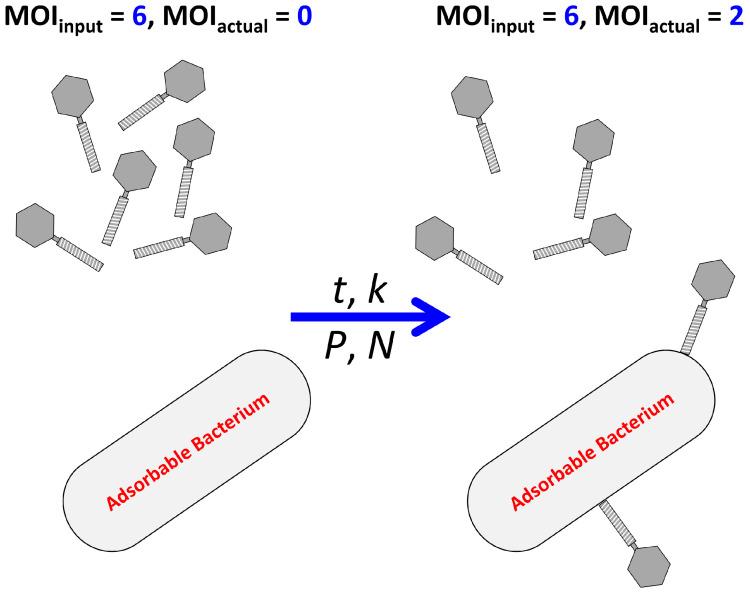
Viruses that infect as well as often kill bacteria are called bacteriophages, or phages. Because of their ability to act bactericidally, phages increasingly are being employed clinically as antibacterial agents, an infection-fighting strategy that has been in practice now for over one hundred years. As with antibacterial agents generally, the development as well as practice of this phage therapy can be aided via the application of various quantitative frameworks. Therefore, reviewed here are considerations of phage multiplicity of infection, bacterial likelihood of becoming adsorbed as a function of phage titers, bacterial susceptibility to phages also as a function of phage titers, and the use of Poisson distributions to predict phage impacts on bacteria. Considered in addition is the use of simulations that can take into account both phage and bacterial replication. These various approaches can be automated, i.e., by employing a number of online-available apps provided by the author, the use of which this review emphasizes. In short, the practice of phage therapy can be aided by various mathematical approaches whose implementation can be eased via online automation.
感染并常常杀死细菌的病毒被称为噬菌体。由于其具有杀菌能力,噬菌体越来越多地在临床上被用作抗菌剂,这种抗感染策略目前已应用了一百多年。与一般的抗菌剂一样,通过应用各种定量框架可以辅助噬菌体疗法的开发和实践。因此,本文回顾了噬菌体感染复数的相关考量、细菌吸附可能性作为噬菌体滴度函数的情况、细菌对噬菌体的敏感性同样作为噬菌体滴度函数的情况,以及使用泊松分布来预测噬菌体对细菌的影响。此外还考虑了使用能够兼顾噬菌体和细菌复制的模拟方法。这些不同的方法可以实现自动化,即通过使用作者提供的一些在线可用应用程序,本综述强调了这些应用程序的使用。简而言之,噬菌体疗法的实践可以借助各种数学方法得到辅助,而这些方法的实施可以通过在线自动化得以简化。

 Zotero 插件