Aguilar-Núñez Daniel, Hamed-Hamed Dina, Aguilar-García María, Cuevas-Cervera María, Pérez-Montilla José Javier, González-Muñoz Ana, Pruimboom Leo, Navarro-Ledesma Santiago
Department of Nursing and Podiatry, Faculty of Health Sciences, University of Malaga, Arquitecto Francisco Penalosa 3, Ampliación de Campus de Teatinos, 29071 Malaga, Spain.
Department of Physiotherapy, Faculty of Health Sciences, Campus of Melilla, University of Granada, Querol Street, 5, 52004 Melilla, Spain.
Biomedicines. 2023 Sep 5;11(9):2461. doi: 10.3390/biomedicines11092461.
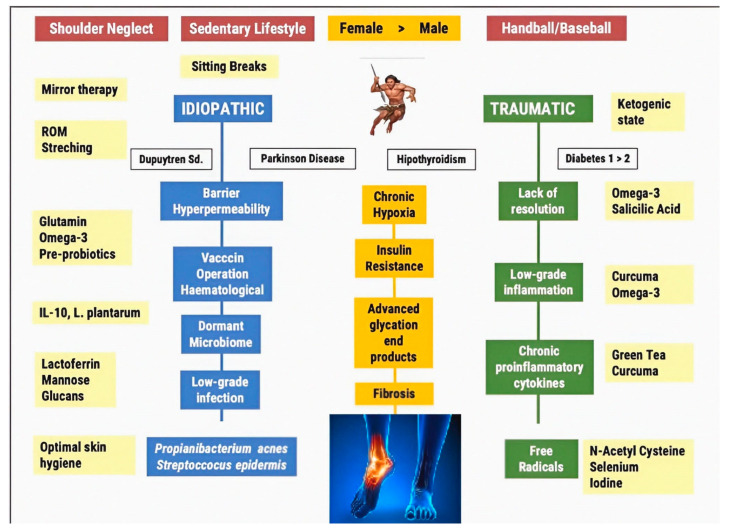
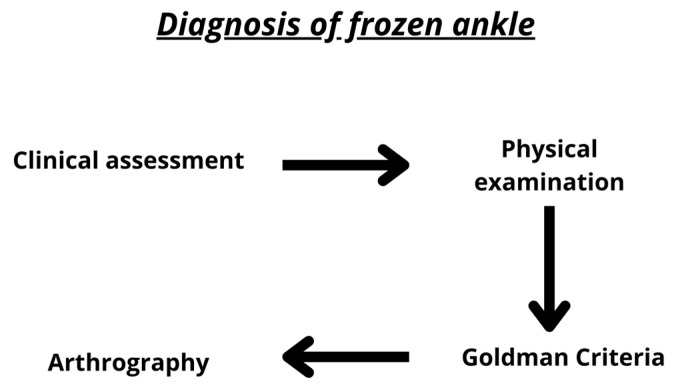
Adhesive capsulitis, characterized by progressive fibrosis, causes a gradual, painful loss of both active and passive articular motion, leading to the final contracture of the joint capsule. The condition commonly referred to as "frozen ankle" (FA), which Goldman was the first to use, relates to the ankle joint and is challenging to both diagnose and treat. Data acquired from people who suffer from this type of damage in other joints such as the shoulder, hip, and wrist also exists. Despite the fact that a well-defined model for the medical management of FA does not exist, a wide spectrum of local treatments, both surgical and non-surgical, exist. This review gives an overview of the current scientific position of the frozen ankle in terms of evolutionary factors, etiology, the different mechanisms of action involved, current treatment options, and other possible interventions based on recent discoveries of pathophysiological mechanisms. The application of extracorporeal shockwave therapy, stretching exercises, and corticosteroid injections combined with physical therapy modalities that enhance pain management, range of motion, and functional capacity is highly advisable for the treatment of adhesive capsulitis, commonly known as "frozen joints". Furthermore, the addition of interventions both impacting and analyzing chronic hypoxia, low-grade inflammation, and sedentary life is proposed.
粘连性关节囊炎以进行性纤维化为特征,会导致主动和被动关节活动逐渐疼痛性丧失,最终导致关节囊挛缩。这种情况通常被称为“冻结踝”(FA),是戈德曼首先使用的术语,与踝关节有关,诊断和治疗都具有挑战性。也有从肩部、髋部和腕部等其他关节遭受此类损伤的人那里获取的数据。尽管不存在明确的FA医疗管理模型,但存在广泛的局部治疗方法,包括手术和非手术治疗。本综述根据进化因素、病因、涉及的不同作用机制、当前的治疗选择以及基于病理生理机制最新发现的其他可能干预措施,概述了冻结踝的当前科学状况。对于粘连性关节囊炎(通常称为“冻结关节”)的治疗,强烈建议应用体外冲击波疗法、伸展运动、皮质类固醇注射,并结合增强疼痛管理、活动范围和功能能力的物理治疗方式。此外,还建议增加对慢性缺氧、低度炎症和久坐生活方式有影响和分析作用的干预措施。