Department of Anatomy, Physiology and Cell Biology, School of Veterinary Medicine, University of California, Davis, CA 95616, USA.
Department of Population Health and Reproduction, School of Veterinary Medicine, University of California, Davis, CA 95616, USA.
Int J Mol Sci. 2023 Sep 6;24(18):13718. doi: 10.3390/ijms241813718.
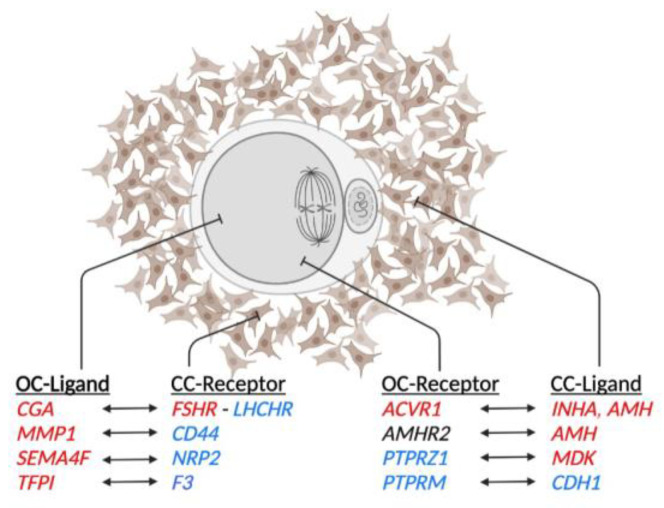
Maturation is a critical step in the development of an oocyte, and it is during this time that the oocyte advances to metaphase II (MII) of the meiotic cycle and acquires developmental competence to be fertilized and become an embryo. However, in vitro maturation (IVM) remains one of the limiting steps in the in vitro production of embryos (IVP), with a variable percentage of oocytes reaching the MII stage and unpredictable levels of developmental competence. Understanding the dynamics of oocyte maturation is essential for the optimization of IVM culture conditions and subsequent IVP outcomes. Thus, the aim of this study was to elucidate the transcriptome dynamics of oocyte maturation by comparing transcriptomic changes during in vitro maturation in both oocytes and their surrounding cumulus cells. Cumulus-oocyte complexes were obtained from antral follicles and divided into two groups: immature and in vitro-matured (MII). RNA was extracted separately from oocytes (OC) and cumulus cells (CC), followed by library preparation and RNA sequencing. A total of 13,918 gene transcripts were identified in OC, with 538 differentially expressed genes (DEG) between immature OC and in vitro-matured OC. In CC, 13,104 genes were expressed with 871 DEG. Gene ontology (GO) analysis showed an association between the DEGs and pathways relating to nuclear maturation in OC and GTPase activity, extracellular matrix organization, and collagen trimers in CC. Additionally, the follicle-stimulating hormone receptor gene () and luteinizing hormone/choriogonadotropin receptor gene () showed differential expressions between CC-MII and immature CC samples. Overall, these results serve as a foundation to further investigate the biological pathways relevant to oocyte maturation in horses and pave the road to improve the IVP outcomes and the overall clinical management of equine assisted reproductive technologies (ART).
卵母细胞的成熟是其发育过程中的一个关键步骤,在此期间,卵母细胞进入减数分裂周期的 MII 期,并获得受精和发育成为胚胎的能力。然而,体外成熟(IVM)仍然是体外胚胎生产(IVP)的限制步骤之一,有一定比例的卵母细胞达到 MII 期,并且发育能力不可预测。了解卵母细胞成熟的动态对于优化 IVM 培养条件和随后的 IVP 结果至关重要。因此,本研究旨在通过比较卵母细胞及其周围卵丘细胞在体外成熟过程中的转录组变化来阐明卵母细胞成熟的转录组动态。从窦卵泡中获得卵丘-卵母细胞复合物,并将其分为两组:未成熟和体外成熟(MII)。分别从卵母细胞(OC)和卵丘细胞(CC)中提取 RNA,然后进行文库制备和 RNA 测序。在 OC 中鉴定出 13918 个基因转录本,其中不成熟 OC 和体外成熟 OC 之间有 538 个差异表达基因(DEG)。在 CC 中,有 13104 个基因表达,其中 871 个 DEG。GO 分析表明,OC 中与核成熟相关的 DEGs 与 GTPase 活性、细胞外基质组织和 CC 中的胶原三聚体有关,CC 中 DEGs 与 GTPase 活性、细胞外基质组织和 CC 中的胶原三聚体有关。此外,卵泡刺激素受体基因()和黄体生成素/绒毛膜促性腺激素受体基因()在 CC-MII 和不成熟 CC 样本之间表现出差异表达。总体而言,这些结果为进一步研究与马卵母细胞成熟相关的生物学途径奠定了基础,并为改善 IVP 结果和马辅助生殖技术(ART)的整体临床管理铺平了道路。