A.N. Bach Institute of Biochemistry, Federal Research Centre 'Fundamentals of Biotechnology' of the Russian Academy of Sciences, Moscow 119071, Russia.
Central Institute for Tuberculosis, Moscow 107564, Russia.
Int J Mol Sci. 2023 Sep 12;24(18):13968. doi: 10.3390/ijms241813968.
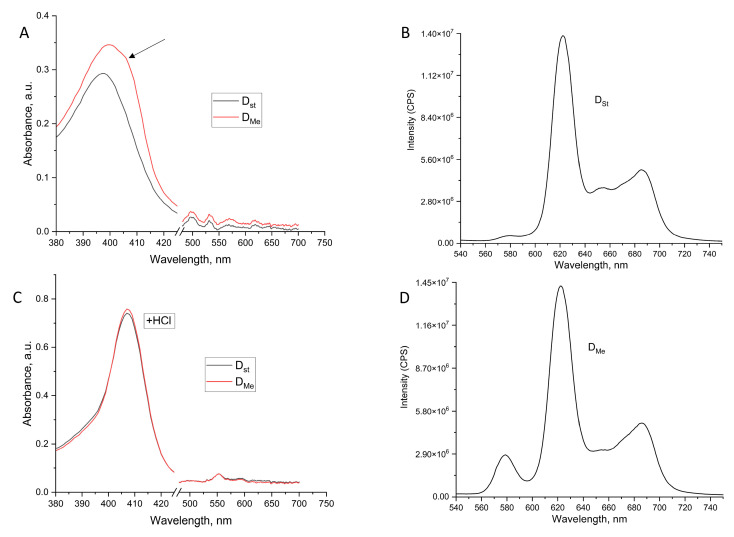
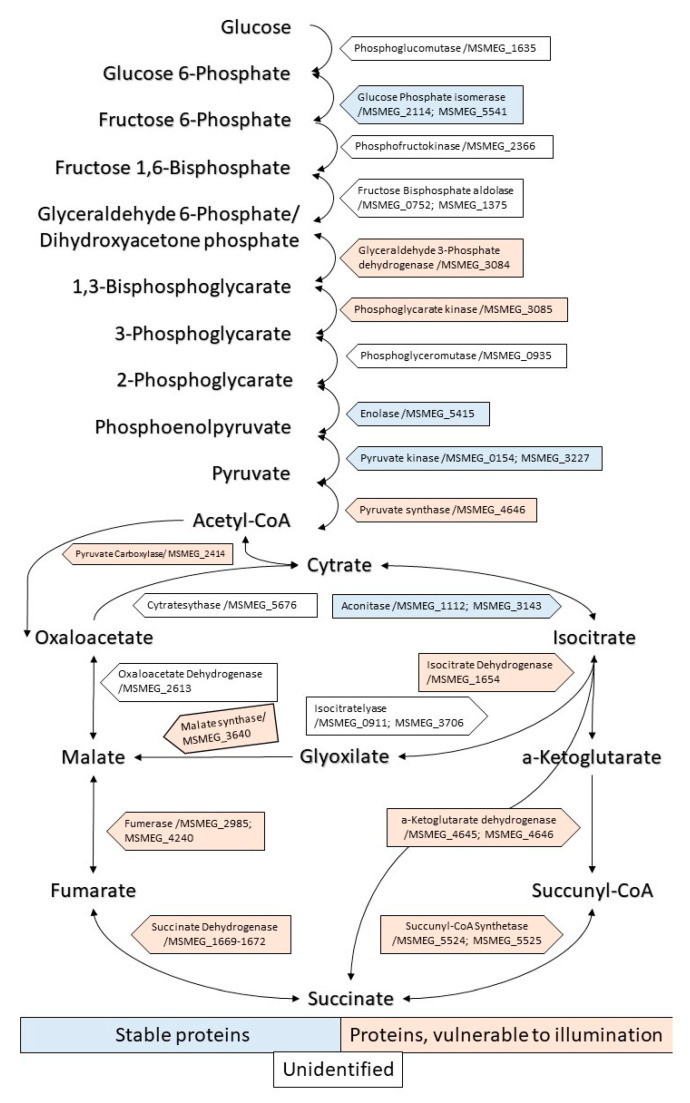
During transition into a dormant state, () cells are able to accumulate free porphyrins that makes them sensitive to photodynamic inactivation (PDI). The formation of dormant cells in a liquid medium with an increased concentration of magnesium (up to 25 mM) and zinc (up to 62 µM) resulted in an increase in the total amount of endogenous porphyrins in dormant cells and their photosensitivity, especially for bacteria phagocytosed by macrophages. To gain insight into possible targets for PDI in bacterial dormant mycobacterial cells, a proteomic profiling with SDS gel electrophoresis and mass spectrometry analysis were conducted. Illumination of dormant forms of resulted in the disappearance of proteins in the separating SDS gel. Dormant cells obtained under an elevated concentration of metal ions were more sensitive to PDI. Differential analysis of proteins with their identification with MALDI-TOF revealed that 45.2% and 63.9% of individual proteins disappeared from the separating gel after illumination for 5 and 15 min, respectively. Light-sensitive proteins include enzymes belonging to the glycolytic pathway, TCA cycle, pentose phosphate pathway, oxidative phosphorylation and energy production. Several proteins involved in protecting against oxygen stress and protein aggregation were found to be sensitive to light. This makes dormant cells highly vulnerable to harmful factors during a long stay in a non-replicative state. PDI caused inhibition of the respiratory chain activity and destroyed enzymes involved in the synthesis of proteins and nucleic acids, the processes which are necessary for dormant cell reactivation and their transition to multiplying bacteria. Because of such multiple targeting, PDI action via endogenous porphyrins could be considered as an effective approach for killing dormant bacteria and a perspective to inactivate dormant mycobacteria and combat the latent form of mycobacteriosis, first of all, with surface localization.
在进入休眠状态的过程中,()细胞能够积累游离卟啉,从而使它们对光动力失活(PDI)敏感。在含有高浓度镁(高达 25mM)和锌(高达 62µM)的液体培养基中形成休眠细胞会导致休眠细胞内源性卟啉总量增加,其光敏性增加,尤其是被巨噬细胞吞噬的细菌。为了深入了解细菌休眠分枝杆菌细胞中 PDI 的可能靶标,进行了 SDS 凝胶电泳和质谱分析的蛋白质组学分析。休眠形式的()的照射导致分离 SDS 凝胶中的蛋白质消失。在金属离子浓度升高的条件下获得的休眠细胞对 PDI 更敏感。用 MALDI-TOF 进行的蛋白质差异分析及其鉴定表明,在光照 5 和 15 分钟后,分别有 45.2%和 63.9%的单个蛋白质从分离胶中消失。对光敏感的蛋白质包括属于糖酵解途径、三羧酸循环、磷酸戊糖途径、氧化磷酸化和能量产生的酶。发现几种与保护免受氧应激和蛋白质聚集有关的蛋白质对光敏感。这使得休眠细胞在非复制状态下长时间停留时极易受到有害因素的影响。PDI 导致呼吸链活性抑制,并破坏参与蛋白质和核酸合成的酶,这些过程对于休眠细胞的再激活及其向增殖细菌的转变是必要的。由于这种多重靶向,通过内源性卟啉的 PDI 作用可以被认为是杀死休眠细菌的有效方法,并且是灭活休眠分枝杆菌和对抗分枝杆菌病潜伏形式的有前途的方法,首先是通过表面定位。