UO Nephrology Dialysis and Transplant, IRCCS Istituto Giannina Gaslini, 16147 Genoa, Italy.
UOSD Dialysis IRCCS Istituto Giannina Gaslini, 16147 Genoa, Italy.
Int J Mol Sci. 2023 Sep 21;24(18):14391. doi: 10.3390/ijms241814391.
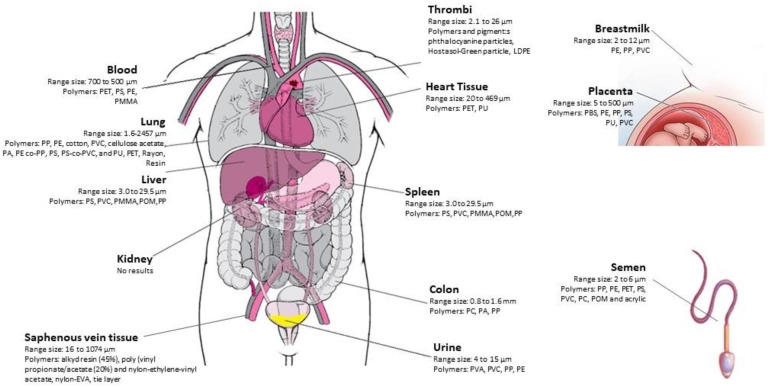
Plastic pollution became a main challenge for human beings as demonstrated by the increasing dispersion of plastic waste into the environment. Microplastics (MPs) have become ubiquitous and humans are exposed daily to inhalation or ingestion of plastic microparticles. Recent studies performed using mainly spectroscopy or spectrometry-based techniques have shown astounding evidence for the presence of MPs in human tissues, organs and fluids. The placenta, meconium, breast milk, lung, intestine, liver, heart and cardiovascular system, blood, urine and cerebrovascular liquid are afflicted by MPs' presence and deposition. On the whole, obtained data underline a great heterogeneity among different tissue and organs of the polymers characterized and the microparticles' dimension, even if most of them seem to be below 50-100 µm. Evidence for the possible contribution of MPs in human diseases is still limited and this field of study in medicine is in an initial state. However, increasing studies on their toxicity in vitro and in vivo suggest worrying effects on human cells mainly mediated by oxidative stress, inflammation and fibrosis. Nephrological studies are insufficient and evidence for the presence of MPs in human kidneys is still lacking, but the little evidence present in the literature has demonstrated histological and functional alteration of kidneys in animal models and cytotoxicity through apoptosis, autophagy, oxidative stress and inflammation in kidney cells. Overall, the manuscript we report in this review recommends urgent further study to analyze potential correlations between kidney disease and MPs' exposure in human.
塑料污染已成为人类面临的主要挑战之一,这一点在塑料废物不断扩散到环境中的情况中得到了证明。微塑料(MPs)已无处不在,人类每天都会通过吸入或摄入塑料微粒而暴露于其中。最近使用主要基于光谱或光谱技术的研究已经提供了令人震惊的证据,证明 MPs 存在于人体组织、器官和液体中。胎盘、胎粪、母乳、肺、肠、肝、心和心血管系统、血液、尿液和脑血管液都受到 MPs 存在和沉积的影响。总的来说,获得的数据强调了不同组织和器官中聚合物的特征和微粒尺寸的巨大异质性,尽管它们大多数似乎都低于 50-100 µm。关于 MPs 可能对人类疾病的贡献的证据仍然有限,医学领域的这一研究领域仍处于初始阶段。然而,越来越多的关于它们在体外和体内的毒性研究表明,它们主要通过氧化应激、炎症和纤维化对人类细胞产生令人担忧的影响。肾脏的研究还不够充分,目前仍缺乏 MPs 存在于人类肾脏中的证据,但文献中的少量证据表明,动物模型中肾脏的组织和功能发生了改变,以及通过细胞凋亡、自噬、氧化应激和炎症对肾脏细胞产生了细胞毒性。总的来说,我们在这篇综述中报告的手稿建议迫切需要进一步研究,以分析人类肾脏疾病与 MPs 暴露之间的潜在相关性。