Belosevic Adrian, Minder Anna-Elisabeth, Gueuning Morgan, van Breemen Franziska, Thun Gian Andri, Mattle-Greminger Maja P, Meyer Stefan, Baumer Alessandra, Minder Elisabeth I, Schneider-Yin Xiaoye, Barman-Aksözen Jasmin
Institute of Laboratory Medicine, Stadtspital Zürich, Triemli, 8063 Zurich, Switzerland.
Division of Endocrinology, Diabetology, Porphyria and Clinical Nutrition, Stadtspital Zürich, Triemli, 8063 Zurich, Switzerland.
Life (Basel). 2023 Sep 10;13(9):1889. doi: 10.3390/life13091889.
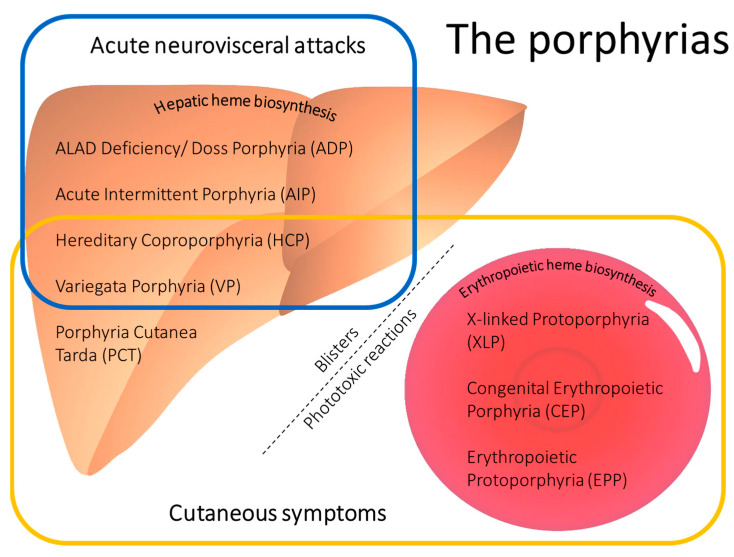
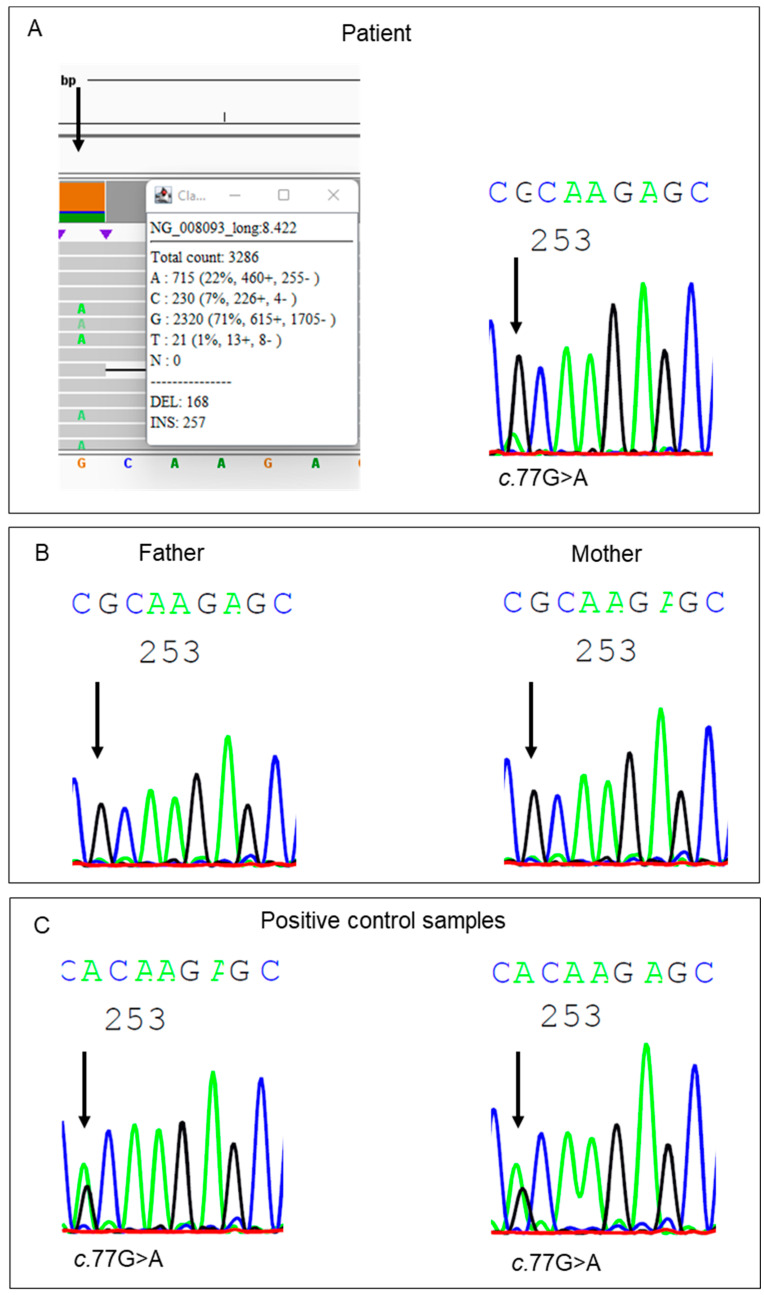
Acute porphyrias are a group of monogenetic inborn errors of heme biosynthesis, characterized by acute and potentially life-threatening neurovisceral attacks upon exposure to certain triggering factors. Biochemical analyses can determine the type of acute porphyria, and subsequent genetic analysis allows for the identification of pathogenic variants in the specific gene, which provides information for family counselling. In 2017, a male Swiss patient was diagnosed with an acute porphyria while suffering from an acute attack. The pattern of porphyrin metabolite excretion in urine, faeces, and plasma was typical for an acute intermittent porphyria (AIP), which is caused by inherited autosomal dominant mutations in the gene for hydroxymethylbilane synthase (HMBS), the third enzyme in the heme biosynthetic pathway. However, the measurement of HMBS enzymatic activity in the erythrocytes was within the normal range and Sanger sequencing of the gene failed to detect any pathogenic variants. To explore the molecular basis of the apparent AIP in this patient, we performed third-generation long-read single-molecule sequencing (nanopore sequencing) on a PCR product spanning the entire gene, including the intronic sequences. We identified a known pathogenic variant, c.77G>A, p.(Arg26His), in exon 3 at an allelic frequency of ~22% in the patient's blood. The absence of the pathogenic variant in the DNA of the parents and the results of additional confirmatory studies supported the presence of a de novo mosaic mutation. To our knowledge, such a mutation has not been previously described in any acute porphyria. Therefore, de novo mosaic mutations should be considered as potential causes of acute porphyrias when no pathogenic genetic variant can be identified through routine molecular diagnostics.
急性卟啉病是一组单基因遗传性血红素生物合成障碍疾病,其特征是在接触某些触发因素后会发生急性且可能危及生命的神经内脏发作。生化分析可以确定急性卟啉病的类型,随后的基因分析能够鉴定特定基因中的致病变异,这为家族遗传咨询提供了信息。2017年,一名瑞士男性患者在急性发作时被诊断为急性卟啉病。尿液、粪便和血浆中卟啉代谢产物的排泄模式是急性间歇性卟啉病(AIP)的典型表现,该病由血红素生物合成途径中的第三种酶——羟甲基胆色素合酶(HMBS)基因的常染色体显性遗传突变引起。然而,红细胞中HMBS酶活性的测定在正常范围内,并且该基因的桑格测序未能检测到任何致病变异。为了探究该患者明显的AIP的分子基础,我们对跨越整个基因(包括内含子序列)的PCR产物进行了第三代长读长单分子测序(纳米孔测序)。我们在患者血液中鉴定出一个已知的致病变异,即外显子3中的c.77G>A,p.(Arg26His),等位基因频率约为22%。父母DNA中不存在该致病变异以及其他验证性研究的结果支持了新发嵌合突变的存在。据我们所知,此前在任何急性卟啉病中均未描述过这种突变。因此,当通过常规分子诊断无法鉴定出致病变异时,应考虑新发嵌合突变是急性卟啉病的潜在病因。