Bialek Wojciech, Collawn James F, Bartoszewski Rafal
Department of Biophysics, Faculty of Biotechnology, University of Wrocław, 50-383 Wrocław, Poland.
Department of Cell, Developmental, and Integrative Biology, University of Alabama at Birmingham, Birmingham, AL 35233, USA.
Molecules. 2023 Sep 21;28(18):6740. doi: 10.3390/molecules28186740.
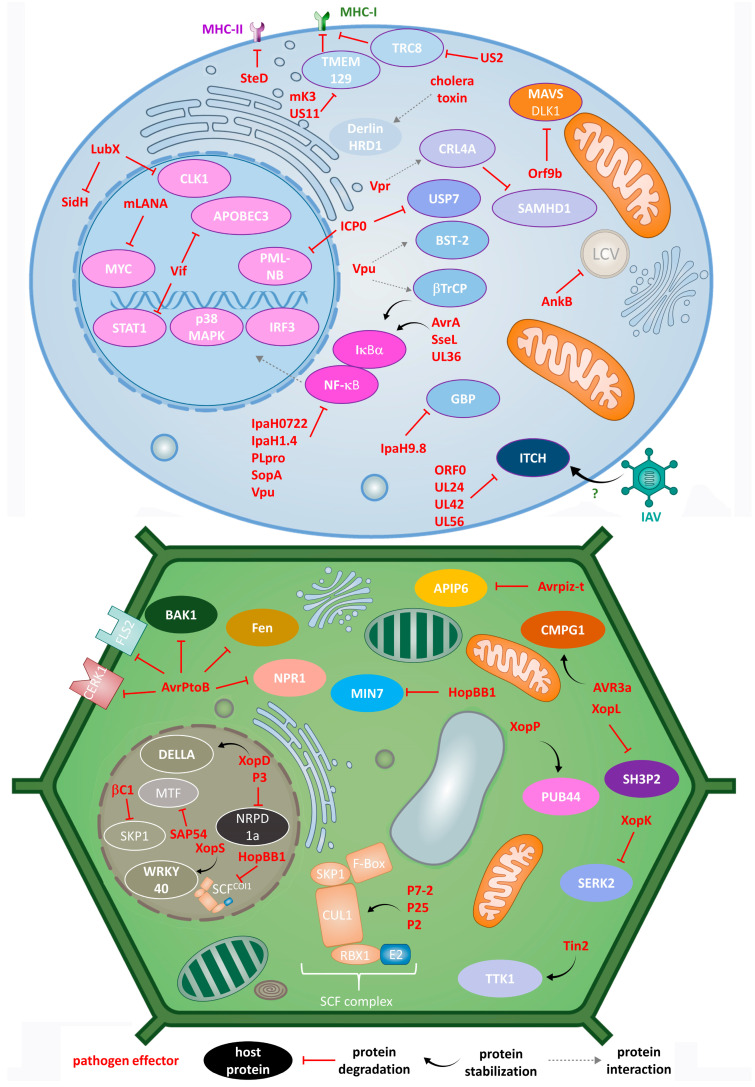
Ubiquitin, a small protein, is well known for tagging target proteins through a cascade of enzymatic reactions that lead to protein degradation. The ubiquitin tag, apart from its signaling role, is paramount in destabilizing the modified protein. Here, we explore the complex role of ubiquitin-mediated protein destabilization in the intricate proteolysis process by the 26S proteasome. In addition, the significance of the so-called ubiquitin-independent pathway and the role of the 20S proteasome are considered. Next, we discuss the ubiquitin-proteasome system's interplay with pathogenic microorganisms and how the microorganisms manipulate this system to establish infection by a range of elaborate pathways to evade or counteract host responses. Finally, we focus on the mechanisms that rely either on (i) hijacking the host and on delivering pathogenic E3 ligases and deubiquitinases that promote the degradation of host proteins, or (ii) counteracting host responses through the stabilization of pathogenic effector proteins.
泛素是一种小蛋白,因其通过一系列导致蛋白质降解的酶促反应标记靶蛋白而闻名。泛素标签除了其信号传导作用外,在使修饰蛋白不稳定方面至关重要。在这里,我们探讨泛素介导的蛋白质不稳定在26S蛋白酶体复杂的蛋白水解过程中的复杂作用。此外,还考虑了所谓的非泛素依赖性途径的重要性以及20S蛋白酶体的作用。接下来,我们讨论泛素-蛋白酶体系统与致病微生物的相互作用,以及微生物如何通过一系列精心设计的途径操纵该系统以建立感染,从而逃避或对抗宿主反应。最后,我们关注依赖于以下机制的机制:(i)劫持宿主并递送促进宿主蛋白降解的致病E3连接酶和去泛素酶,或(ii)通过稳定致病效应蛋白来对抗宿主反应。