Mudau Mulalo, Ngobeni-Nyambi Renay, Momba Maggy Ndombo Benteke
Department of Environmental, Water and Earth Sciences, Tshwane University of Technology, Arcadia Campus, Private Bag X680, Pretoria 0001, South Africa.
Department of Medicine, Division of Infectious Diseases, University of North Carolina School of Medicine, Chapel Hill, NC 27599, USA.
Pathogens. 2023 Aug 26;12(9):1085. doi: 10.3390/pathogens12091085.
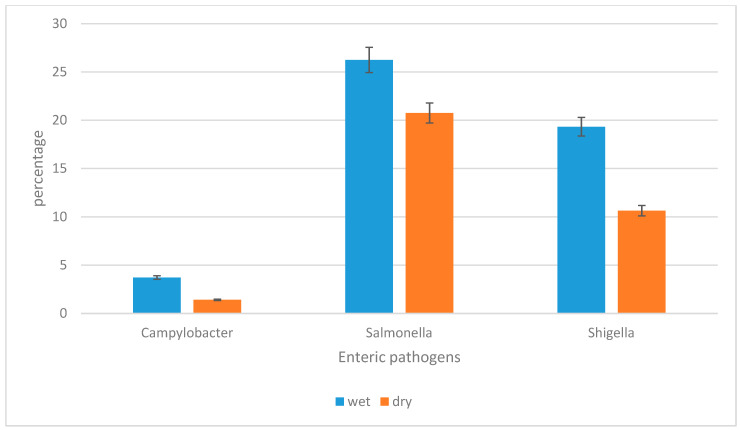
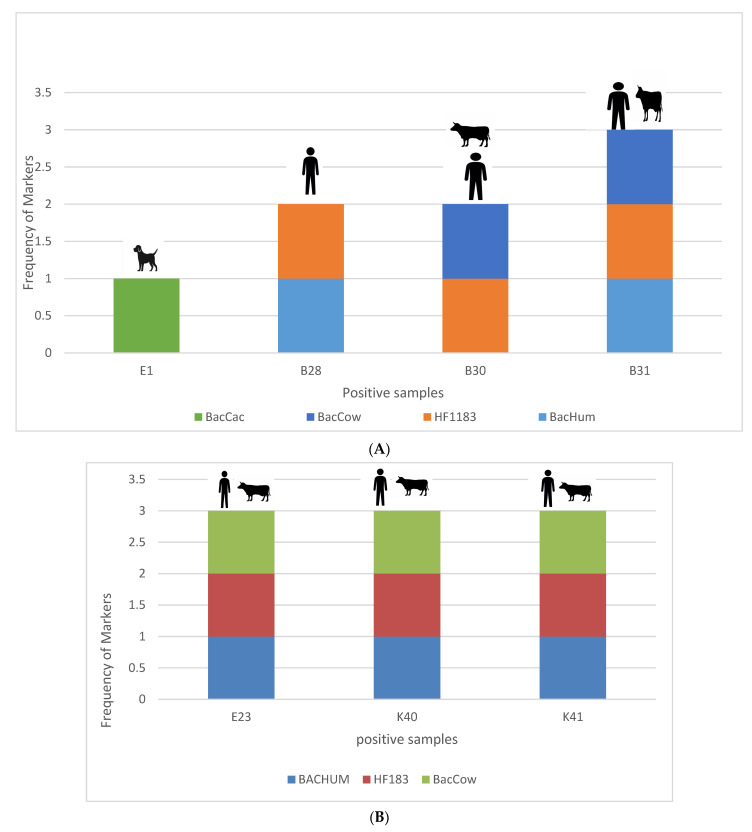
Access to clean and safe drinking water still remains a major challenge in the developing world, causing public health risks in terms of waterborne infections, especially in rural areas of sub-Saharan Africa. This study aimed to track and detect enteric pathogens ( subsp. serovar Typhimurium str. LT2, , and subsp. ) in rural water sources. It also sought to establish a correlation between these pathogens and the sources of faecal pollution. Multiplex qPCR and specific primers and probes were used for detection and tracking. The study successfully correlated the occurrence of target pathogens with sources of human and animal faecal contamination using host-specific genetic markers ( and for humans, for cows, for pigs, for chickens, and for dogs). The study revealed that enteric pathogens were found in 47.69% and 32.80% of samples during the wet and dry seasons, respectively. These pathogens were associated with human or animal faecal contamination. Correlations between pathogens and contamination sources were significant ( ≤ 0.05), with varying strengths during the wet and dry seasons. The findings emphasize the importance of identifying faecal contamination sources to protect rural communities from waterborne infections.
在发展中世界,获取清洁安全的饮用水仍然是一项重大挑战,在水源性感染方面引发公共卫生风险,尤其是在撒哈拉以南非洲的农村地区。本研究旨在追踪和检测农村水源中的肠道病原体(鼠伤寒沙门氏菌亚种血清型鼠伤寒菌株LT2、 以及 亚种 )。它还试图在这些病原体与粪便污染来源之间建立关联。采用多重定量聚合酶链反应以及特异性引物和探针进行检测和追踪。该研究利用宿主特异性遗传标记(人类的 和 、牛的 、猪的 、鸡的 以及狗的 )成功地将目标病原体的出现与人类和动物粪便污染来源关联起来。研究表明,在雨季和旱季,分别有47.69%和32.80%的样本中发现了肠道病原体。这些病原体与人类或动物粪便污染有关。病原体与污染来源之间的相关性显著( ≤ 0.05),在雨季和旱季强度有所不同。研究结果强调了识别粪便污染来源对于保护农村社区免受水源性感染的重要性。