Department of Public Health, Medicine and Health Sciences College, Ambo University, P.O.BOX:19, Ambo, Oromia, Ethiopia.
BMC Pediatr. 2021 Nov 30;21(1):532. doi: 10.1186/s12887-021-03022-2.
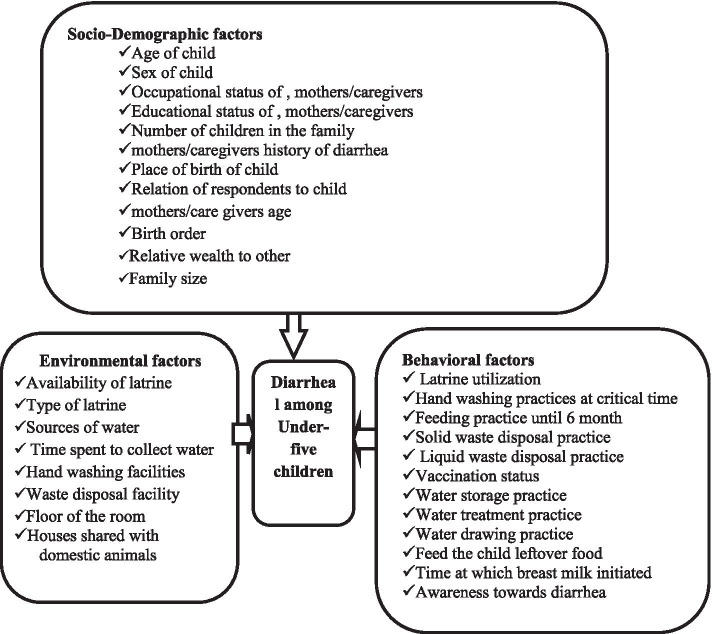
Globally, in 2017, there were nearly 1.7 billion cases of childhood diarrheal diseases, and it is the second most important cause of morbidity and mortality among under-five children in low-income countries, including Ethiopia. Sanitary conditions, poor housing, an unsanitary environment, insufficient safe water supply, cohabitation with domestic animals that may carry human pathogens, and a lack of food storage facilities, in combination with socioeconomic and behavioral factors, are common causes of diarrhea disease and have had a significant impact on diarrhea incidence in the majority of developing countries.
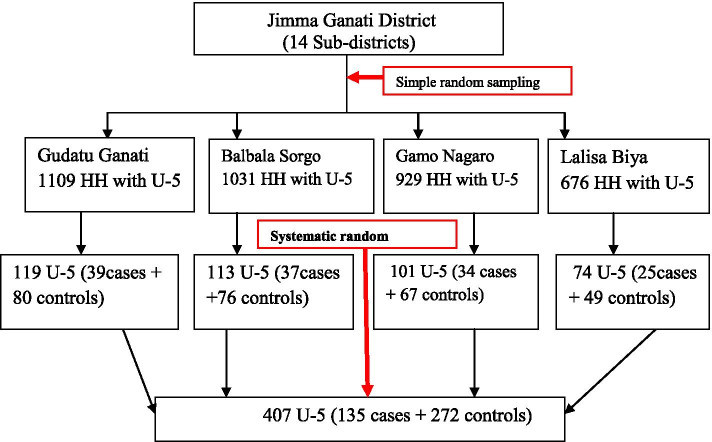
A community-based unmatched case-control study was conducted on 407 systematically sampled under-five children of Jimma Geneti District (135 with diarrhea and 272 without diarrhea) from May 01 to 30, 2020. Data was collected using an interview administered questionnaire and observational checklist adapted from the WHO/UNICEF core questionnaire and other related literature. Descriptive, bivariate, and multivariate binary logistic regression analyses were done by using SPSS version 20.0.
Sociodemographic determinants such as being a child of 12-23 months of age (AOR 3.3, 95% CI 1.68-6.46; P < 0.05) and mothers'/caregivers' history of diarrheal diseases (AOR 7.38, 95% CI 3.12-17.44; P < 0.05) were significantly associated with diarrheal diseases among under-five children. Environmental and behavioral factors such as lack of a hand-washing facility near a latrine (AOR 5.22, 95% CI 3.94-26.49; P < 0.05), a lack of hand-washing practice at critical times (AOR 10.6, 95% CI 3.74-29.81; P < 0.05), improper domestic solid waste disposal (AOR 2.68, 95% CI 1.39-5.18; P < 0.05), and not being vaccinated against rotavirus (AOR 2.45, 95% CI 1.25-4.81; P < 0,05) were found important determinants of diarrheal diseases among under-five children.
The unavailability of a hand-washing facility nearby latrine, mothers'/caregivers' history of the last 2 weeks' diarrheal diseases, improper latrine utilization, lack of hand-washing practice at critical times, improper solid waste disposal practices, and rotavirus vaccination status were the determinants of diarrheal diseases among under-five children identified in this study. Thus, promoting the provision of continuous and modified health information programs for households on the importance of sanitation, personal hygiene, and vaccination against rotavirus is fundamental to decreasing the burden of diarrheal disease among under-five children.
在全球范围内,2017 年有近 17 亿例儿童腹泻病例,在包括埃塞俄比亚在内的低收入国家,它是五岁以下儿童发病率和死亡率的第二大主要原因。卫生条件差、住房简陋、环境卫生差、安全饮用水供应不足、与可能携带人类病原体的家养动物同居以及缺乏食物储存设施,加上社会经济和行为因素,是腹泻病的常见原因,对大多数发展中国家的腹泻发病率产生了重大影响。
2020 年 5 月 1 日至 30 日,对吉马 Genet 区的 407 名系统抽样的 5 岁以下儿童(135 名腹泻和 272 名无腹泻)进行了基于社区的病例对照研究。使用访谈式问卷调查表和经过 WHO/UNICEF 核心问卷和其他相关文献改编的观察清单收集数据。使用 SPSS 版本 20.0 进行描述性、双变量和多变量二元逻辑回归分析。
社会人口统计学决定因素,如 12-23 个月龄的儿童(AOR 3.3,95%CI 1.68-6.46;P<0.05)和母亲/照顾者的腹泻病史(AOR 7.38,95%CI 3.12-17.44;P<0.05)与 5 岁以下儿童腹泻病显著相关。环境和行为因素,如厕所附近缺乏洗手设施(AOR 5.22,95%CI 3.94-26.49;P<0.05)、关键时间缺乏洗手习惯(AOR 10.6,95%CI 3.74-29.81;P<0.05)、家庭固体废物处理不当(AOR 2.68,95%CI 1.39-5.18;P<0.05)和未接种轮状病毒疫苗(AOR 2.45,95%CI 1.25-4.81;P<0.05)是 5 岁以下儿童腹泻病的重要决定因素。
本研究发现,厕所附近没有洗手设施、母亲/照顾者在过去 2 周内的腹泻病史、厕所使用不当、关键时间缺乏洗手习惯、固体废物处理不当和轮状病毒疫苗接种状况是 5 岁以下儿童腹泻病的决定因素。因此,促进为家庭提供持续和改进的卫生信息方案,宣传卫生、个人卫生和轮状病毒疫苗接种的重要性,对于降低 5 岁以下儿童腹泻病的负担至关重要。