Figueiredo Clara Salles, Roseira Elias Soares, Viana Tainá Teixeira, Silveira Marcelo Augusto Duarte, de Melo Rodrigo Morel Vieira, Fernandez Miguel Godeiro, Lemos Livia Maria Goes, Passos Luiz Carlos Santana
Programa de Pós Graduação em Medicina e Saúde (Graduate Program in Medicine and Health), Federal University of Bahia, Salvador 40110-060, BA, Brazil.
Hospital Ana Nery, Salvador 40301-155, BA, Brazil.
Pharmaceuticals (Basel). 2023 Sep 1;16(9):1242. doi: 10.3390/ph16091242.
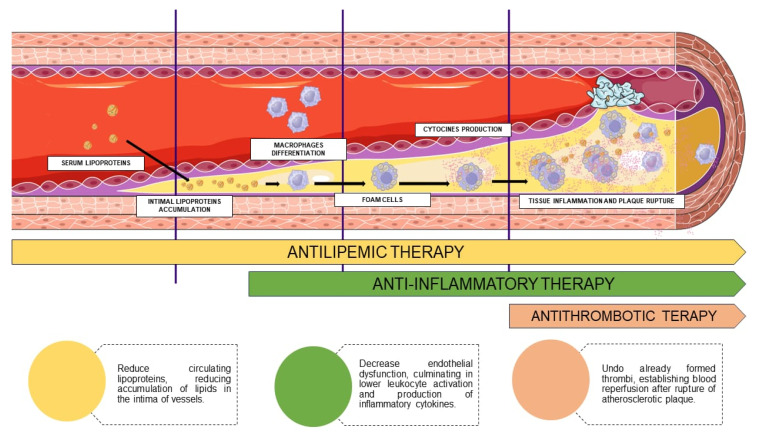
Atherosclerosis is a lipid-driven immune-inflammatory disease that affects the arteries, leading to multifocal plaque development. The inflammatory process involves the activation of immune cells and various inflammatory pathways. Anti-inflammatory drugs have been shown to be effective in reducing cardiovascular events in individuals with coronary disease. However, their use is still limited due to concerns about long-term follow-up, cost-effectiveness, adverse effects, and the identification of the ideal patient profile to obtain maximum benefits. This review aims to improve the understanding of inflammation in coronary atherosclerosis and explore potential therapeutic interventions, encompassing both traditional and non-traditional anti-inflammatory approaches. By addressing these concepts, we seek to contribute to the advancement of knowledge about this type of treatment for coronary artery disease.
动脉粥样硬化是一种由脂质驱动的免疫炎症性疾病,会影响动脉,导致多灶性斑块形成。炎症过程涉及免疫细胞的激活和各种炎症途径。抗炎药物已被证明可有效减少冠心病患者的心血管事件。然而,由于对长期随访、成本效益、不良反应以及确定能获得最大益处的理想患者特征的担忧,其使用仍然有限。本综述旨在增进对冠状动脉粥样硬化炎症的理解,并探索潜在的治疗干预措施,包括传统和非传统的抗炎方法。通过阐述这些概念,我们力求为有关这类冠心病治疗的知识进步做出贡献。