Naidoo Damian, Meyer-Weitz Anna, Govender Kaymarlin
Discipline of Psychology, School of Applied Human Sciences, Howard College, University of KwaZulu-Natal, Durban 4041, South Africa.
Health Promotion Unit, KwaZulu-Natal Department of Health, Pietermaritzburg, Private Bag X9051, Pietermaritzburg 3200, South Africa.
Vaccines (Basel). 2023 Sep 15;11(9):1491. doi: 10.3390/vaccines11091491.
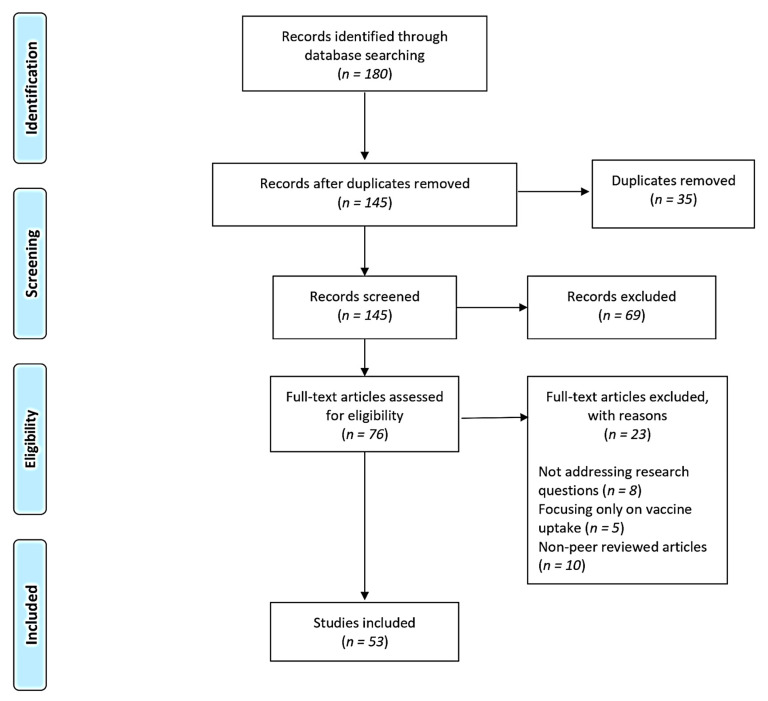
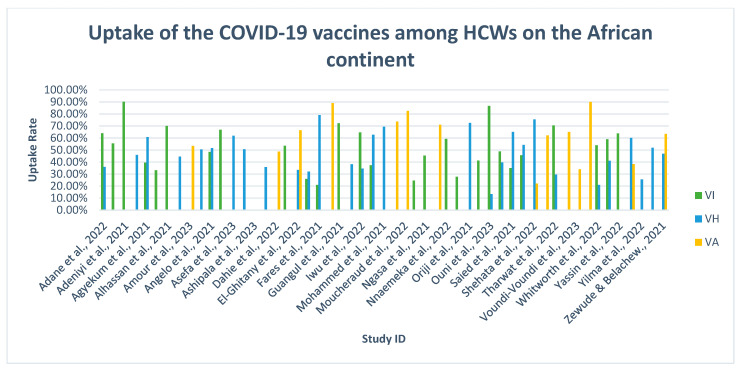
Vaccination plays a crucial role in combating the global COVID-19 pandemic. Immunizing all healthcare workers (HCWs) is essential for increasing vaccine confidence and acceptance within the general population. Understanding the factors that hinder or facilitate vaccine uptake among HCWs is of utmost importance, considering they are among the first to be vaccinated. This review follows Arksey and O'Malley's five-stage methodological framework. We searched PubMed, Web of Science, ProQuest, WorldCat Discovery, and Google Scholar for peer-reviewed articles published from 2020 to 2023. A descriptive analysis and narrative synthesis approach were employed to collect and synthesize data. Using the social-ecological model as a framework, the literature was categorized into themes at the intrapersonal, interpersonal, organizational, community, and policy levels. We reviewed a total of fifty-three published academic articles, with the majority of studies conducted in Ethiopia and Nigeria. The intention for vaccine uptake resulted in an unsatisfactory (52%) overall uptake rate among HCWs. Individual-level determinants associated with vaccine uptake included being male, middle-aged, being a physician, having a higher level of education, and having a chronic illness. This review identified significant barriers at each level, such as safety concerns, perceived scientific uncertainty, vaccine ineffectiveness, lack of trust in stakeholders, and religious beliefs. Additionally, we identified facilitators at each level, with the most common factors promoting intention to uptake being the desire to protect oneself and others and a high perceived susceptibility to contracting COVID-19. This review highlights the existence of significant barriers to vaccine uptake on the African continent. Given that HCWs play a crucial role in guiding the public's vaccination decisions, it is imperative to prioritize education and training efforts about the safety and effectiveness of COVID-19 vaccines.
疫苗接种在抗击全球新冠疫情中发挥着关键作用。为提高普通民众对疫苗的信心和接受度,为所有医护人员接种疫苗至关重要。鉴于医护人员是首批接种疫苗的群体之一,了解阻碍或促进医护人员接种疫苗的因素至关重要。本综述遵循阿克西和奥马利的五阶段方法框架。我们在PubMed、科学网、ProQuest、WorldCat Discovery和谷歌学术搜索中检索了2020年至2023年发表的同行评议文章。采用描述性分析和叙述性综合方法收集和综合数据。以社会生态模型为框架,将文献分为个人、人际、组织、社区和政策层面的主题。我们共综述了53篇已发表的学术文章,其中大多数研究在埃塞俄比亚和尼日利亚进行。医护人员接种疫苗的意愿导致总体接种率不尽人意(52%)。与疫苗接种相关的个体层面决定因素包括男性、中年、医生、受教育程度较高以及患有慢性病。本综述确定了每个层面的重大障碍,如安全担忧、感知到的科学不确定性、疫苗无效、对利益相关者缺乏信任以及宗教信仰。此外,我们还确定了每个层面的促进因素,最常见的促进接种意愿的因素是保护自己和他人的愿望以及对感染新冠病毒的高易感性。本综述强调了非洲大陆在疫苗接种方面存在重大障碍。鉴于医护人员在引导公众接种疫苗决策方面发挥着关键作用,必须优先开展关于新冠疫苗安全性和有效性的教育和培训工作。