Kahan Anat, Mahe Karan, Dutta Sayan, Kassraian Pegah, Wang Alexander, Gradinaru Viviana
Division of Biology and Biological Engineering, California Institute of Technology, Pasadena, CA 91125, USA.
iScience. 2023 Sep 9;26(10):107865. doi: 10.1016/j.isci.2023.107865. eCollection 2023 Oct 20.
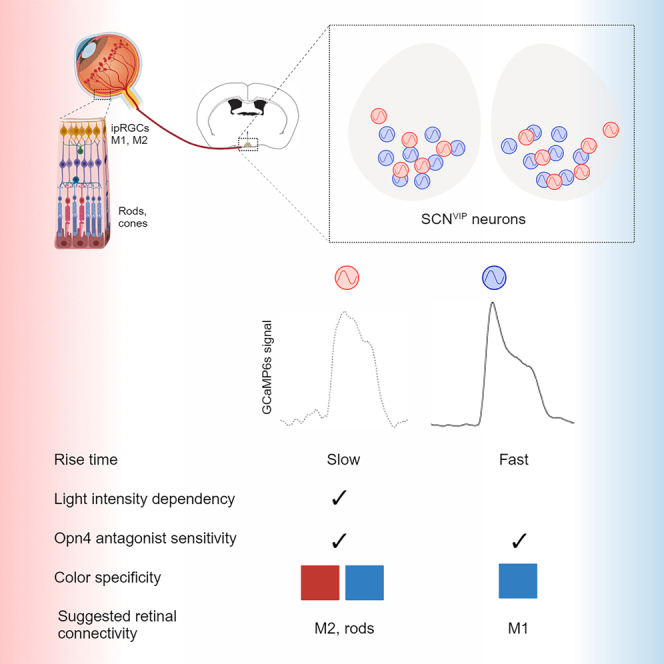
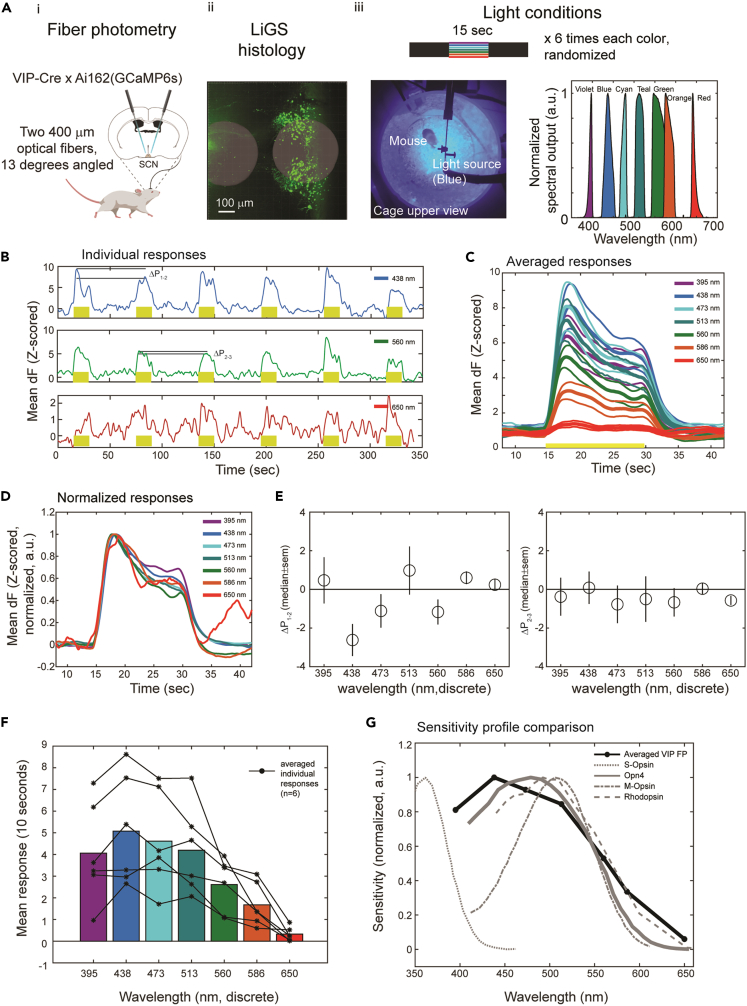
The circadian rhythm pacemaker, the suprachiasmatic nucleus (SCN), mediates light entrainment via vasoactive intestinal peptide (VIP) neurons (SCN). Yet, how these neurons uniquely respond and connect to intrinsically photosensitive retinal ganglion cells (ipRGCs) expressing melanopsin (Opn4) has not been determined functionally in freely behaving animals. To address this, we first used monosynaptic tracing from SCN neurons in mice and identified two SCN subpopulations. Second, we recorded calcium changes in response to ambient light, at both bulk and single-cell levels, and found two unique activity patterns in response to high- and low-intensity blue light. The activity patterns of both subpopulations could be manipulated by application of an Opn4 antagonist. These results suggest that the two SCN subpopulations connect to two types of Opn4-expressing ipRGCs, likely M1 and M2, but only one is responsive to red light. These findings have important implications for our basic understanding of non-image-forming circadian light processing.
昼夜节律起搏器,即视交叉上核(SCN),通过血管活性肠肽(VIP)神经元介导光信号的同步化(SCN)。然而,在自由活动的动物中,这些神经元如何独特地响应并连接到表达黑视蛋白(Opn4)的内在光敏视网膜神经节细胞(ipRGCs),尚未在功能上得到确定。为了解决这个问题,我们首先在小鼠中利用SCN神经元进行单突触追踪,并鉴定出两个SCN亚群。其次,我们在群体和单细胞水平上记录了对环境光的钙变化,并发现了对高强度和低强度蓝光的两种独特活动模式。两个亚群的活动模式均可通过应用Opn4拮抗剂来操纵。这些结果表明,两个SCN亚群连接到两种表达Opn4的ipRGCs,可能是M1和M2,但只有一个对红光有反应。这些发现对于我们对非成像昼夜节律光处理的基本理解具有重要意义。