Kyrle Paul A, Eischer Lisbeth, Šinkovec Hana, Gressenberger Paul, Gary Thomas, Brodmann Marianne, Heinze Georg, Eichinger Sabine
Division of Hematology and Hemostasis, Department of Medicine I, Medical University of Vienna, Vienna A-1090, Austria.
Karl Landsteiner Institute of Thrombosis Research, Vienna A-1020, Austria.
Eur Heart J. 2024 Jan 1;45(1):45-53. doi: 10.1093/eurheartj/ehad618.
Patients with unprovoked venous thromboembolism (VTE) have a high recurrence risk, and guidelines suggest extended-phase anticoagulation. Many patients never experience recurrence but are exposed to bleeding. The aim of this study was to assess the performance of the Vienna Prediction Model (VPM) and to evaluate if the VPM accurately identifies these patients.
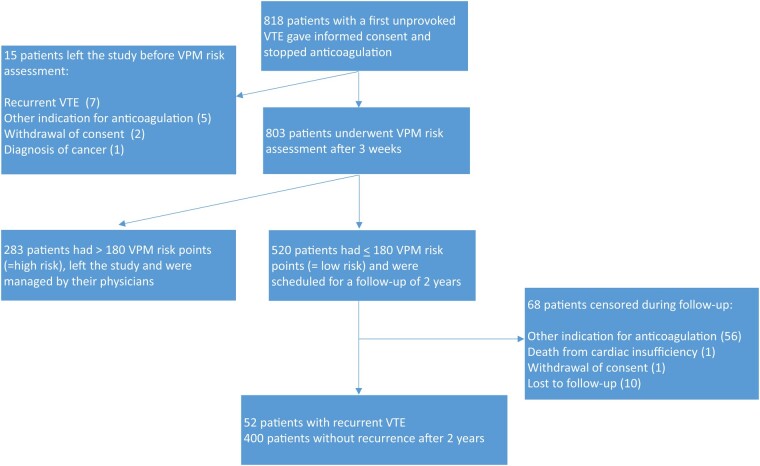
In patients with unprovoked VTE, the VPM was performed 3 weeks after anticoagulation withdrawal. Those with a predicted 1-year recurrence risk of ≤5.5% were prospectively followed. Study endpoint was recurrent VTE over 2 years.
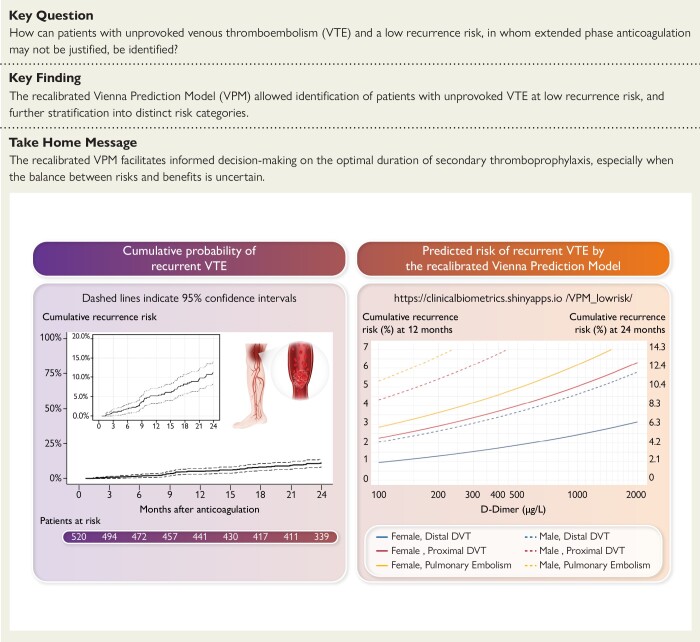
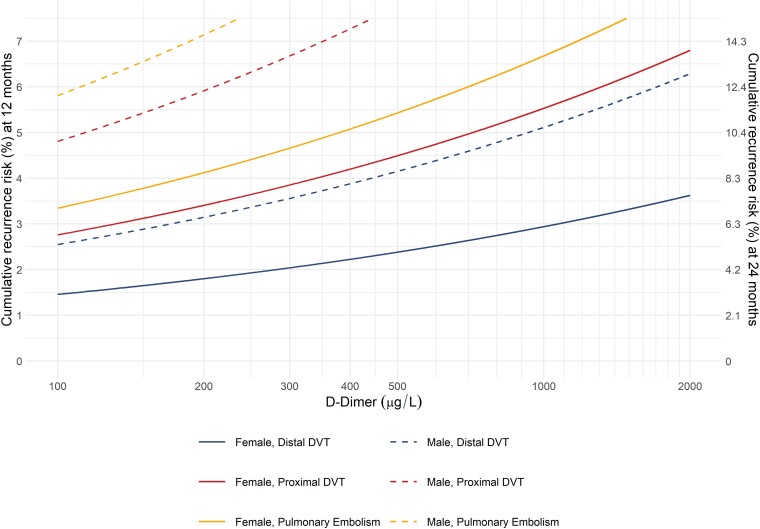
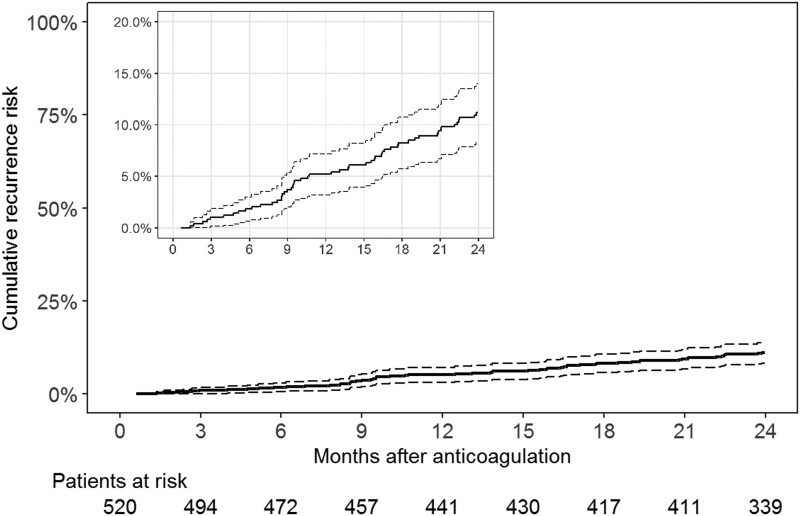
A total of 818 patients received anticoagulation for a median of 3.9 months. 520 patients (65%) had a predicted annual recurrence risk of ≤5.5%. During a median time of 23.9 months, 52 patients had non-fatal recurrence. The recurrence risk was 5.2% [95% confidence interval (CI) 3.2-7.2] at 1 year and 11.2% (95% CI 8.3-14) at 2 years. Model calibration was adequate after 1 year. The VPM underestimated the recurrence risk of patients with a 2-year recurrence rate of >5%. In a post-hoc analysis, the VPM's baseline hazard was recalibrated. Bootstrap validation confirmed an ideal ratio of observed and expected recurrence events. The recurrence risk was highest in men with proximal deep-vein thrombosis or pulmonary embolism and lower in women regardless of the site of incident VTE.
In this prospective evaluation of the performance of the VPM, the 1-year rate of recurrence in patients with unprovoked VTE was 5.2%. Recalibration improved identification of patients at low recurrence risk and stratification into distinct low-risk categories.
不明原因静脉血栓栓塞症(VTE)患者复发风险高,指南建议进行延长疗程的抗凝治疗。许多患者从未复发,但却面临出血风险。本研究旨在评估维也纳预测模型(VPM)的性能,并评估该模型能否准确识别这些患者。
在不明原因VTE患者中,抗凝治疗停药3周后应用VPM。对预测1年复发风险≤5.5%的患者进行前瞻性随访。研究终点为2年内VTE复发。
共有818例患者接受了抗凝治疗,中位疗程为3.9个月。520例患者(65%)预测的年复发风险≤5.5%。在中位时间为23.9个月的随访期间,52例患者发生非致命性复发。1年时复发风险为5.2%[95%置信区间(CI)3.2 - 7.2],2年时为11.2%(95% CI 8.3 - 14)。1年后模型校准良好。VPM低估了2年复发率>5%患者的复发风险。在事后分析中,对VPM的基线风险进行了重新校准。自助法验证证实观察到的和预期的复发事件比例理想。近端深静脉血栓形成或肺栓塞男性患者的复发风险最高,无论首发VTE部位如何,女性患者的复发风险较低。
在对VPM性能的这项前瞻性评估中,不明原因VTE患者的1年复发率为5.2%。重新校准改善了对低复发风险患者的识别,并将其分层为不同的低风险类别。