Interdisciplinary Program in Ecology and Evolutionary Biology, Texas A&M University, College Station, TX, USA.
Department of Poultry Science, Texas A&M University, College Station, TX, USA.
J Hered. 2024 Feb 3;115(1):1-10. doi: 10.1093/jhered/esad059.
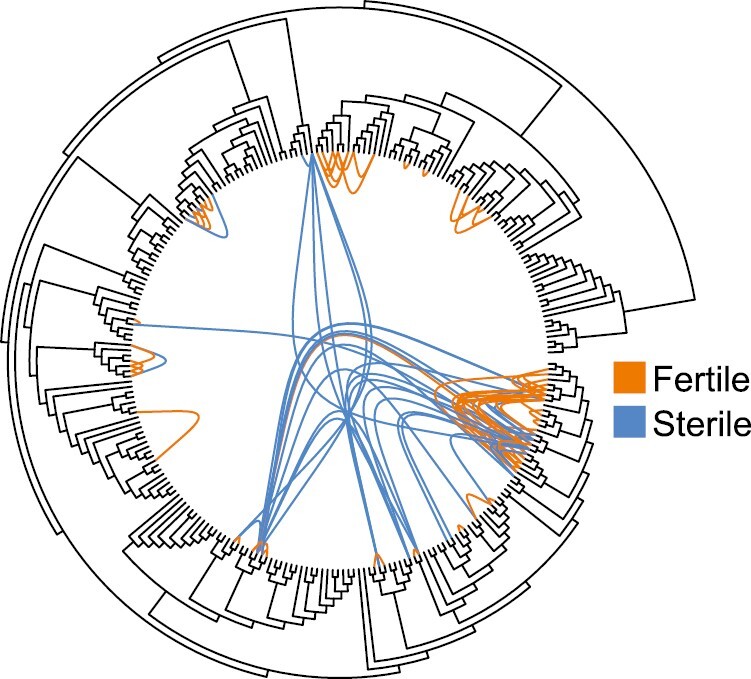
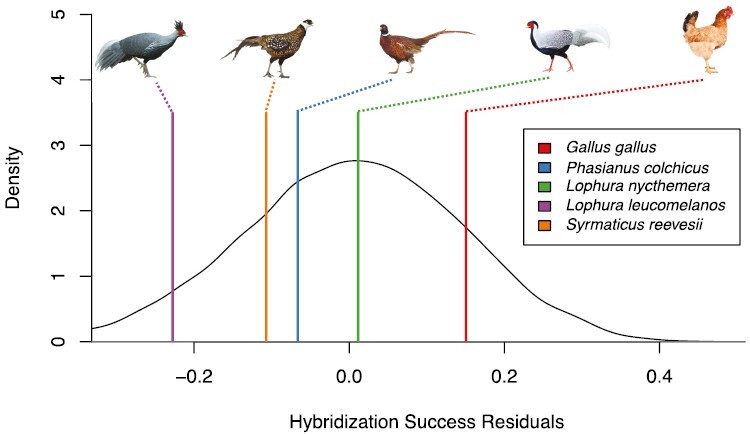
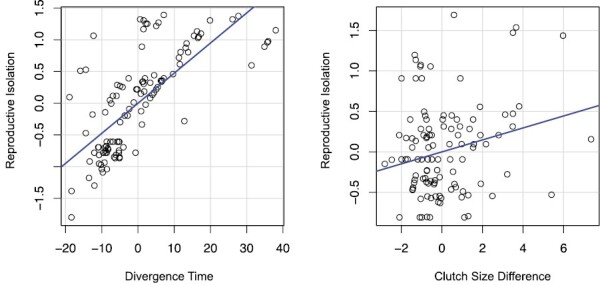
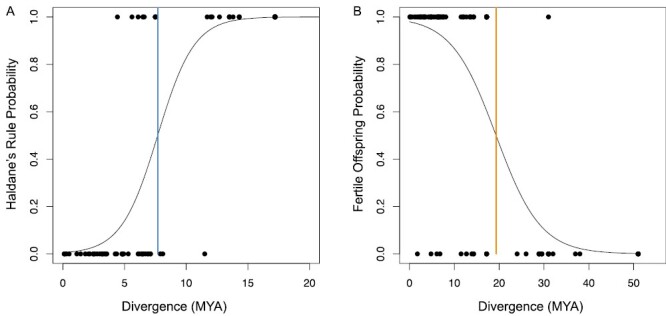
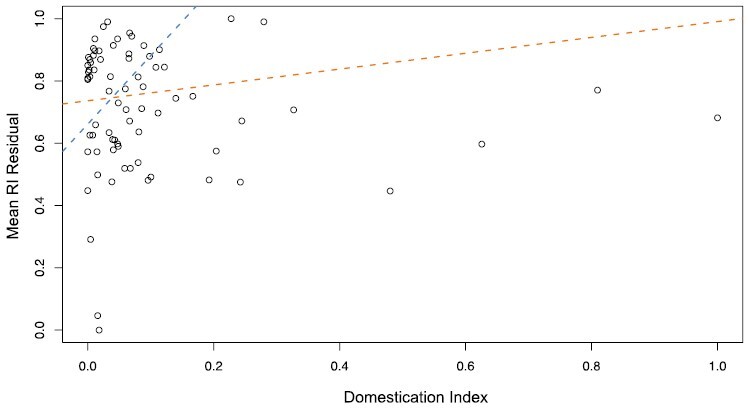
Some species are able to hybridize despite being exceptionally diverged. The causes of this variation in accumulation of reproductive isolation remain poorly understood, and domestication as an impetus or hindrance to reproductive isolation remains to be characterized. In this study, we investigated the role of divergence time, domestication, and mismatches in morphology, habitat, and clutch size among hybridizing species on reproductive isolation in the bird order Galliformes. We compiled and analyzed hybridization occurrences from literature and recorded measures of postzygotic reproductive isolation. We used a text-mining approach leveraging a historical aviculture magazine to quantify the degree of domestication across species. We obtained divergence time, morphology, habitat, and clutch size data from open sources. We found 123 species pairs (involving 77 species) with known offspring fertility (sterile, only males fertile, or both sexes fertile). We found that divergence time and clutch size were significant predictors of reproductive isolation (McFadden's Pseudo-R2 = 0.59), but not habitat or morphological mismatch. Perhaps most interesting, we found a significant relationship between domestication and reproductive compatibility after correcting for phylogeny, removing extreme values, and addressing potential biases (F1,74 = 5.43, R2 = 0.06, P-value = 0.02). We speculate that the genetic architecture and disruption in selective reproductive regimes associated with domestication may impact reproductive isolation, causing domesticated species to be more reproductively labile.
有些物种尽管差异很大,但仍能杂交。导致生殖隔离积累差异的原因仍知之甚少,而驯化作为生殖隔离的推动力或阻碍因素仍有待描述。在这项研究中,我们研究了鸟类目鸡形目中杂交物种之间的分化时间、驯化以及形态、栖息地和卵数的不匹配对生殖隔离的作用。我们从文献中汇编和分析了杂交发生的情况,并记录了种间合子后生殖隔离的测量值。我们使用了一种利用历史养禽杂志的文本挖掘方法来量化物种间驯化的程度。我们从公开来源获得了分化时间、形态、栖息地和卵数的数据。我们发现了 123 对已知后代育性的物种(涉及 77 个物种)(不育、仅雄性可育或两性均可育)。我们发现分化时间和卵数是生殖隔离的重要预测因子(麦克法登伪 R2 = 0.59),但栖息地或形态不匹配不是。也许最有趣的是,我们发现驯化与生殖相容性之间存在显著关系,在纠正了系统发育、去除极端值并解决潜在偏差后(F1,74 = 5.43,R2 = 0.06,P 值 = 0.02)。我们推测,与驯化相关的遗传结构和选择性生殖模式的破坏可能会影响生殖隔离,导致驯化物种的生殖更加不稳定。